

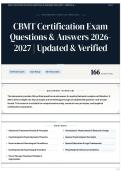
CBMT CERTIFICATION EXAM QUESTIONS & ANSWERS 2026-2027 | UPDATED & … EXAM
P R O F E S S I O N A L P R A C T I C E M AT E R I A L S
CBMT Certification Exam
Questions & Answers 2026-
2027 | Updated & Verified
Verified Answers Exam Ready With Rationales
166 QUESTIONS
DOCUMENT OVERVIEW
This document provides 166 verified questions and answers for applied behavior analysis certification. It
offers direct insight into key concepts and terminology through an established question-and-answer
format. This resource is suitable for comprehensive study, review of core principles, and targeted
certification preparation.
CONTENTS
• Behavioral Treatment Models & Principles • Assessment, Measurement & Research Design
• Psychological & Psychodynamic Theories • General Psychological Concepts
• Neuroscience & Neurological Conditions • Special Education & Legal Frameworks
• Developmental Psychology & Disorders • Physiological & Sensory Conditions
• Music Therapy Treatment Models &
Approaches
Page 1
, E XA M Q U EST I O N S
Q1 QUESTION 1 OF 166
data-based model
CORRECT ANSWER
An approach based on information retrieved through experimentation or direct observation
Q2 QUESTION 2 OF 166
reversal design (ABAB design)
CORRECT ANSWER
A single subject, applied behavior analysis design which generally involves observing behavior during baseline,
treatment, a return to baseline, and treatment reapplied.
Q3 QUESTION 3 OF 166
successive approximations
CORRECT ANSWER
Behaviors which gradually resemble the target behavior or terminal objective
Q4 QUESTION 4 OF 166
schedule of reinforcement
CORRECT ANSWER
The behavioral requirements for a reinforcing stimulus to be delivered. Schedules may be fixed or variable
based on interval or ratio criteria
Page 2
, Q5 QUESTION 5 OF 166
Fading
CORRECT ANSWER
The gradual removal of all explicit prompts or cues in an attempt to maintain the behavior on its own
Q6 QUESTION 6 OF 166
Behavioral treatment model
CORRECT ANSWER
By Skinner. All behaviors are learned, so all behaviors can be unlearned or replaced by new behaviors. Task
analysis and reinforcement schedule
Q7 QUESTION 7 OF 166
reinforcement schedule
CORRECT ANSWER
fixed ratio, variable ratio, fixed interval, variable interval
Q8 QUESTION 8 OF 166
classical conditioning
CORRECT ANSWER
Pavlovian technique pairing neutral stimulus with a meaningful stimulus
Q9 QUESTION 9 OF 166
Page 3
, Frequency recording
CORRECT ANSWER
Records number of times a target behavior occurs
Q10 QUESTION 10 OF 166
Duration Recording
CORRECT ANSWER
Recording technique that measures how long a particular behavior lasts during a given period
Q11 QUESTION 11 OF 166
discrimination
CORRECT ANSWER
Ability to tell difference between stimuli
Q12 QUESTION 12 OF 166
positive reinforcement
CORRECT ANSWER
the presentation of a stimulus resulting in an increase in the behavior it follows
Q13 QUESTION 13 OF 166
Shaping
CORRECT ANSWER
A technique for developing new behaviors by reinforcing successive approximations of the desired behavior
Page 4
P R O F E S S I O N A L P R A C T I C E M AT E R I A L S
CBMT Certification Exam
Questions & Answers 2026-
2027 | Updated & Verified
Verified Answers Exam Ready With Rationales
166 QUESTIONS
DOCUMENT OVERVIEW
This document provides 166 verified questions and answers for applied behavior analysis certification. It
offers direct insight into key concepts and terminology through an established question-and-answer
format. This resource is suitable for comprehensive study, review of core principles, and targeted
certification preparation.
CONTENTS
• Behavioral Treatment Models & Principles • Assessment, Measurement & Research Design
• Psychological & Psychodynamic Theories • General Psychological Concepts
• Neuroscience & Neurological Conditions • Special Education & Legal Frameworks
• Developmental Psychology & Disorders • Physiological & Sensory Conditions
• Music Therapy Treatment Models &
Approaches
Page 1
, E XA M Q U EST I O N S
Q1 QUESTION 1 OF 166
data-based model
CORRECT ANSWER
An approach based on information retrieved through experimentation or direct observation
Q2 QUESTION 2 OF 166
reversal design (ABAB design)
CORRECT ANSWER
A single subject, applied behavior analysis design which generally involves observing behavior during baseline,
treatment, a return to baseline, and treatment reapplied.
Q3 QUESTION 3 OF 166
successive approximations
CORRECT ANSWER
Behaviors which gradually resemble the target behavior or terminal objective
Q4 QUESTION 4 OF 166
schedule of reinforcement
CORRECT ANSWER
The behavioral requirements for a reinforcing stimulus to be delivered. Schedules may be fixed or variable
based on interval or ratio criteria
Page 2
, Q5 QUESTION 5 OF 166
Fading
CORRECT ANSWER
The gradual removal of all explicit prompts or cues in an attempt to maintain the behavior on its own
Q6 QUESTION 6 OF 166
Behavioral treatment model
CORRECT ANSWER
By Skinner. All behaviors are learned, so all behaviors can be unlearned or replaced by new behaviors. Task
analysis and reinforcement schedule
Q7 QUESTION 7 OF 166
reinforcement schedule
CORRECT ANSWER
fixed ratio, variable ratio, fixed interval, variable interval
Q8 QUESTION 8 OF 166
classical conditioning
CORRECT ANSWER
Pavlovian technique pairing neutral stimulus with a meaningful stimulus
Q9 QUESTION 9 OF 166
Page 3
, Frequency recording
CORRECT ANSWER
Records number of times a target behavior occurs
Q10 QUESTION 10 OF 166
Duration Recording
CORRECT ANSWER
Recording technique that measures how long a particular behavior lasts during a given period
Q11 QUESTION 11 OF 166
discrimination
CORRECT ANSWER
Ability to tell difference between stimuli
Q12 QUESTION 12 OF 166
positive reinforcement
CORRECT ANSWER
the presentation of a stimulus resulting in an increase in the behavior it follows
Q13 QUESTION 13 OF 166
Shaping
CORRECT ANSWER
A technique for developing new behaviors by reinforcing successive approximations of the desired behavior
Page 4



