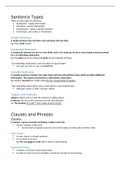
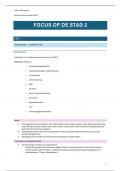
Sentence Types
There are four types of sentences:
1. Statements - supply information
2. Questions - ask for information
3. Exclamations - express specific emotions
4. Commands - give orders or instructions
Simple Sentences:
A simple sentence has one finite verb and deals with one idea.
Eg: Anna reads a book.
Compound Sentences:
A compound sentence has two or more finite verbs. It is made up of two or more simple sentences joined
by a co-ordinating conjunction.
Eg: Dan plays soccer at school and works on his computer at home.
*Co-ordinating conjunctions: joins two ideas of equal weight
For, and, nor, but, or, yet, so (FANBOYS)
Complex Sentences:
A complex sentence contains one main clause and one sub-ordinate clause which provides additional
information. The clauses are joined by a subordinate conjunction.
Eg: Candice received her results while she was recuperating in hospital.
*Sub-ordinating conjunctions: joins a main idea to a sub-ordinate idea
Although, unless, if, after, because, before
Subject and Predicate:
Subject: reflects who or what the sentence is talking about
Predicate: the rest of the sentence from the verb onwards
Eg: The students in Grade 7 were happy to go to school.
Clauses and Phrases
Clauses:
A clause is a group of words containing a subject and verb.
Always contains a finite verb
See the Parts of speech notes for more information on finite and non-finite verbs
Main Clause
A main clause is a simple sentence.
It can stand on its own.
Eg: The van came to a halt after it had run out of petrol.
Dependant Clause
Contains a verb but cannot stand alone.
It needs an main clause to complete a sentence and give its full meaning.
, Eg: While the engine was running, the man jumped out of the car.
Dependant clauses can be divided into the following groups:
Noun clause:
The Perform the same functions as nouns.
Answers the who or what of the sentence (it will be the subject or object).
Eg: What they learned at school helped them in the work place.
Adjectival clause:
It gives meaning to a word or words in the main clause.
Similar to additional information given in brackets.
Usually begins with who, which, that, whom or whose.
Eg: The girl who had the longest hair won the beauty competition.
Adverbial clause:
Perform the same function as the adverb.
Answers when, where, how, why.
Eg: They jumped up and down when the sun set.
Eg: They jumped up and down because it was raining.
Phrases:
A phrase is a group of words without a finite verb
It is used as a single part of speech.
Can never stand alone
Adjectival Phrases:
Tell us more about the noun
Eg: The model with the dazzling smile came from Durban.
Noun Phrases:
Answers who or what is in connection with the noun
Eg: Everyone in the courtroom stood when the judge entered.
Adverbial Phrases:
Answer how, when, where and why in connection with the verb.
Eg: The girl, wanting to read, entered the room. (why?)
Eg: The girl entered the room happily and confidently. (how?)
Punctuation
Commas:
Commas are used to create a pause.
Used to separate a list of items
Shows where one clause or phrase ends another begins
Shows where additional information has been added
Follows introductory words in direct speech
Comma Splice: Do not use a comma between two main clauses; rather use a semi-colon, full stop or
coordinating conjunction.
There are four types of sentences:
1. Statements - supply information
2. Questions - ask for information
3. Exclamations - express specific emotions
4. Commands - give orders or instructions
Simple Sentences:
A simple sentence has one finite verb and deals with one idea.
Eg: Anna reads a book.
Compound Sentences:
A compound sentence has two or more finite verbs. It is made up of two or more simple sentences joined
by a co-ordinating conjunction.
Eg: Dan plays soccer at school and works on his computer at home.
*Co-ordinating conjunctions: joins two ideas of equal weight
For, and, nor, but, or, yet, so (FANBOYS)
Complex Sentences:
A complex sentence contains one main clause and one sub-ordinate clause which provides additional
information. The clauses are joined by a subordinate conjunction.
Eg: Candice received her results while she was recuperating in hospital.
*Sub-ordinating conjunctions: joins a main idea to a sub-ordinate idea
Although, unless, if, after, because, before
Subject and Predicate:
Subject: reflects who or what the sentence is talking about
Predicate: the rest of the sentence from the verb onwards
Eg: The students in Grade 7 were happy to go to school.
Clauses and Phrases
Clauses:
A clause is a group of words containing a subject and verb.
Always contains a finite verb
See the Parts of speech notes for more information on finite and non-finite verbs
Main Clause
A main clause is a simple sentence.
It can stand on its own.
Eg: The van came to a halt after it had run out of petrol.
Dependant Clause
Contains a verb but cannot stand alone.
It needs an main clause to complete a sentence and give its full meaning.
, Eg: While the engine was running, the man jumped out of the car.
Dependant clauses can be divided into the following groups:
Noun clause:
The Perform the same functions as nouns.
Answers the who or what of the sentence (it will be the subject or object).
Eg: What they learned at school helped them in the work place.
Adjectival clause:
It gives meaning to a word or words in the main clause.
Similar to additional information given in brackets.
Usually begins with who, which, that, whom or whose.
Eg: The girl who had the longest hair won the beauty competition.
Adverbial clause:
Perform the same function as the adverb.
Answers when, where, how, why.
Eg: They jumped up and down when the sun set.
Eg: They jumped up and down because it was raining.
Phrases:
A phrase is a group of words without a finite verb
It is used as a single part of speech.
Can never stand alone
Adjectival Phrases:
Tell us more about the noun
Eg: The model with the dazzling smile came from Durban.
Noun Phrases:
Answers who or what is in connection with the noun
Eg: Everyone in the courtroom stood when the judge entered.
Adverbial Phrases:
Answer how, when, where and why in connection with the verb.
Eg: The girl, wanting to read, entered the room. (why?)
Eg: The girl entered the room happily and confidently. (how?)
Punctuation
Commas:
Commas are used to create a pause.
Used to separate a list of items
Shows where one clause or phrase ends another begins
Shows where additional information has been added
Follows introductory words in direct speech
Comma Splice: Do not use a comma between two main clauses; rather use a semi-colon, full stop or
coordinating conjunction.