

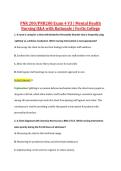
PNR 200/PNR200 Exam 4 V3 | Mental Health
Nursing Q&A with Rationale | Fortis College
1. A nurse is caring for a client with Borderline Personality Disorder who is frequently using
‘splitting’ as a defense mechanism. Which nursing intervention is most appropriate?
A. Encourage the client to discuss their feelings with multiple staff members.
B. Confront the client immediately when they praise one staff member over another.
C. Allow the client to choose their primary nurse for each shift.
D. Hold regular staff meetings to ensure a consistent approach to care.
Correct Answer: D
Explanation: Splitting is a common defense mechanism where the client views people as
all good or all bad, which often leads to staff conflict. Maintaining a consistent approach
among all team members prevents the client from playing staff against each other. This
consistency is vital for providing a stable therapeutic environment for patients with
personality disorders.
2. A client diagnosed with Anorexia Nervosa has a BMI of 14.5. Which nursing intervention
takes priority during the first 48 hours of admission?
A. Discussing the client’s distorted body image.
B. Monitoring for peripheral edema and electrolyte imbalances.
C. Implementing a strict exercise regimen to reduce anxiety.
,D. Allowing the client to eat alone to reduce social pressure.
Correct Answer: B
Explanation: Physiological stability is the priority for clients with severe malnutrition, as
they are at high risk for refeeding syndrome and cardiac arrhythmias. Monitoring
electrolytes and fluid status is essential to prevent life-threatening complications during
the initial phase of treatment. Psychological interventions are typically addressed once the
client is medically stable.
3. A client is experiencing alcohol withdrawal and exhibits tremors, diaphoresis, and a heart
rate of 110 bpm. Which medication should the nurse anticipate administering?
A. Disulfiram
B. Naloxone
C. Methadone
D. Lorazepam
Correct Answer: D
Explanation: Benzodiazepines like Lorazepam are the gold standard for managing acute
alcohol withdrawal symptoms and preventing progression to seizures or delirium tremens.
These medications provide cross-tolerance with alcohol and stabilize the central nervous
system. Disulfiram is used for maintenance sobriety, not for acute withdrawal
management.
, 4. Which clinical finding is most characteristic of a client in the middle stage (moderate) of
Alzheimer’s disease?
A. Occasional forgetfulness of where keys were placed.
B. Total loss of speech and inability to swallow.
C. Independent management of complex financial tasks.
D. Wandering and getting lost in familiar environments.
Correct Answer: D
Explanation: The moderate stage of Alzheimer’s is characterized by significant cognitive
decline, including disorientation to place and time. Clients often wander and require
increased supervision to ensure their safety. This stage differs from early-stage
forgetfulness and late-stage physical dependency.
5. A nurse is assessing a client for Opioid Toxicity. Which triad of symptoms would confirm
this diagnosis?
A. Pinpoint pupils, respiratory depression, and coma.
B. Tachycardia, hypertension, and dilated pupils.
C. Severe tremors, hallucinations, and fever.
D. Weight loss, hyperactivity, and insomnia.
Correct Answer: A
Nursing Q&A with Rationale | Fortis College
1. A nurse is caring for a client with Borderline Personality Disorder who is frequently using
‘splitting’ as a defense mechanism. Which nursing intervention is most appropriate?
A. Encourage the client to discuss their feelings with multiple staff members.
B. Confront the client immediately when they praise one staff member over another.
C. Allow the client to choose their primary nurse for each shift.
D. Hold regular staff meetings to ensure a consistent approach to care.
Correct Answer: D
Explanation: Splitting is a common defense mechanism where the client views people as
all good or all bad, which often leads to staff conflict. Maintaining a consistent approach
among all team members prevents the client from playing staff against each other. This
consistency is vital for providing a stable therapeutic environment for patients with
personality disorders.
2. A client diagnosed with Anorexia Nervosa has a BMI of 14.5. Which nursing intervention
takes priority during the first 48 hours of admission?
A. Discussing the client’s distorted body image.
B. Monitoring for peripheral edema and electrolyte imbalances.
C. Implementing a strict exercise regimen to reduce anxiety.
,D. Allowing the client to eat alone to reduce social pressure.
Correct Answer: B
Explanation: Physiological stability is the priority for clients with severe malnutrition, as
they are at high risk for refeeding syndrome and cardiac arrhythmias. Monitoring
electrolytes and fluid status is essential to prevent life-threatening complications during
the initial phase of treatment. Psychological interventions are typically addressed once the
client is medically stable.
3. A client is experiencing alcohol withdrawal and exhibits tremors, diaphoresis, and a heart
rate of 110 bpm. Which medication should the nurse anticipate administering?
A. Disulfiram
B. Naloxone
C. Methadone
D. Lorazepam
Correct Answer: D
Explanation: Benzodiazepines like Lorazepam are the gold standard for managing acute
alcohol withdrawal symptoms and preventing progression to seizures or delirium tremens.
These medications provide cross-tolerance with alcohol and stabilize the central nervous
system. Disulfiram is used for maintenance sobriety, not for acute withdrawal
management.
, 4. Which clinical finding is most characteristic of a client in the middle stage (moderate) of
Alzheimer’s disease?
A. Occasional forgetfulness of where keys were placed.
B. Total loss of speech and inability to swallow.
C. Independent management of complex financial tasks.
D. Wandering and getting lost in familiar environments.
Correct Answer: D
Explanation: The moderate stage of Alzheimer’s is characterized by significant cognitive
decline, including disorientation to place and time. Clients often wander and require
increased supervision to ensure their safety. This stage differs from early-stage
forgetfulness and late-stage physical dependency.
5. A nurse is assessing a client for Opioid Toxicity. Which triad of symptoms would confirm
this diagnosis?
A. Pinpoint pupils, respiratory depression, and coma.
B. Tachycardia, hypertension, and dilated pupils.
C. Severe tremors, hallucinations, and fever.
D. Weight loss, hyperactivity, and insomnia.
Correct Answer: A



