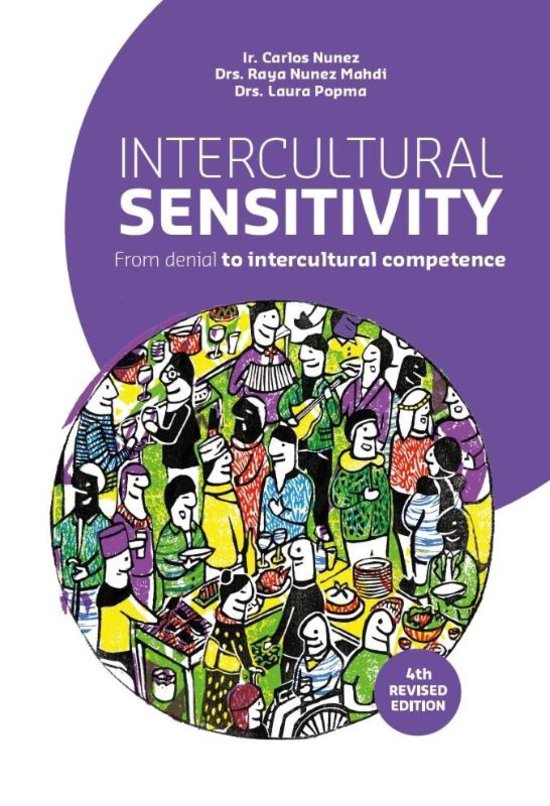
Summary book pages Q4
According to Edgar Schein, culture consists of layers like an onion.
1. Artefacts of culture
2. Norms and values
3. Basic assumptions
Artefacts of culture:
The outer layer, or material culture, we call artefacts of culture. Artefacts are the first things
you notice when entering a country.
Norms and values:
Written and unwritten standards of correct, desired behavior. Values express what we think
is good or right. Norms and values are not as visible as artefacts. It takes some time to
notice, let alone learn them.
Basic assumptions:
The deepest layer. They are abstract and invisible, we learn them very young and we are
unaware of their influence. Intercultural communication is about bringing basic assumptions
of our own culture to our awareness and to recognize the basic assumptions of other
cultures.
Intercultural communication:
The communication between sources and receivers from different cultures.
External noise:
Interference from the environment during communication.
Internal noise:
Also called psychological noise, involves emotions, worries, or personal prejudice that get in
the way of paying attention to what is actually being communicated.
Cultural noise:
This occurs when differences in cultural programming distorts the message.
Global citizenship:
A sense of belonging to a broader community and common humanity. It emphasizes
political, economic, social and cultural interdependency and interconnectedness between
the local, the national and the global.
Low context communication:
Here, information is communicated explicitly, with words. Words, written or spoken are
important in communicating the message. Furthermore, in low context communication,
people prefer to structure their information into segments or also called “compartments”. A
low context culture has a preference for starting with the main point and ending with
details.
, High context communication:
Here, most of the message is in the persons themselves and in the context of the message.
So not everything is spelled out explicitly with words, but implicitly and often non-verbally.
One word, gesture or hint at the context is enough to understand the whole picture and
message. A high context culture has a preference for starting with context, and get to the
main point later.
Intercultural sensitivity means to be able to provide the right amount of context and
explicitness.
Power distance explains why we assume that it is normal that power is distributed equally in
our families, at school or at work. Or just the opposite, why we assume that it shouldn’t be
equal.
In an individualistic society, the ties between individuals are loose. You are mainly
responsible for yourself, and for your direct, nuclear family.
In collective societies, people are part of close groups since birth. You are responsible for
your group. The groups provide protection in return for unconditional loyalty.
A masculine society is one where assertiveness, achievement and success are important
values. In masculine societies the emotional gender-roles are strictly divided. Men are
expected to be assertive, tough and aim at material success, while woman are expected to
be modest, tender and oriented towards quality-of-life.
In feminine societies, the emotional gender roles overlap. Men as well as woman are
expected to be modest, tender and oriented towards quality-of-life. Just act normal, as they
say in the Netherlands, is a typical reflection of femininity in Dutch society.
Uncertainty avoidance is the extent to which members of a culture learned to feel
comfortable or uncomfortable in unstructured, unknown situations. Uncertainty avoidance
is expressed in stress about the unknown, the need for predictability and the respect for
strict and informal rules. This minimizes uncertain situations.
Countries high on long-term orientation value thrift and perseverance. They are oriented to
future rewards and they value saving. Furthermore, when circumstances change, they adapt
well. Long-term orientation culture programmes you to value overcoming huge obstacles
with time, strength and perseverance. In long-term oriented countries, parents teach
children that perseverance leads to results. They learn to be frugal with money. At school,
students work hard because that will result in great future success.
Short-term oriented societies value virtues that are related to the past and the present – for
example preserving traditions, national pride, and fulfilling social obligations. In short-term
oriented countries, children learn to achieve fast results with short efforts. Of course they
also learn to save money. But the social pressure to spend the money is great. At school
students also work hard, but success and failure are often seen as results of luck and chance.
At work people value freedom, rights, success and self-expression.
According to Edgar Schein, culture consists of layers like an onion.
1. Artefacts of culture
2. Norms and values
3. Basic assumptions
Artefacts of culture:
The outer layer, or material culture, we call artefacts of culture. Artefacts are the first things
you notice when entering a country.
Norms and values:
Written and unwritten standards of correct, desired behavior. Values express what we think
is good or right. Norms and values are not as visible as artefacts. It takes some time to
notice, let alone learn them.
Basic assumptions:
The deepest layer. They are abstract and invisible, we learn them very young and we are
unaware of their influence. Intercultural communication is about bringing basic assumptions
of our own culture to our awareness and to recognize the basic assumptions of other
cultures.
Intercultural communication:
The communication between sources and receivers from different cultures.
External noise:
Interference from the environment during communication.
Internal noise:
Also called psychological noise, involves emotions, worries, or personal prejudice that get in
the way of paying attention to what is actually being communicated.
Cultural noise:
This occurs when differences in cultural programming distorts the message.
Global citizenship:
A sense of belonging to a broader community and common humanity. It emphasizes
political, economic, social and cultural interdependency and interconnectedness between
the local, the national and the global.
Low context communication:
Here, information is communicated explicitly, with words. Words, written or spoken are
important in communicating the message. Furthermore, in low context communication,
people prefer to structure their information into segments or also called “compartments”. A
low context culture has a preference for starting with the main point and ending with
details.
, High context communication:
Here, most of the message is in the persons themselves and in the context of the message.
So not everything is spelled out explicitly with words, but implicitly and often non-verbally.
One word, gesture or hint at the context is enough to understand the whole picture and
message. A high context culture has a preference for starting with context, and get to the
main point later.
Intercultural sensitivity means to be able to provide the right amount of context and
explicitness.
Power distance explains why we assume that it is normal that power is distributed equally in
our families, at school or at work. Or just the opposite, why we assume that it shouldn’t be
equal.
In an individualistic society, the ties between individuals are loose. You are mainly
responsible for yourself, and for your direct, nuclear family.
In collective societies, people are part of close groups since birth. You are responsible for
your group. The groups provide protection in return for unconditional loyalty.
A masculine society is one where assertiveness, achievement and success are important
values. In masculine societies the emotional gender-roles are strictly divided. Men are
expected to be assertive, tough and aim at material success, while woman are expected to
be modest, tender and oriented towards quality-of-life.
In feminine societies, the emotional gender roles overlap. Men as well as woman are
expected to be modest, tender and oriented towards quality-of-life. Just act normal, as they
say in the Netherlands, is a typical reflection of femininity in Dutch society.
Uncertainty avoidance is the extent to which members of a culture learned to feel
comfortable or uncomfortable in unstructured, unknown situations. Uncertainty avoidance
is expressed in stress about the unknown, the need for predictability and the respect for
strict and informal rules. This minimizes uncertain situations.
Countries high on long-term orientation value thrift and perseverance. They are oriented to
future rewards and they value saving. Furthermore, when circumstances change, they adapt
well. Long-term orientation culture programmes you to value overcoming huge obstacles
with time, strength and perseverance. In long-term oriented countries, parents teach
children that perseverance leads to results. They learn to be frugal with money. At school,
students work hard because that will result in great future success.
Short-term oriented societies value virtues that are related to the past and the present – for
example preserving traditions, national pride, and fulfilling social obligations. In short-term
oriented countries, children learn to achieve fast results with short efforts. Of course they
also learn to save money. But the social pressure to spend the money is great. At school
students also work hard, but success and failure are often seen as results of luck and chance.
At work people value freedom, rights, success and self-expression.