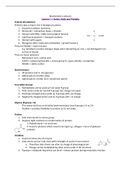
Biochemistry Lectures
Protein Introduction
Proteins play a major role in biological systems
1. Enzymes (catalyse reactions)
2. Structural = connective tissue + muscles
3. Interact with RNA + DNA (transcription factors)
4. Lipid bound proteins = transport systems
5. Interact with sugars
6. Recognise other molecules (antibodies + growth factors)
They are flexible + have function
- E.g. lactoferrin protein changes shape when interacting w/ iron + can distinguish iron
as free or bound
They are linear polymers
- Monomeric unit = amino acid
- COOH = carboxyl group NH2 = amino group R = gives identity + properties
- Middle = alpha-carbon
Nomenclature
1. All proteins end in -ine (glycine)
2. Abbreviate to 3 letters (Gly)
3. Abbreviate to 1 letter (G or sometimes weird)
Four Main Groups
1. Hydrophobic amino acids w/ non polar R group
2. Polar amino acids w/ neutral R groups but charge not equal
3. Positively charged amino acids w/ R groups with +ve charge
4. Negatively charged amino acid w/ R groups with -ve charge
Glycine (R group = H)
- This amino acid has no chirality (asymmetricity) since R group is H so 2 H
- Flexible + provides flexibility to protein as its not bulky
Proline
1. Side chain bonds to amine group
2. Imposes tight restrains on conformation of protein
3. Peptide bond = cis and trans
4. Found is proteins which need to be rigid e.g. collagen + turns of globular
proteins
Histidine
1. Found at active site of enzyme
2. Only amino acid w/ side chain pKA (strength of acid) of near neutral
a. Therefore side chains can alter its charge at physiological pH
b. Charge can be modulated by other amino acids in 3D structure
3. R group = imidazole ring which can bind + release protons during enzymatic reaction
,Cysteine
1. Has free thiol group (-SH)
2. Can form covalent bonds w/ other cysteine in 3D structure
3. pKa = 8.4 so also in active site
Zwitterionicity
Amino acids are zwitterionic
- This means in neutral pH, they exist mostly as dipolar ions
- NH2 protonated to NH3+ and COOH deprotonated to COO-
At low pH = both groups protonated
As pH rises = COOH loses proton
At pH 9 = amino group loses protons
Some R groups are charged e.g lysine = basic +ve charge, glutamate acidic -ve charge
Aromatic Side Chains (Rings)
1. Phenylamine, Phe, F
2. Tyrosine, Tyr, Y
3. Tryptophan, Trp, W
These absorb strongly (around wavelength 280nm)
Peptide Bond Formation
Trans + Cis Peptide Bond
Peptide chains in proteins = trans conformation (R groups of different side of chain)
- This avoids steric clashes
- Except proline
Typical bond length = 1.32A (angstroms)
Amino acid sequences have direction
1. Amino/N terminal residue
2. Carboxyl/C terminal residue
, Hierarchy of Protein Structure
1. Primary Structure = the sequence of the amino acids (peptide bonds)
2. Secondary Structure = simple, repetitive motifs that are found in almost all proteins
3. Tertiary Structure = the overall fold of a protein (3D structure)
4. Quaternary Structure = when several proteins fold together
Polypeptide Chains
The peptide bond has partial double bond character
- C-N bond = 1.49A
- C=N bond = 1.27A
- Peptide bond = 1.32A
Therefore, it is in the middle b/w C-N and C=N bond length, hence partial bond character
- This gives rigidity to the structure + prevents movement around the bond
Rotation Around Bonds
The structure of each amino acid in a polypeptide can be altered by rotation around two
pure single bonds
1. Phi is the angle of rotation around the bond b/w N and the alpha C
2. Psi is the angle of rotation around the bond b/w/ a-C and carbonyl carbon
3. These two angles determine the path of the polypeptide chain
Combinations of Phi and Psi
Are all combinations possible?
- Ramachandran et al in 1963 recognized that many combinations are forbidden due
to steric collisions b/w atoms
o So only certain angles permitted to stop collisions
- The allowed values are visualized in 2D plot called Ramachandran Plot
-
Folded Structures
1. Highly flexible polymers w/ large numbers of possible conformations do not fold into
unique structures
2. The rigidity of the peptide unit and the restricted combinations of phi and psi angles
limits the no. of structure allowed in the unfolded form
Secondary structures = folds into alpha helixes, beta sheets, turns and loops
Protein Introduction
Proteins play a major role in biological systems
1. Enzymes (catalyse reactions)
2. Structural = connective tissue + muscles
3. Interact with RNA + DNA (transcription factors)
4. Lipid bound proteins = transport systems
5. Interact with sugars
6. Recognise other molecules (antibodies + growth factors)
They are flexible + have function
- E.g. lactoferrin protein changes shape when interacting w/ iron + can distinguish iron
as free or bound
They are linear polymers
- Monomeric unit = amino acid
- COOH = carboxyl group NH2 = amino group R = gives identity + properties
- Middle = alpha-carbon
Nomenclature
1. All proteins end in -ine (glycine)
2. Abbreviate to 3 letters (Gly)
3. Abbreviate to 1 letter (G or sometimes weird)
Four Main Groups
1. Hydrophobic amino acids w/ non polar R group
2. Polar amino acids w/ neutral R groups but charge not equal
3. Positively charged amino acids w/ R groups with +ve charge
4. Negatively charged amino acid w/ R groups with -ve charge
Glycine (R group = H)
- This amino acid has no chirality (asymmetricity) since R group is H so 2 H
- Flexible + provides flexibility to protein as its not bulky
Proline
1. Side chain bonds to amine group
2. Imposes tight restrains on conformation of protein
3. Peptide bond = cis and trans
4. Found is proteins which need to be rigid e.g. collagen + turns of globular
proteins
Histidine
1. Found at active site of enzyme
2. Only amino acid w/ side chain pKA (strength of acid) of near neutral
a. Therefore side chains can alter its charge at physiological pH
b. Charge can be modulated by other amino acids in 3D structure
3. R group = imidazole ring which can bind + release protons during enzymatic reaction
,Cysteine
1. Has free thiol group (-SH)
2. Can form covalent bonds w/ other cysteine in 3D structure
3. pKa = 8.4 so also in active site
Zwitterionicity
Amino acids are zwitterionic
- This means in neutral pH, they exist mostly as dipolar ions
- NH2 protonated to NH3+ and COOH deprotonated to COO-
At low pH = both groups protonated
As pH rises = COOH loses proton
At pH 9 = amino group loses protons
Some R groups are charged e.g lysine = basic +ve charge, glutamate acidic -ve charge
Aromatic Side Chains (Rings)
1. Phenylamine, Phe, F
2. Tyrosine, Tyr, Y
3. Tryptophan, Trp, W
These absorb strongly (around wavelength 280nm)
Peptide Bond Formation
Trans + Cis Peptide Bond
Peptide chains in proteins = trans conformation (R groups of different side of chain)
- This avoids steric clashes
- Except proline
Typical bond length = 1.32A (angstroms)
Amino acid sequences have direction
1. Amino/N terminal residue
2. Carboxyl/C terminal residue
, Hierarchy of Protein Structure
1. Primary Structure = the sequence of the amino acids (peptide bonds)
2. Secondary Structure = simple, repetitive motifs that are found in almost all proteins
3. Tertiary Structure = the overall fold of a protein (3D structure)
4. Quaternary Structure = when several proteins fold together
Polypeptide Chains
The peptide bond has partial double bond character
- C-N bond = 1.49A
- C=N bond = 1.27A
- Peptide bond = 1.32A
Therefore, it is in the middle b/w C-N and C=N bond length, hence partial bond character
- This gives rigidity to the structure + prevents movement around the bond
Rotation Around Bonds
The structure of each amino acid in a polypeptide can be altered by rotation around two
pure single bonds
1. Phi is the angle of rotation around the bond b/w N and the alpha C
2. Psi is the angle of rotation around the bond b/w/ a-C and carbonyl carbon
3. These two angles determine the path of the polypeptide chain
Combinations of Phi and Psi
Are all combinations possible?
- Ramachandran et al in 1963 recognized that many combinations are forbidden due
to steric collisions b/w atoms
o So only certain angles permitted to stop collisions
- The allowed values are visualized in 2D plot called Ramachandran Plot
-
Folded Structures
1. Highly flexible polymers w/ large numbers of possible conformations do not fold into
unique structures
2. The rigidity of the peptide unit and the restricted combinations of phi and psi angles
limits the no. of structure allowed in the unfolded form
Secondary structures = folds into alpha helixes, beta sheets, turns and loops