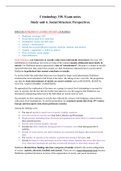
Criminology 310. Exam notes.
Study unit 6. Social Structure Perspectives.
DISCUSS DURKHEIM’S ANOMIE THEORY (10 MARKS)
Durkheim, sociology 1892.
Social desires need to be controlled
Assumption: society can fuel crime
Anomie = normlessness
Suicide has societal influence (egoistic, altruistic, fatalistic and anomic)
Anomie = aspirations vs. ability to achieve
Wars, economy, social change
Class differences
Emile Durkheim saw behaviour as socially rather than individually determined. His most NB
contribution to criminology lies in his reviving of the concept anomie, delineated most clearly in
suicide. For Durkheim anomie represented a state of “normlessness”. Because it is norms or socially
expected behaviour, that control how people act, their breakdown represents that to social control.
Durkheim hypothesised that anomie contributes to suicide.
To test his belief that individual behaviour was shaped by larger social phenomena, Durkheim
examined the most individual of all forms of deviance: the taking of one’s own life. His proposition
was that the basic determinants of suicide are social variables such as RELIGION, MARITAL
STATUS, AND ECONOMIC CONDITIONS.
He approached the explanation of deviance on a group (or macro) level (attempting to account for
rates of suicide), but the fact that his brother had taken his own life suggests that Durkheim was
interested in interpreting behaviour at the individual (or micro) level as well.
Occasionally he drew analogies in suicide that reflected his concern with bridging a macro-theory
with micro-level explanations. To test his proposition, he examined suicide data from 19th century
Europe and descriptive data about preliterate societies.
Among his findings were:
The rate of suicide is much lower in purely Catholic countries.
Jews showed lower suicide rates than both Catholics and Protestants.
Single persons (including those divorced and separated) are more likely to commit suicide
than married persons.
Suicide rates increase steadily with age.
Suicides are more numerous during periods of economic crisis than during periods of
stability.
Periods of crisis such as war and revolution are associated with higher-than-normal suicide
rates.
The number of suicides in the military is greater than among Christians, and
Suicide is found in some preliterate societies where norms stipulate that wives take their own
lives when their husbands die and that servants kill themselves when their masters die.
Durkheim divided these findings into four categories of suicide related to the social configuration
of society: egoistic, altruistic, fatalistic and anomic. These are on a macro-theoretical level because
Durkheim explained deviances in terms of the organization of society and social institutions.
, It was Durkheim’s research on suicide that laid the foundation for anomie or strain theory. Anomic
suicide occurs when rapid or extreme social change or crisis threatens group norms.
Durkheim’s FOUR TYPES OF SUICIDE are:
1. EGOISTIC – suicide resulting from the weakening of commitment to group values and
goals, especially when the individual has come to rely primarily upon his or her own
resources.
2. ALTRUISTIC – suicide precipitated by an over-commitment to group values and norms.
3. FATALISTIC – suicide derived from excessive regulation (e.g. slavery or imprisonment)
4. ANOMIC – suicide that occurs when rapid or extreme social change or crisis threaten group
norms.
Anomie:
A state or a condition in society in which the norms are no longer effective in regulating
behaviour.
Is also the result of a disjunction between people’s aspirations and their ability to achieve
these goals.
May be brought about by rapid social change such as drastic economic growth.
Class differences as Durkheim speculated that such economic expansion would be more
likely to affect the upper and middle classes, whose expectations and aspirations expand
to an insatiable level.
Durkheim noted a lower suicide rate among the lower classes and suggested that poverty
insulated the poor from experiencing anomie and, thus, suicide.
Durkheim felt, aspirations, are class related, with the upper classes having higher goals than
those below them
He felt that a successful social structure defines reasonable limits for desires, but that
when social organization falters, insatiable desires are unleashed.
Unlimited aspirations create pressure for deviant solutions. Recent instances of “creative
accounting” practices that lead to criminal charges, serve as examples of the effect of such
unlimited aspirations.
DISCUSS MERTON’S THEORY OF SOCIAL STRUCTURE AND ANOMIE. (10 MARKS)
Merton (1938) – social conditions
Desires are socially generated
Cultural systems = values and goals
Study unit 6. Social Structure Perspectives.
DISCUSS DURKHEIM’S ANOMIE THEORY (10 MARKS)
Durkheim, sociology 1892.
Social desires need to be controlled
Assumption: society can fuel crime
Anomie = normlessness
Suicide has societal influence (egoistic, altruistic, fatalistic and anomic)
Anomie = aspirations vs. ability to achieve
Wars, economy, social change
Class differences
Emile Durkheim saw behaviour as socially rather than individually determined. His most NB
contribution to criminology lies in his reviving of the concept anomie, delineated most clearly in
suicide. For Durkheim anomie represented a state of “normlessness”. Because it is norms or socially
expected behaviour, that control how people act, their breakdown represents that to social control.
Durkheim hypothesised that anomie contributes to suicide.
To test his belief that individual behaviour was shaped by larger social phenomena, Durkheim
examined the most individual of all forms of deviance: the taking of one’s own life. His proposition
was that the basic determinants of suicide are social variables such as RELIGION, MARITAL
STATUS, AND ECONOMIC CONDITIONS.
He approached the explanation of deviance on a group (or macro) level (attempting to account for
rates of suicide), but the fact that his brother had taken his own life suggests that Durkheim was
interested in interpreting behaviour at the individual (or micro) level as well.
Occasionally he drew analogies in suicide that reflected his concern with bridging a macro-theory
with micro-level explanations. To test his proposition, he examined suicide data from 19th century
Europe and descriptive data about preliterate societies.
Among his findings were:
The rate of suicide is much lower in purely Catholic countries.
Jews showed lower suicide rates than both Catholics and Protestants.
Single persons (including those divorced and separated) are more likely to commit suicide
than married persons.
Suicide rates increase steadily with age.
Suicides are more numerous during periods of economic crisis than during periods of
stability.
Periods of crisis such as war and revolution are associated with higher-than-normal suicide
rates.
The number of suicides in the military is greater than among Christians, and
Suicide is found in some preliterate societies where norms stipulate that wives take their own
lives when their husbands die and that servants kill themselves when their masters die.
Durkheim divided these findings into four categories of suicide related to the social configuration
of society: egoistic, altruistic, fatalistic and anomic. These are on a macro-theoretical level because
Durkheim explained deviances in terms of the organization of society and social institutions.
, It was Durkheim’s research on suicide that laid the foundation for anomie or strain theory. Anomic
suicide occurs when rapid or extreme social change or crisis threatens group norms.
Durkheim’s FOUR TYPES OF SUICIDE are:
1. EGOISTIC – suicide resulting from the weakening of commitment to group values and
goals, especially when the individual has come to rely primarily upon his or her own
resources.
2. ALTRUISTIC – suicide precipitated by an over-commitment to group values and norms.
3. FATALISTIC – suicide derived from excessive regulation (e.g. slavery or imprisonment)
4. ANOMIC – suicide that occurs when rapid or extreme social change or crisis threaten group
norms.
Anomie:
A state or a condition in society in which the norms are no longer effective in regulating
behaviour.
Is also the result of a disjunction between people’s aspirations and their ability to achieve
these goals.
May be brought about by rapid social change such as drastic economic growth.
Class differences as Durkheim speculated that such economic expansion would be more
likely to affect the upper and middle classes, whose expectations and aspirations expand
to an insatiable level.
Durkheim noted a lower suicide rate among the lower classes and suggested that poverty
insulated the poor from experiencing anomie and, thus, suicide.
Durkheim felt, aspirations, are class related, with the upper classes having higher goals than
those below them
He felt that a successful social structure defines reasonable limits for desires, but that
when social organization falters, insatiable desires are unleashed.
Unlimited aspirations create pressure for deviant solutions. Recent instances of “creative
accounting” practices that lead to criminal charges, serve as examples of the effect of such
unlimited aspirations.
DISCUSS MERTON’S THEORY OF SOCIAL STRUCTURE AND ANOMIE. (10 MARKS)
Merton (1938) – social conditions
Desires are socially generated
Cultural systems = values and goals