Criminology 310. Exam notes.
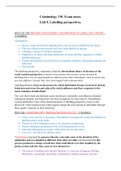
Unit 9. Labelling perspectives.
DISCUSS THE PREMISE AND GENERIC ASSUMPTIONS OF LABELLING THEORY .
(5 MARKS)
Assumptions:
Society creates deviants by labelling those who are seen as different from others.
They are different only because they have been labelled as deviant.
Labelling = process of further criminality
Emphasis is on those who make definitions of crime and their responses to further
problem behaviour
Formal and informal social reactions to criminality influence subsequent attitudes and
behaviour
Self-concept
The labelling perspective, sometimes called the interactional theory of deviance or the
social reaction perspective, is based on the premise that society creates deviants by
labelling those who are apprehended as different from other individuals, when in reality they
are only different because they have been tagged with a deviant label.
Labelling theorists focus on the process by which individuals become involved in deviant
behaviour and stress the part played by social audiences and their responses to the
norm violations of individuals.
The view that formal and informal social reactions to criminality can influence criminals’
subsequent attitudes and behaviours has been recognized for some time by Tannenbaum,
Lemert and Becker, three of the chief proponents of labelling perspective, focus on the
process by which formal social control agents change the self-concept of individuals through
these agents’ reactions to their behaviour.
DISCUSS TANNENBAUM’S ‘DRAMATISATION OF EVIL.’ (5 MARKS)
1938, Crime and The Community (Tannenbaum developed the earliest formulation of
labelling theory in his book)
Process in which delinquent came to the attention of authorities
Process influences perceptions of the self (dramatization of evil)
Join other delinquents to escape, which turns into deviant career
Less evil = less likely for deviant career
Tannenbaum examined the process whereby a juvenile came to the attention of the
authorities and was labelled as different from other juveniles. He theorized that this
process produced a change in both how those individuals were then handled by the
justice system and how they came to view themselves:
The process of making the criminal, therefore, is a process of tagging, defining,
identifying, segregating, describing, emphasizing, making conscious and self-
, conscious; it becomes a way of stimulating, suggesting, emphasizing, and evoking the
very traits that are complained of.
Tannenbaum called this process the dramatization of evil. He wrote that the process of
tagging a juvenile resulted in the youth’s becoming involved with other delinquents and that
these associations represented an attempt to escape the society that was responsible for
negative labelling. The delinquent then became involved in a deviant career, and regardless
of the efforts of individuals in the community and justice system to change his or her “evil”
behaviour, the negative behaviour became increasingly hardened and resistant to positive
values. Tannenbaum proposed that the less the evil is dramatized, the less likely youths are to
become involved in deviant careers.
DISCUSS LEMERT’S THEORY OF PRIMARY AND SECONDARY DEVIATION (10
MARKS)
Interaction: control agents and violators
Progression to crime:
Primary deviation
Secondary deviation
(gradual process)
Lemert focused attention on the interaction between social control agents and rule
violators and on how certain behaviours came to be labelled criminal, delinquent or
deviant.
Lemert’s concept of primary and secondary deviation is regarded as one of the most
important theoretical constructs of the labelling perspective. According to Lemert, primary
deviation consists of the individual’s behaviour and secondary deviation is society’s
response to that behaviour. The social reaction to the deviant, could be interpreted as forcing
a change in status or role; that is, society’s reaction to the deviant resulted in a transformation
in the individual’s identity. The social reaction to the deviant, whether a disapproving glance
Unit 9. Labelling perspectives.
DISCUSS THE PREMISE AND GENERIC ASSUMPTIONS OF LABELLING THEORY .
(5 MARKS)
Assumptions:
Society creates deviants by labelling those who are seen as different from others.
They are different only because they have been labelled as deviant.
Labelling = process of further criminality
Emphasis is on those who make definitions of crime and their responses to further
problem behaviour
Formal and informal social reactions to criminality influence subsequent attitudes and
behaviour
Self-concept
The labelling perspective, sometimes called the interactional theory of deviance or the
social reaction perspective, is based on the premise that society creates deviants by
labelling those who are apprehended as different from other individuals, when in reality they
are only different because they have been tagged with a deviant label.
Labelling theorists focus on the process by which individuals become involved in deviant
behaviour and stress the part played by social audiences and their responses to the
norm violations of individuals.
The view that formal and informal social reactions to criminality can influence criminals’
subsequent attitudes and behaviours has been recognized for some time by Tannenbaum,
Lemert and Becker, three of the chief proponents of labelling perspective, focus on the
process by which formal social control agents change the self-concept of individuals through
these agents’ reactions to their behaviour.
DISCUSS TANNENBAUM’S ‘DRAMATISATION OF EVIL.’ (5 MARKS)
1938, Crime and The Community (Tannenbaum developed the earliest formulation of
labelling theory in his book)
Process in which delinquent came to the attention of authorities
Process influences perceptions of the self (dramatization of evil)
Join other delinquents to escape, which turns into deviant career
Less evil = less likely for deviant career
Tannenbaum examined the process whereby a juvenile came to the attention of the
authorities and was labelled as different from other juveniles. He theorized that this
process produced a change in both how those individuals were then handled by the
justice system and how they came to view themselves:
The process of making the criminal, therefore, is a process of tagging, defining,
identifying, segregating, describing, emphasizing, making conscious and self-
, conscious; it becomes a way of stimulating, suggesting, emphasizing, and evoking the
very traits that are complained of.
Tannenbaum called this process the dramatization of evil. He wrote that the process of
tagging a juvenile resulted in the youth’s becoming involved with other delinquents and that
these associations represented an attempt to escape the society that was responsible for
negative labelling. The delinquent then became involved in a deviant career, and regardless
of the efforts of individuals in the community and justice system to change his or her “evil”
behaviour, the negative behaviour became increasingly hardened and resistant to positive
values. Tannenbaum proposed that the less the evil is dramatized, the less likely youths are to
become involved in deviant careers.
DISCUSS LEMERT’S THEORY OF PRIMARY AND SECONDARY DEVIATION (10
MARKS)
Interaction: control agents and violators
Progression to crime:
Primary deviation
Secondary deviation
(gradual process)
Lemert focused attention on the interaction between social control agents and rule
violators and on how certain behaviours came to be labelled criminal, delinquent or
deviant.
Lemert’s concept of primary and secondary deviation is regarded as one of the most
important theoretical constructs of the labelling perspective. According to Lemert, primary
deviation consists of the individual’s behaviour and secondary deviation is society’s
response to that behaviour. The social reaction to the deviant, could be interpreted as forcing
a change in status or role; that is, society’s reaction to the deviant resulted in a transformation
in the individual’s identity. The social reaction to the deviant, whether a disapproving glance