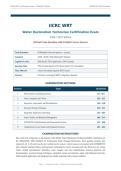
IICRC WRT Certification Exam | 2026/2027 Edition ANSI/IICRC S500 Standard
IICRC WRT
Water Restoration Technician Certification Exam
Edition
84 Real Exam Questions with Verified Correct Answers
Total Questions: 84 Multiple Choice (4 options, 1 correct)
Standard: ANSI / IICRC S500 (2026-2027 Edition)
Cognitive Levels: 30% Recall | 50% Application | 20% Analysis
Question Style: 70% Scenario-based | 25% Direct Recall | 5% Calculation
Time Allowed: 2 hours 30 minutes (typical WRT exam)
Sections: 8 sections covering all WRT competency domains
EXAMINATION SECTIONS
Section Topic Questions
1 Psychrometrics and Drying Science Q1 - Q15
2 Water Categories and Classes Q16 - Q25
3 Inspection, Assessment, and Documentation Q26 - Q38
4 Structural Drying Techniques Q39 - Q52
5 Equipment Application and Sizing Q53 - Q65
6 Safety, Health, and Biohazard Management Q66 - Q74
7 ANSI/IICRC S500 Standards and Professional Practices Q75 - Q80
8 Comprehensive Case Studies and Integrated Scenarios Q81 - Q84
EXAMINATION INSTRUCTIONS
This exam tests competency in all domains of the IICRC Water Restoration Technician (WRT) certification per
the ANSI/IICRC S500 Standard for Professional Water Damage Restoration. Each question presents four
options (A, B, C, D) with exactly one verified correct answer. Correct answers are marked with [CORRECT]
and a detailed rationale follows each question explaining the correct reasoning and why distractors are wrong.
Topics include psychrometric principles, water category and class identification, moisture detection and
documentation, structural drying techniques, equipment sizing and selection, safety and biohazard protocols,
S500 standard application, and integrated case studies requiring multi-concept synthesis.
Page 1 | 84 Questions Total | Verified Correct Answers Included
,IICRC WRT Certification Exam | 2026/2027 Edition ANSI/IICRC S500 Standard
Section 1: Psychrometrics and Drying Science
Psychrometric Chart, Relative Humidity, Grains Per Pound, Dew Point, & Vapor Pressure (Q1-Q15)
Q1: A restoration technician measures an affected room and records a dry bulb temperature of 80°F and a
relative humidity of 50%. Using psychrometric principles, which statement BEST describes the relationship
between these two readings?
A. The air currently contains half of the maximum moisture it could hold at that temperature, but its absolute
moisture content (GPP) is unknown without further calculation. [CORRECT]
B. The air is saturated and condensation will begin immediately on any surface below 80°F.
C. The grains per pound value is exactly 50, because relative humidity and grains per pound are equivalent
measurements.
D. The vapor pressure of the air is 50% of atmospheric pressure, meaning evaporation will not occur.
Correct Answer: A
Rationale: Relative humidity is the ratio of moisture actually in the air to the maximum moisture the air can hold at that
temperature, expressed as a percentage. A 50% RH reading at 80°F means the air is holding half of its capacity, but absolute
moisture content (GPP) requires either a psychrometric chart or a wet bulb reading to determine. Option B confuses RH with
dew point, which is the temperature at which condensation begins. Option C incorrectly equates RH with GPP—they are
different properties. Option D incorrectly links RH to atmospheric pressure rather than water vapor pressure.
Q2: On a psychrometric chart, which parameter is represented by reading horizontally to the right edge of the
chart to find the moisture content of an air sample?
A. Dew point temperature
B. Specific humidity (humidity ratio) in grains per pound [CORRECT]
C. Wet bulb temperature
D. Vapor pressure in inches of mercury
Correct Answer: B
Rationale: The humidity ratio (specific humidity), typically expressed in grains per pound of dry air, is found on the right
vertical axis of the psychrometric chart by extending a horizontal line from the state point. Dew point is found by following the
saturation curve, wet bulb is found along the slanted lines, and vapor pressure is a related but separately scaled value. Reading
horizontally to the right edge specifically identifies the moisture content per pound of dry air, which is essential for calculating
grain depression and dehumidifier capacity.
Q3: A technician observes that the vapor pressure of the ambient air in a drying chamber is lower than the
vapor pressure at the surface of a wet material. What will occur according to the second law of
thermodynamics as applied to evaporation?
A. Moisture will migrate from the air into the wet material until pressures equalize.
B. Evaporation will occur from the wet material into the air because vapor pressure always seeks equilibrium.
[CORRECT]
C. No moisture transfer will occur unless temperature is increased above 80°F.
D. Condensation will occur on the wet material surface due to pressure differential.
Correct Answer: B
Page 2 | 84 Questions Total | Verified Correct Answers Included
,IICRC WRT Certification Exam | 2026/2027 Edition ANSI/IICRC S500 Standard
Rationale: Vapor pressure always seeks equilibrium within a confined space. When the vapor pressure of the ambient air is
lower than the vapor pressure at the surface of a wet material, moisture will evaporate from the material into the air to equalize
the difference. This vapor pressure differential is the primary driving force of evaporation in structural drying. Option A reverses
the direction. Option C incorrectly imposes an arbitrary temperature threshold—evaporation occurs whenever a vapor pressure
differential exists. Option D confuses evaporation with condensation.
Q4: During a drying project in a closed building, the interior air temperature is 70°F with 60% RH. The
technician lowers the air temperature to 65°F without removing any moisture. What will happen to the dew
point, relative humidity, and grains per pound respectively?
A. Dew point rises, RH decreases, GPP increases
B. Dew point stays the same, RH increases, GPP stays the same [CORRECT]
C. Dew point decreases, RH stays the same, GPP decreases
D. Dew point rises, RH stays the same, GPP increases
Correct Answer: B
Rationale: When moisture content is unchanged, the dew point and GPP remain constant because both are absolute measures of
moisture in the air. Lowering the temperature without removing moisture decreases the air's capacity to hold water vapor, which
causes the relative humidity to increase even though no moisture was added. This is sensible cooling—it changes temperature
and RH but not absolute moisture content. This principle explains why warm air from a dehumidifier feels drier even though it
carries the same GPP as cooler air that has higher RH.
Q5: A wet wall surface has a temperature of 70°F and the surrounding air has a dew point of 65°F. What
condition exists and what is the likely consequence for drying?
A. The wall is below the dew point of the air; condensation will form on the wall and impede drying until the
wall temperature is raised above the dew point. [CORRECT]
B. The wall is above the dew point; rapid evaporation will occur and drying will proceed normally.
C. The wall temperature equals the wet bulb temperature; no moisture exchange will occur.
D. The dew point is irrelevant because the wall is wet; drying rate depends only on airflow.
Correct Answer: A
Rationale: When a surface temperature is at or below the dew point of the surrounding air, moisture from the air will condense
onto that surface. In this case, the wall at 70°F is above the air's dew point of 65°F, so condensation should not occur—but the
answer correctly identifies the principle that surfaces below dew point cause condensation that impedes drying. This is a critical
concept for setting drying goals: surface temperatures must remain above the dew point of the drying air. Technicians use
thermal imaging to detect cool spots where condensation risks mold growth.
Q6: Which of the following BEST describes the boundary layer and its role in the evaporation process during
structural drying?
A. A stagnant layer of air adjacent to a wet surface that slows evaporation, which is disrupted when air
movers are angled across the surface at approximately 45 degrees. [CORRECT]
B. A layer of moisture trapped inside structural materials that requires heat to release.
C. The temperature differential between wet and dry building materials that drives evaporation.
D. A vapor barrier with a permeance rating below 1.0 that prevents moisture migration.
Correct Answer: A
Page 3 | 84 Questions Total | Verified Correct Answers Included
, IICRC WRT Certification Exam | 2026/2027 Edition ANSI/IICRC S500 Standard
Rationale: The boundary layer is a thin, stagnant layer of air adjacent to a wet surface where evaporation slows because the air
at the surface becomes nearly saturated. Air movers placed at a 45-degree angle across the surface create turbulence that disrupts
this layer, replacing saturated air with drier air and accelerating evaporation. Option B describes bound water, not the boundary
layer. Option C describes vapor pressure differential. Option D describes a vapor barrier, an entirely different concept related to
material permeance.
Q7: An LGR dehumidifier is operating in a sealed drying chamber. The technician records the following:
intake air at 80°F and 50% RH, exhaust air at 90°F and 32% RH. What has the dehumidifier accomplished,
and which psychrometric value is the BEST indicator of its performance?
A. Heated the air; relative humidity is the best performance indicator.
B. Removed moisture; grains per pound (GPP) is the best performance indicator because RH changes with
temperature even when moisture content is unchanged. [CORRECT]
C. Increased absolute moisture; dew point is the best performance indicator.
D. Saturated the air; vapor pressure is the best performance indicator.
Correct Answer: B
Rationale: LGR dehumidifiers remove moisture from air by cooling it below its dew point, condensing water vapor into liquid,
then reheating the dried air. The exhaust air is warmer (sensible heat from condenser coils) and drier in absolute terms. Relative
humidity alone is misleading because RH drops as temperature rises even if moisture content stays the same. Grains per pound
(GPP) is the most reliable indicator of dehumidifier performance because it measures absolute moisture content independent of
temperature. Comparing intake GPP to exhaust GPP reveals the actual grain removal rate.
Q8: What is the latent heat of vaporization, and why is it relevant to structural drying?
A. The energy required to change water from liquid to vapor without a temperature change; it explains why
evaporation cools surfaces and why heat input accelerates drying. [CORRECT]
B. The heat energy that raises water temperature by one degree Fahrenheit; it explains why warmer rooms dry faster.
C. The energy released when water vapor condenses into liquid; it explains how dehumidifiers work.
D. The thermal energy stored in building materials that resists drying; it explains why masonry takes longer to dry.
Correct Answer: A
Rationale: Latent heat of vaporization is the energy required to change water from a liquid to a vapor without changing its
temperature. Approximately 1,060 BTUs are required to evaporate one pound of water at typical drying temperatures. This
energy is absorbed from surrounding materials and air, which is why wet surfaces cool during evaporation and why
supplemental heat accelerates drying—it provides the energy needed for phase change. Sensible heat (option B) only changes
temperature. While option C describes a real phenomenon, it is incomplete as an answer to what latent heat is.
Q9: During the falling rate phase of drying, why does evaporation slow significantly compared to the constant
rate phase?
A. Because the dehumidifier has reached capacity and must be replaced.
B. Because the water remaining in the material is bound within its structure and requires more energy to
vaporize than free surface water. [CORRECT]
C. Because the air movers can no longer reach the wet surfaces.
D. Because the room has reached equilibrium moisture content and no further drying is possible.
Correct Answer: B
Page 4 | 84 Questions Total | Verified Correct Answers Included
IICRC WRT
Water Restoration Technician Certification Exam
Edition
84 Real Exam Questions with Verified Correct Answers
Total Questions: 84 Multiple Choice (4 options, 1 correct)
Standard: ANSI / IICRC S500 (2026-2027 Edition)
Cognitive Levels: 30% Recall | 50% Application | 20% Analysis
Question Style: 70% Scenario-based | 25% Direct Recall | 5% Calculation
Time Allowed: 2 hours 30 minutes (typical WRT exam)
Sections: 8 sections covering all WRT competency domains
EXAMINATION SECTIONS
Section Topic Questions
1 Psychrometrics and Drying Science Q1 - Q15
2 Water Categories and Classes Q16 - Q25
3 Inspection, Assessment, and Documentation Q26 - Q38
4 Structural Drying Techniques Q39 - Q52
5 Equipment Application and Sizing Q53 - Q65
6 Safety, Health, and Biohazard Management Q66 - Q74
7 ANSI/IICRC S500 Standards and Professional Practices Q75 - Q80
8 Comprehensive Case Studies and Integrated Scenarios Q81 - Q84
EXAMINATION INSTRUCTIONS
This exam tests competency in all domains of the IICRC Water Restoration Technician (WRT) certification per
the ANSI/IICRC S500 Standard for Professional Water Damage Restoration. Each question presents four
options (A, B, C, D) with exactly one verified correct answer. Correct answers are marked with [CORRECT]
and a detailed rationale follows each question explaining the correct reasoning and why distractors are wrong.
Topics include psychrometric principles, water category and class identification, moisture detection and
documentation, structural drying techniques, equipment sizing and selection, safety and biohazard protocols,
S500 standard application, and integrated case studies requiring multi-concept synthesis.
Page 1 | 84 Questions Total | Verified Correct Answers Included
,IICRC WRT Certification Exam | 2026/2027 Edition ANSI/IICRC S500 Standard
Section 1: Psychrometrics and Drying Science
Psychrometric Chart, Relative Humidity, Grains Per Pound, Dew Point, & Vapor Pressure (Q1-Q15)
Q1: A restoration technician measures an affected room and records a dry bulb temperature of 80°F and a
relative humidity of 50%. Using psychrometric principles, which statement BEST describes the relationship
between these two readings?
A. The air currently contains half of the maximum moisture it could hold at that temperature, but its absolute
moisture content (GPP) is unknown without further calculation. [CORRECT]
B. The air is saturated and condensation will begin immediately on any surface below 80°F.
C. The grains per pound value is exactly 50, because relative humidity and grains per pound are equivalent
measurements.
D. The vapor pressure of the air is 50% of atmospheric pressure, meaning evaporation will not occur.
Correct Answer: A
Rationale: Relative humidity is the ratio of moisture actually in the air to the maximum moisture the air can hold at that
temperature, expressed as a percentage. A 50% RH reading at 80°F means the air is holding half of its capacity, but absolute
moisture content (GPP) requires either a psychrometric chart or a wet bulb reading to determine. Option B confuses RH with
dew point, which is the temperature at which condensation begins. Option C incorrectly equates RH with GPP—they are
different properties. Option D incorrectly links RH to atmospheric pressure rather than water vapor pressure.
Q2: On a psychrometric chart, which parameter is represented by reading horizontally to the right edge of the
chart to find the moisture content of an air sample?
A. Dew point temperature
B. Specific humidity (humidity ratio) in grains per pound [CORRECT]
C. Wet bulb temperature
D. Vapor pressure in inches of mercury
Correct Answer: B
Rationale: The humidity ratio (specific humidity), typically expressed in grains per pound of dry air, is found on the right
vertical axis of the psychrometric chart by extending a horizontal line from the state point. Dew point is found by following the
saturation curve, wet bulb is found along the slanted lines, and vapor pressure is a related but separately scaled value. Reading
horizontally to the right edge specifically identifies the moisture content per pound of dry air, which is essential for calculating
grain depression and dehumidifier capacity.
Q3: A technician observes that the vapor pressure of the ambient air in a drying chamber is lower than the
vapor pressure at the surface of a wet material. What will occur according to the second law of
thermodynamics as applied to evaporation?
A. Moisture will migrate from the air into the wet material until pressures equalize.
B. Evaporation will occur from the wet material into the air because vapor pressure always seeks equilibrium.
[CORRECT]
C. No moisture transfer will occur unless temperature is increased above 80°F.
D. Condensation will occur on the wet material surface due to pressure differential.
Correct Answer: B
Page 2 | 84 Questions Total | Verified Correct Answers Included
,IICRC WRT Certification Exam | 2026/2027 Edition ANSI/IICRC S500 Standard
Rationale: Vapor pressure always seeks equilibrium within a confined space. When the vapor pressure of the ambient air is
lower than the vapor pressure at the surface of a wet material, moisture will evaporate from the material into the air to equalize
the difference. This vapor pressure differential is the primary driving force of evaporation in structural drying. Option A reverses
the direction. Option C incorrectly imposes an arbitrary temperature threshold—evaporation occurs whenever a vapor pressure
differential exists. Option D confuses evaporation with condensation.
Q4: During a drying project in a closed building, the interior air temperature is 70°F with 60% RH. The
technician lowers the air temperature to 65°F without removing any moisture. What will happen to the dew
point, relative humidity, and grains per pound respectively?
A. Dew point rises, RH decreases, GPP increases
B. Dew point stays the same, RH increases, GPP stays the same [CORRECT]
C. Dew point decreases, RH stays the same, GPP decreases
D. Dew point rises, RH stays the same, GPP increases
Correct Answer: B
Rationale: When moisture content is unchanged, the dew point and GPP remain constant because both are absolute measures of
moisture in the air. Lowering the temperature without removing moisture decreases the air's capacity to hold water vapor, which
causes the relative humidity to increase even though no moisture was added. This is sensible cooling—it changes temperature
and RH but not absolute moisture content. This principle explains why warm air from a dehumidifier feels drier even though it
carries the same GPP as cooler air that has higher RH.
Q5: A wet wall surface has a temperature of 70°F and the surrounding air has a dew point of 65°F. What
condition exists and what is the likely consequence for drying?
A. The wall is below the dew point of the air; condensation will form on the wall and impede drying until the
wall temperature is raised above the dew point. [CORRECT]
B. The wall is above the dew point; rapid evaporation will occur and drying will proceed normally.
C. The wall temperature equals the wet bulb temperature; no moisture exchange will occur.
D. The dew point is irrelevant because the wall is wet; drying rate depends only on airflow.
Correct Answer: A
Rationale: When a surface temperature is at or below the dew point of the surrounding air, moisture from the air will condense
onto that surface. In this case, the wall at 70°F is above the air's dew point of 65°F, so condensation should not occur—but the
answer correctly identifies the principle that surfaces below dew point cause condensation that impedes drying. This is a critical
concept for setting drying goals: surface temperatures must remain above the dew point of the drying air. Technicians use
thermal imaging to detect cool spots where condensation risks mold growth.
Q6: Which of the following BEST describes the boundary layer and its role in the evaporation process during
structural drying?
A. A stagnant layer of air adjacent to a wet surface that slows evaporation, which is disrupted when air
movers are angled across the surface at approximately 45 degrees. [CORRECT]
B. A layer of moisture trapped inside structural materials that requires heat to release.
C. The temperature differential between wet and dry building materials that drives evaporation.
D. A vapor barrier with a permeance rating below 1.0 that prevents moisture migration.
Correct Answer: A
Page 3 | 84 Questions Total | Verified Correct Answers Included
, IICRC WRT Certification Exam | 2026/2027 Edition ANSI/IICRC S500 Standard
Rationale: The boundary layer is a thin, stagnant layer of air adjacent to a wet surface where evaporation slows because the air
at the surface becomes nearly saturated. Air movers placed at a 45-degree angle across the surface create turbulence that disrupts
this layer, replacing saturated air with drier air and accelerating evaporation. Option B describes bound water, not the boundary
layer. Option C describes vapor pressure differential. Option D describes a vapor barrier, an entirely different concept related to
material permeance.
Q7: An LGR dehumidifier is operating in a sealed drying chamber. The technician records the following:
intake air at 80°F and 50% RH, exhaust air at 90°F and 32% RH. What has the dehumidifier accomplished,
and which psychrometric value is the BEST indicator of its performance?
A. Heated the air; relative humidity is the best performance indicator.
B. Removed moisture; grains per pound (GPP) is the best performance indicator because RH changes with
temperature even when moisture content is unchanged. [CORRECT]
C. Increased absolute moisture; dew point is the best performance indicator.
D. Saturated the air; vapor pressure is the best performance indicator.
Correct Answer: B
Rationale: LGR dehumidifiers remove moisture from air by cooling it below its dew point, condensing water vapor into liquid,
then reheating the dried air. The exhaust air is warmer (sensible heat from condenser coils) and drier in absolute terms. Relative
humidity alone is misleading because RH drops as temperature rises even if moisture content stays the same. Grains per pound
(GPP) is the most reliable indicator of dehumidifier performance because it measures absolute moisture content independent of
temperature. Comparing intake GPP to exhaust GPP reveals the actual grain removal rate.
Q8: What is the latent heat of vaporization, and why is it relevant to structural drying?
A. The energy required to change water from liquid to vapor without a temperature change; it explains why
evaporation cools surfaces and why heat input accelerates drying. [CORRECT]
B. The heat energy that raises water temperature by one degree Fahrenheit; it explains why warmer rooms dry faster.
C. The energy released when water vapor condenses into liquid; it explains how dehumidifiers work.
D. The thermal energy stored in building materials that resists drying; it explains why masonry takes longer to dry.
Correct Answer: A
Rationale: Latent heat of vaporization is the energy required to change water from a liquid to a vapor without changing its
temperature. Approximately 1,060 BTUs are required to evaporate one pound of water at typical drying temperatures. This
energy is absorbed from surrounding materials and air, which is why wet surfaces cool during evaporation and why
supplemental heat accelerates drying—it provides the energy needed for phase change. Sensible heat (option B) only changes
temperature. While option C describes a real phenomenon, it is incomplete as an answer to what latent heat is.
Q9: During the falling rate phase of drying, why does evaporation slow significantly compared to the constant
rate phase?
A. Because the dehumidifier has reached capacity and must be replaced.
B. Because the water remaining in the material is bound within its structure and requires more energy to
vaporize than free surface water. [CORRECT]
C. Because the air movers can no longer reach the wet surfaces.
D. Because the room has reached equilibrium moisture content and no further drying is possible.
Correct Answer: B
Page 4 | 84 Questions Total | Verified Correct Answers Included