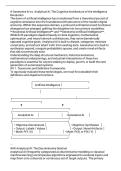
# Generative AI vs. Analytical AI: The Cognitive Architecture of the Intelligence
Revolution
The dawn of artificial intelligence has transitioned from a theoretical pursuit of
cognitive simulation into the foundational infrastructure of the modern digital
economy. Within this expansive domain, a profound architectural and functional
divergence has emerged, splitting the discipline into two primary modalities:
**Analytical Artificial Intelligence** and **Generative Artificial Intelligence**.
While both paradigms depend heavily on data ingestion, mathematical
optimization, and neural network architectures, they serve diametrically
opposed cognitive goals. Analytical AI is built to dissect, categorize, minimize
uncertainty, and extract latent truth from existing data. Generative AI is built to
synthesize, expand, navigate probabilistic spaces, and create novel artifacts
that did not previously exist.
Understanding the deep structural mechanics, historical evolutions,
mathematical underpinnings, and industrial intersections of these two
paradigms is essential for anyone seeking to deploy, govern, or build the next
generation of automated systems.
## 1. Taxonomic and Definitive Frameworks
To rigorously evaluate these technologies, we must first establish their
definitions and objective functions.
```
┌───────────────────────────┐
│ Artificial Intelligence │
└─────────────┬─────────────┘
│
┌───────────────────────────────┴────────────────
───────────────┐
▼ ▼
┌───────────────────────────┐
┌───────────────────────────┐
│ Analytical AI │ │ Generative AI │
├───────────────────────────┤
├───────────────────────────┤
│ • Objective: Discriminate │ │ • Objective: Synthesize │
│ • Output: Labels / Values │ │ • Output: Novel Artifacts │
│ • Math: P(Y | X) │ │ • Math: P(X) or P(X | Y) │
└───────────────────────────┘
└───────────────────────────┘
```
### Analytical AI: The Discriminative Sentinel
Analytical AI (frequently categorized as discriminative modeling or classical
machine learning) encompasses algorithms engineered to evaluate inputs and
map them onto a discrete or continuous set of target outputs. The primary
, objective is **reconstructed comprehension**. It takes the chaotic complexity of
the real world and reduces it to structured, actionable insights.
Mathematically, an analytical model is concerned with computing the
conditional probability:
Where:
* X represents a high-dimensional vector of input features (e.g., historical user
metrics, sensor telemetry, market indicators).
* Y represents the specific target label, classification, or continuous numerical
target variable.
Analytical AI operates as a filter. It answers fundamental objective questions: *Is
this transaction fraudulent? What will the price of this asset be tomorrow?
Which group of customers is most likely to churn based on this behavioral
pattern?*
### Generative AI: The Synthesizing Engine
Generative AI encompasses algorithmic frameworks designed to learn the
underlying structural distribution of a training dataset in order to produce
completely original, high-fidelity data artifacts (text, images, synthetic audio,
code, molecular structures) that mirror the characteristics of the training data
without directly copying it.
Mathematically, generative models seek to solve the joint probability distribution:
Or alternatively, the conditional probability of an input space given a target label:
In a generative framework, the model must understand not just how a label Y is
separated by a boundary line from another label, but how the entire feature
space X is constructed from scratch. If an analytical model learns to distinguish
a portrait of a person from a landscape, a generative model learns the
fundamental geometry of human faces so perfectly that it can paint an entirely
new face that has never existed in reality.
## 2. Theoretical and Mathematical Foundations
The operational rift between these two modalities becomes clear when
examining their core mathematical foundations and neural architectures.
### The Discriminative Boundary vs. The Generative Density Space
The structural difference between the two can be illustrated through geometric
space:
```
Analytical AI (Discriminative Boundary) Generative AI (Probability Density
Space)
Feature Y Feature Y
▲ ▲
│ X X (Class A) │ ****
│ X X │ * X X * (Learns the
│───────Boundary Line──────── │ * X (AI) X * entire
underlying
│ O O │ * X X * distribution)
│ O O (Class B) │ ****
Revolution
The dawn of artificial intelligence has transitioned from a theoretical pursuit of
cognitive simulation into the foundational infrastructure of the modern digital
economy. Within this expansive domain, a profound architectural and functional
divergence has emerged, splitting the discipline into two primary modalities:
**Analytical Artificial Intelligence** and **Generative Artificial Intelligence**.
While both paradigms depend heavily on data ingestion, mathematical
optimization, and neural network architectures, they serve diametrically
opposed cognitive goals. Analytical AI is built to dissect, categorize, minimize
uncertainty, and extract latent truth from existing data. Generative AI is built to
synthesize, expand, navigate probabilistic spaces, and create novel artifacts
that did not previously exist.
Understanding the deep structural mechanics, historical evolutions,
mathematical underpinnings, and industrial intersections of these two
paradigms is essential for anyone seeking to deploy, govern, or build the next
generation of automated systems.
## 1. Taxonomic and Definitive Frameworks
To rigorously evaluate these technologies, we must first establish their
definitions and objective functions.
```
┌───────────────────────────┐
│ Artificial Intelligence │
└─────────────┬─────────────┘
│
┌───────────────────────────────┴────────────────
───────────────┐
▼ ▼
┌───────────────────────────┐
┌───────────────────────────┐
│ Analytical AI │ │ Generative AI │
├───────────────────────────┤
├───────────────────────────┤
│ • Objective: Discriminate │ │ • Objective: Synthesize │
│ • Output: Labels / Values │ │ • Output: Novel Artifacts │
│ • Math: P(Y | X) │ │ • Math: P(X) or P(X | Y) │
└───────────────────────────┘
└───────────────────────────┘
```
### Analytical AI: The Discriminative Sentinel
Analytical AI (frequently categorized as discriminative modeling or classical
machine learning) encompasses algorithms engineered to evaluate inputs and
map them onto a discrete or continuous set of target outputs. The primary
, objective is **reconstructed comprehension**. It takes the chaotic complexity of
the real world and reduces it to structured, actionable insights.
Mathematically, an analytical model is concerned with computing the
conditional probability:
Where:
* X represents a high-dimensional vector of input features (e.g., historical user
metrics, sensor telemetry, market indicators).
* Y represents the specific target label, classification, or continuous numerical
target variable.
Analytical AI operates as a filter. It answers fundamental objective questions: *Is
this transaction fraudulent? What will the price of this asset be tomorrow?
Which group of customers is most likely to churn based on this behavioral
pattern?*
### Generative AI: The Synthesizing Engine
Generative AI encompasses algorithmic frameworks designed to learn the
underlying structural distribution of a training dataset in order to produce
completely original, high-fidelity data artifacts (text, images, synthetic audio,
code, molecular structures) that mirror the characteristics of the training data
without directly copying it.
Mathematically, generative models seek to solve the joint probability distribution:
Or alternatively, the conditional probability of an input space given a target label:
In a generative framework, the model must understand not just how a label Y is
separated by a boundary line from another label, but how the entire feature
space X is constructed from scratch. If an analytical model learns to distinguish
a portrait of a person from a landscape, a generative model learns the
fundamental geometry of human faces so perfectly that it can paint an entirely
new face that has never existed in reality.
## 2. Theoretical and Mathematical Foundations
The operational rift between these two modalities becomes clear when
examining their core mathematical foundations and neural architectures.
### The Discriminative Boundary vs. The Generative Density Space
The structural difference between the two can be illustrated through geometric
space:
```
Analytical AI (Discriminative Boundary) Generative AI (Probability Density
Space)
Feature Y Feature Y
▲ ▲
│ X X (Class A) │ ****
│ X X │ * X X * (Learns the
│───────Boundary Line──────── │ * X (AI) X * entire
underlying
│ O O │ * X X * distribution)
│ O O (Class B) │ ****