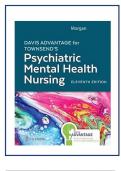
Davis Advantage for Medical-
Surgical Nursing
Making Connections to Practice
3rd Edition
• Author(s)Janice Hoffman; Nancy
Sullivan
• Print ISBN: 9781719647366
TEST BANK
1) MCQ
,Clinical Scenario:
A postoperative adult patient becomes restless and says, “I feel
like I cannot get enough air.” The nurse notes a respiratory rate
of 28/min and an oxygen saturation of 88% on room air.
Question Stem:
What is the nurse’s priority action?
Answer Options:
A. Apply oxygen and remain with the patient while reassessing
breathing
B. Document the findings and reassess in 30 minutes
C. Encourage the patient to ambulate to improve lung
expansion
D. Administer a prescribed sedative to reduce anxiety
Correct Answer:
A
Detailed Rationale:
This patient is showing cues of acute respiratory compromise.
The nurse must respond using the ABC priority framework by
supporting oxygenation and staying with the patient while
completing a focused respiratory assessment. Early
intervention reduces risk for deterioration.
Incorrect Option Analysis:
• B. Incorrect because delaying action may worsen
hypoxemia. Misconception: stable-looking patients can
wait. Risk: respiratory decline.
, • C. Incorrect because ambulation is not the first
intervention in a hypoxic patient. Misconception: all
postop dyspnea is atelectasis. Risk: increased oxygen
demand.
• D. Incorrect because sedation can depress respirations.
Misconception: anxiety is the main problem. Risk:
worsened hypoventilation.
Nursing Process Linkage:
Implementation
Clinical Judgment Competencies (NCJMM):
Recognize Cues; Take Action
Difficulty Level:
Moderate
Bloom’s Cognitive Level:
Apply
NCLEX Client Needs Category:
Physiological Adaptation
Key Learning Objective:
Prioritize immediate nursing action for acute respiratory
deterioration.
2) MCQ
, Clinical Scenario:
A unit manager reviews repeated central line infection data and
asks the staff to improve practice.
Question Stem:
Which action best reflects evidence-based nursing care?
Answer Options:
A. Continue current practice because it has worked in the past
B. Use the most current research, unit data, and patient
preferences to guide practice change
C. Ask each nurse to choose their preferred line-care method
D. Wait for a provider to identify the best nursing intervention
Correct Answer:
B
Detailed Rationale:
Evidence-based nursing care combines best available research,
clinical expertise, and patient values. Reviewing current
evidence and unit outcomes supports safer, more consistent
care.
Incorrect Option Analysis:
• A. Incorrect because tradition alone is not evidence.
Misconception: long-standing practice is automatically
effective. Risk: continuation of harmful variations.
• C. Incorrect because individual preference does not ensure
consistency or safety. Misconception: flexibility always
improves care. Risk: variable infection prevention.
Surgical Nursing
Making Connections to Practice
3rd Edition
• Author(s)Janice Hoffman; Nancy
Sullivan
• Print ISBN: 9781719647366
TEST BANK
1) MCQ
,Clinical Scenario:
A postoperative adult patient becomes restless and says, “I feel
like I cannot get enough air.” The nurse notes a respiratory rate
of 28/min and an oxygen saturation of 88% on room air.
Question Stem:
What is the nurse’s priority action?
Answer Options:
A. Apply oxygen and remain with the patient while reassessing
breathing
B. Document the findings and reassess in 30 minutes
C. Encourage the patient to ambulate to improve lung
expansion
D. Administer a prescribed sedative to reduce anxiety
Correct Answer:
A
Detailed Rationale:
This patient is showing cues of acute respiratory compromise.
The nurse must respond using the ABC priority framework by
supporting oxygenation and staying with the patient while
completing a focused respiratory assessment. Early
intervention reduces risk for deterioration.
Incorrect Option Analysis:
• B. Incorrect because delaying action may worsen
hypoxemia. Misconception: stable-looking patients can
wait. Risk: respiratory decline.
, • C. Incorrect because ambulation is not the first
intervention in a hypoxic patient. Misconception: all
postop dyspnea is atelectasis. Risk: increased oxygen
demand.
• D. Incorrect because sedation can depress respirations.
Misconception: anxiety is the main problem. Risk:
worsened hypoventilation.
Nursing Process Linkage:
Implementation
Clinical Judgment Competencies (NCJMM):
Recognize Cues; Take Action
Difficulty Level:
Moderate
Bloom’s Cognitive Level:
Apply
NCLEX Client Needs Category:
Physiological Adaptation
Key Learning Objective:
Prioritize immediate nursing action for acute respiratory
deterioration.
2) MCQ
, Clinical Scenario:
A unit manager reviews repeated central line infection data and
asks the staff to improve practice.
Question Stem:
Which action best reflects evidence-based nursing care?
Answer Options:
A. Continue current practice because it has worked in the past
B. Use the most current research, unit data, and patient
preferences to guide practice change
C. Ask each nurse to choose their preferred line-care method
D. Wait for a provider to identify the best nursing intervention
Correct Answer:
B
Detailed Rationale:
Evidence-based nursing care combines best available research,
clinical expertise, and patient values. Reviewing current
evidence and unit outcomes supports safer, more consistent
care.
Incorrect Option Analysis:
• A. Incorrect because tradition alone is not evidence.
Misconception: long-standing practice is automatically
effective. Risk: continuation of harmful variations.
• C. Incorrect because individual preference does not ensure
consistency or safety. Misconception: flexibility always
improves care. Risk: variable infection prevention.