Problem 5A
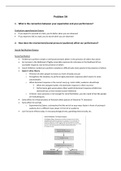
1. What is the connection between your expectation and your performance?
Evaluation apprehension theory
• If you expect to succeed at a task, you do better when you are observed
• If you expect to fail at a task, you do worse when you are observed
2. How does the environment/social pressure (audience) affect our performance?
Social facilitation theory
Social facilitation
• Tendency to perform simple or well-practiced tasks better in the presence of others than alone
• An increase in the likelihood of highly accessible responses & a decrease in the likelihood of less
accessible response, due to the presence of others
• Social inhibition: tendency to perform complex or difficult tasks more poorly in the presence of others
• Zajonc’s drive theory
o Presence of other people increases our level of bodily arousal
o Strengthens the tendency to perform highly dominant responses which seems to come
automatically
o When dominant response is the correct one (e.g. motor skills), audience should help
§ When the task gets harder, the dominant response is often incorrect
§ Performance gets worse when others watch & dominant response inhibits less
dominant but correct reaction (social inhibition)
o Criticism: mere presence is not enough for social facilitation, you also need to feel like people
are evaluating you
• Same effect for virtual presence of fictional others (picture of favourite TV character)
• Same effect for animals
o Experiment by Zajonc: cockroaches find the exit of an easy maze faster in front of cockroach
audience & in a difficult maze slower in front of an audience
• Can find same effects today in neuropsychological tests, gambling electronically, etc.
, Evaluation Apprehension Theory
• Presence of others who are in a position to judge us produces evaluation apprehension which
changes our performance (social facilitation)
• When we focus on other people’s opinions, it creates arousal which can lead to positive & negative
effect on a performance
• If you expect to succeed at a task, you do better when you are observed
• If you expect to fail at a task, you do worse when you are observed
• Theory is not proven
Distraction-conflict theory (contradictory findings)
• Mere presence causes us to think about them, to react to them or monitor what they are doing
• Our impulses do two different things at once → concentrate on the task & react to others
• Starts to conflict with each other → we become anxious & aroused
• Scope of attention for the task becomes narrowed
• Distraction may improve performance on difficult tasks as we only focus on relevant cues amongst
others
→ conflicting research → theory important for theory evolution
• Study by Huguet
o People performed better in the presence of distracting others who could not witness the
participant’s performance compared to performing alone
→ social facilitation takes also place in crowds as there are many opportunities for evaluation & distraction
→ mere presence of others can produce arousal either because of other people are highly evaluative or
distracting
3. Why do some people perform better in groups and others alone? (Also considering
personal factors: such as experience in performing in front of a group)
Social loafing theory
• pattern in which people working together on a task generate less total effort than they would have if
they had each worked alone
• Ringelmann effect → rope-pulling contest
o Possible other explanation: effect occurs on process & coordination loss
• Social loafing is more likely to occur when
o Individual sees partner as stereotypically well suited for the task
o Interdependence is minimal & individual roles are unimportant
1. What is the connection between your expectation and your performance?
Evaluation apprehension theory
• If you expect to succeed at a task, you do better when you are observed
• If you expect to fail at a task, you do worse when you are observed
2. How does the environment/social pressure (audience) affect our performance?
Social facilitation theory
Social facilitation
• Tendency to perform simple or well-practiced tasks better in the presence of others than alone
• An increase in the likelihood of highly accessible responses & a decrease in the likelihood of less
accessible response, due to the presence of others
• Social inhibition: tendency to perform complex or difficult tasks more poorly in the presence of others
• Zajonc’s drive theory
o Presence of other people increases our level of bodily arousal
o Strengthens the tendency to perform highly dominant responses which seems to come
automatically
o When dominant response is the correct one (e.g. motor skills), audience should help
§ When the task gets harder, the dominant response is often incorrect
§ Performance gets worse when others watch & dominant response inhibits less
dominant but correct reaction (social inhibition)
o Criticism: mere presence is not enough for social facilitation, you also need to feel like people
are evaluating you
• Same effect for virtual presence of fictional others (picture of favourite TV character)
• Same effect for animals
o Experiment by Zajonc: cockroaches find the exit of an easy maze faster in front of cockroach
audience & in a difficult maze slower in front of an audience
• Can find same effects today in neuropsychological tests, gambling electronically, etc.
, Evaluation Apprehension Theory
• Presence of others who are in a position to judge us produces evaluation apprehension which
changes our performance (social facilitation)
• When we focus on other people’s opinions, it creates arousal which can lead to positive & negative
effect on a performance
• If you expect to succeed at a task, you do better when you are observed
• If you expect to fail at a task, you do worse when you are observed
• Theory is not proven
Distraction-conflict theory (contradictory findings)
• Mere presence causes us to think about them, to react to them or monitor what they are doing
• Our impulses do two different things at once → concentrate on the task & react to others
• Starts to conflict with each other → we become anxious & aroused
• Scope of attention for the task becomes narrowed
• Distraction may improve performance on difficult tasks as we only focus on relevant cues amongst
others
→ conflicting research → theory important for theory evolution
• Study by Huguet
o People performed better in the presence of distracting others who could not witness the
participant’s performance compared to performing alone
→ social facilitation takes also place in crowds as there are many opportunities for evaluation & distraction
→ mere presence of others can produce arousal either because of other people are highly evaluative or
distracting
3. Why do some people perform better in groups and others alone? (Also considering
personal factors: such as experience in performing in front of a group)
Social loafing theory
• pattern in which people working together on a task generate less total effort than they would have if
they had each worked alone
• Ringelmann effect → rope-pulling contest
o Possible other explanation: effect occurs on process & coordination loss
• Social loafing is more likely to occur when
o Individual sees partner as stereotypically well suited for the task
o Interdependence is minimal & individual roles are unimportant