Transport in Animals
8.1 Transport system in multicellular animals
8.1 Transport System in Multicellular Animals
- As organisms get bigger, the distances between 8.2 Blood Vessels
the cells and the outside of the body get greater. 8.3 Blood, tissue fluid, and lymph
Diffusion would transport substances into and
out of the inner core of the body, but it would be 8.4 transport of oxygen and carbon dioxide in the blood
so slow that the organism would not survive. 8.5 the heart
- Specialised transport systems are needed because:
o The metabolic demands are high, therefore the demands for oxygen and glucose and removal
of CO2 are higher.
o The surface area to volume ratio is too small
o The diffusion distances are too large.
o Molecules e.g., hormones or enzymes are made in one place but needed in another
- Most large multicellular animals have specialised circulatory systems which carry O2, CO2, nutrient,
waste products and hormones around the body. Most have blood, vessels and a pumping mechanism.
- When substances are transported in a mass of fluid with a mechanisms for moving the fluid around
the body it is known as mass transport.
Circulation Open Closed
Features - Blood not contained within vessels. - Blood in vessels
- Heart pumps into open cavities - Heart pumps blood into arteries, returns via
- Haemolymph flows at low pressure veins.
- Bathes all tissues directly - Flows at higher pressure and at higher speed.
- Cannot control the rate of flow to differing - Blood not in direct contact with cells,
organs. exchanges occur through capillary vessel walls
- Shallower concentration gradients via tissue fluid.
- Not used for transport of O2/CO2 - Can vary rate of blood flow to tissues
- Mainly found in invertebrate animals (e.g., insects (vasodilation/constriction of arterioles)
and molluscs) - Respiratory pigments for carrying oxygen.
- Closed circulations are much more efficient, blood flows at higher pressure and higher speeds. The
amount of blood can be varied (vasoconstriction/vasodilation).
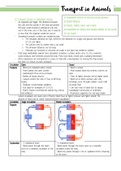
Circulation Single Circulation Double Circulation
Diagram
Explanation - 2 chambered heart - 4 chambered heart
- Blood passes through the heart - Blood passes through the heart twice on a complete
once on a complete circulation of the circulation round the body.
body. - Blood only passes through 1 set of capillaries before returning
to the heart.
, - Blood passes through the 2 sets of - Pulmonary: Right ventricle of heart à lungs à Left atrium
capillaries in a complete circuit (gills - Systemic: Left ventricle of heart à body tissues à Right
à other body tissues) before atrium
returning to heart. - Higher pressure possible in systemic circulation
- Lower pressure - Faster rate of flow of blood down pressure gradient
- Slower rate of blood flow - Faster rate of exchanges
- Generally slower rate of exchanges - Higher rate of aerobic respiration possible.
(diffusion) - Greater activity possible
- Slower metabolic rate - Most mammals have this type
- Fish have this time
- Single circulation is less effective as gills capillaries slow down the blood flows, so the body receives blood
at a low pressure. This lowers metabolic rate.
- Birds and mammals are endotherms and so maintain their core body temperature, this requires a higher
rate of respiration in order to release heat energy to maintain that temperature. They have a double
circulation because they allow for higher metabolic rates to be maintained because oxygenated and
deoxygenated blood do not mix. This means blood leaving the heart is rich in oxygen, which is essential
for the high-energy demands of birds and mammals.
8.2 Blood Vessels
Blood Vessel Components:
- Elastic fibres – these are composed of elastin and can stretch and recoil, providing vessel walls with
flexibility.
- Smooth muscle – contracts or relaxes, which changes the size of the lumen (the channel within the
blood vessel).
- Collagen – provides structural support to maintain the shape and volume of the vessel.
Arteries:
- Carry blood away from the heart at high pressure.
- Small lumen and thick walls.
- Walls contain collagen, to give strength, elastic tissue to allow the walls to stretch
and recoil when the heart pumps. This helps to even out the surges of blood
pumped from the heart to give a continuous flow.
- Smooth muscle can contract and constrict the artery, this is used to limit blood
flow to certain organs or tissues.
- Endothelium is folded and can unfold when the artery stretches.
- Arterioles link the arteries and the capillaries; they have more smooth muscle and
less elastin in their walls than arteries. They have little pulse surge but can
constrict or dilate to control the flow of blood into individual organs.
- When smooth muscle in the arteriole contracts it constricts the vessel and
prevents blood flowing into a capillary bed, this is vasoconstriction. When it relaxes,
blood flows through the capillary bed, this is vasodilation.
Veins:
- Carry blood back to the heart at low pressure.
- Deoxygenated blood flows from capillaries into very small veins called venules and then into larger veins.
- Veins do not have a pulse, the surges from the heart pumping are lost as the blood passes through the
narrow capillaries.
- Hold 60% of blood volume.
- Has valves to prevent backflow.
- Large lumen to ease the flow of blood.
8.1 Transport system in multicellular animals
8.1 Transport System in Multicellular Animals
- As organisms get bigger, the distances between 8.2 Blood Vessels
the cells and the outside of the body get greater. 8.3 Blood, tissue fluid, and lymph
Diffusion would transport substances into and
out of the inner core of the body, but it would be 8.4 transport of oxygen and carbon dioxide in the blood
so slow that the organism would not survive. 8.5 the heart
- Specialised transport systems are needed because:
o The metabolic demands are high, therefore the demands for oxygen and glucose and removal
of CO2 are higher.
o The surface area to volume ratio is too small
o The diffusion distances are too large.
o Molecules e.g., hormones or enzymes are made in one place but needed in another
- Most large multicellular animals have specialised circulatory systems which carry O2, CO2, nutrient,
waste products and hormones around the body. Most have blood, vessels and a pumping mechanism.
- When substances are transported in a mass of fluid with a mechanisms for moving the fluid around
the body it is known as mass transport.
Circulation Open Closed
Features - Blood not contained within vessels. - Blood in vessels
- Heart pumps into open cavities - Heart pumps blood into arteries, returns via
- Haemolymph flows at low pressure veins.
- Bathes all tissues directly - Flows at higher pressure and at higher speed.
- Cannot control the rate of flow to differing - Blood not in direct contact with cells,
organs. exchanges occur through capillary vessel walls
- Shallower concentration gradients via tissue fluid.
- Not used for transport of O2/CO2 - Can vary rate of blood flow to tissues
- Mainly found in invertebrate animals (e.g., insects (vasodilation/constriction of arterioles)
and molluscs) - Respiratory pigments for carrying oxygen.
- Closed circulations are much more efficient, blood flows at higher pressure and higher speeds. The
amount of blood can be varied (vasoconstriction/vasodilation).
Circulation Single Circulation Double Circulation
Diagram
Explanation - 2 chambered heart - 4 chambered heart
- Blood passes through the heart - Blood passes through the heart twice on a complete
once on a complete circulation of the circulation round the body.
body. - Blood only passes through 1 set of capillaries before returning
to the heart.
, - Blood passes through the 2 sets of - Pulmonary: Right ventricle of heart à lungs à Left atrium
capillaries in a complete circuit (gills - Systemic: Left ventricle of heart à body tissues à Right
à other body tissues) before atrium
returning to heart. - Higher pressure possible in systemic circulation
- Lower pressure - Faster rate of flow of blood down pressure gradient
- Slower rate of blood flow - Faster rate of exchanges
- Generally slower rate of exchanges - Higher rate of aerobic respiration possible.
(diffusion) - Greater activity possible
- Slower metabolic rate - Most mammals have this type
- Fish have this time
- Single circulation is less effective as gills capillaries slow down the blood flows, so the body receives blood
at a low pressure. This lowers metabolic rate.
- Birds and mammals are endotherms and so maintain their core body temperature, this requires a higher
rate of respiration in order to release heat energy to maintain that temperature. They have a double
circulation because they allow for higher metabolic rates to be maintained because oxygenated and
deoxygenated blood do not mix. This means blood leaving the heart is rich in oxygen, which is essential
for the high-energy demands of birds and mammals.
8.2 Blood Vessels
Blood Vessel Components:
- Elastic fibres – these are composed of elastin and can stretch and recoil, providing vessel walls with
flexibility.
- Smooth muscle – contracts or relaxes, which changes the size of the lumen (the channel within the
blood vessel).
- Collagen – provides structural support to maintain the shape and volume of the vessel.
Arteries:
- Carry blood away from the heart at high pressure.
- Small lumen and thick walls.
- Walls contain collagen, to give strength, elastic tissue to allow the walls to stretch
and recoil when the heart pumps. This helps to even out the surges of blood
pumped from the heart to give a continuous flow.
- Smooth muscle can contract and constrict the artery, this is used to limit blood
flow to certain organs or tissues.
- Endothelium is folded and can unfold when the artery stretches.
- Arterioles link the arteries and the capillaries; they have more smooth muscle and
less elastin in their walls than arteries. They have little pulse surge but can
constrict or dilate to control the flow of blood into individual organs.
- When smooth muscle in the arteriole contracts it constricts the vessel and
prevents blood flowing into a capillary bed, this is vasoconstriction. When it relaxes,
blood flows through the capillary bed, this is vasodilation.
Veins:
- Carry blood back to the heart at low pressure.
- Deoxygenated blood flows from capillaries into very small veins called venules and then into larger veins.
- Veins do not have a pulse, the surges from the heart pumping are lost as the blood passes through the
narrow capillaries.
- Hold 60% of blood volume.
- Has valves to prevent backflow.
- Large lumen to ease the flow of blood.