Practical Scientific Procedures & Techniques—Task 1
Luke David Farrar
Introduction
In this task, a primary standard solution (a solution used to accurately determine the
concentration of a substance) needs to be prepared with an accuracy of 80%> for use in the
titre against our secondary standard solution (a solution that has been measured against our
primary standard solution or another known solution—usually not as much confidence as our
primary standard solution) in task 2. To achieve this, a standard, or known, solution is needed
—a primary standard prepared with an accurate range of 99.95%-99.98%—so that we can be
confident in the results of our secondary standard solution.
This needs to be completed before we can confidently titrate our secondary standard
solution against an unknown solution.
What is titration?
Titration is a technique used to determine the concentration of a substance. A known
reagent is first prepared—in our case, sodium carbonate—as a titrant to determine the
concentration of our unknown solution—hydrochloric acid.
How I prepared my primary standard
solution for titration…
Preparation method
To begin with, I weighed out a small amount of
sodium carbonate—in my case, 1.322g—and placed the
NaCO into a small beaker. As I zeroed off my weight
with a beaker already placed on top of it I didn’t have to
measure the beaker separately and have to take the mass
of the beaker away from the mass of the beaker and the
sodium carbonate measured together.
Then, I added about 100cm3 of de-ionised water,
stirring the solution with a glass rod to fully dissolve it. I
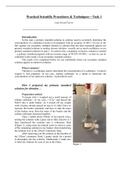
then transferred the contents into a volumetric flask
(Figure 1), using more de-ionised water to remove some
of the remaining solution in my beaker when transferring
the solution over to the 250cm3 volumetric flask.
After measuring out the solution to the baseline of
the 250cm3 volumetric flask, I gently shook for a period
to thoroughly mix the contents. Additionally, I made sure
to label my solution for ease of use in the future.
Figure 1
, Titrating our primary solution with a
secondary solution…
Standardising a secondary solution
First, we transferred a 25cm3 aliquot of sodium
carbonate solution to a 250cm3 conical flask.
For stage 1, we added a few drops of
phenolphthalein indicator solution. While
titrating, we noted the endpoint of the titration
—when the solution changed from pink to
colourless.
Then, for stage 2, added a few drops of methyl
orange. While titrating, we noted the endpoint
of the titration—when the solution changed
from yellow to red.
Stage 2—cm3 Run 1 (Test) Run 2 Run 3
Final volume 41.2 23.2 22.8
Initial volume 23.2 12.5 11.8
Titre 18 10.8 11
Mean titre 10.8 (0.0108dm3)
We then repeated the above steps three times
(not including a test run that isn’t included in
the final results) which is included below.
Stage 1—cm3 Run 1 (Test) Run 2 Run 3 Run 4
Final volume 23.2 12.5 11.8 11.1
Initial volume 0 0 0 0
Titre 23.2 12.5 11.8 11.1
Mean titre 11.8 (0.0118dm3)
Luke David Farrar
Introduction
In this task, a primary standard solution (a solution used to accurately determine the
concentration of a substance) needs to be prepared with an accuracy of 80%> for use in the
titre against our secondary standard solution (a solution that has been measured against our
primary standard solution or another known solution—usually not as much confidence as our
primary standard solution) in task 2. To achieve this, a standard, or known, solution is needed
—a primary standard prepared with an accurate range of 99.95%-99.98%—so that we can be
confident in the results of our secondary standard solution.
This needs to be completed before we can confidently titrate our secondary standard
solution against an unknown solution.
What is titration?
Titration is a technique used to determine the concentration of a substance. A known
reagent is first prepared—in our case, sodium carbonate—as a titrant to determine the
concentration of our unknown solution—hydrochloric acid.
How I prepared my primary standard
solution for titration…
Preparation method
To begin with, I weighed out a small amount of
sodium carbonate—in my case, 1.322g—and placed the
NaCO into a small beaker. As I zeroed off my weight
with a beaker already placed on top of it I didn’t have to
measure the beaker separately and have to take the mass
of the beaker away from the mass of the beaker and the
sodium carbonate measured together.
Then, I added about 100cm3 of de-ionised water,
stirring the solution with a glass rod to fully dissolve it. I
then transferred the contents into a volumetric flask
(Figure 1), using more de-ionised water to remove some
of the remaining solution in my beaker when transferring
the solution over to the 250cm3 volumetric flask.
After measuring out the solution to the baseline of
the 250cm3 volumetric flask, I gently shook for a period
to thoroughly mix the contents. Additionally, I made sure
to label my solution for ease of use in the future.
Figure 1
, Titrating our primary solution with a
secondary solution…
Standardising a secondary solution
First, we transferred a 25cm3 aliquot of sodium
carbonate solution to a 250cm3 conical flask.
For stage 1, we added a few drops of
phenolphthalein indicator solution. While
titrating, we noted the endpoint of the titration
—when the solution changed from pink to
colourless.
Then, for stage 2, added a few drops of methyl
orange. While titrating, we noted the endpoint
of the titration—when the solution changed
from yellow to red.
Stage 2—cm3 Run 1 (Test) Run 2 Run 3
Final volume 41.2 23.2 22.8
Initial volume 23.2 12.5 11.8
Titre 18 10.8 11
Mean titre 10.8 (0.0108dm3)
We then repeated the above steps three times
(not including a test run that isn’t included in
the final results) which is included below.
Stage 1—cm3 Run 1 (Test) Run 2 Run 3 Run 4
Final volume 23.2 12.5 11.8 11.1
Initial volume 0 0 0 0
Titre 23.2 12.5 11.8 11.1
Mean titre 11.8 (0.0118dm3)