Business Negotiations
Alfred Zerres
Week 1: Business transactions and organizational buying behavior
Week 2-6: Negotiation management
- 4 negotiation exercises. (Week 2-5): sometimes in a group, and sometimes alone.
Individual essay: apply the theory to real world scenarios
Group Presentation: forces you to excess the negotiation literature
Week 1
Lecture 1. 29-03-2021
Negotiation lectures and workgroups.
Central point of the course is negotiating.
Group assignment (30%):
Pick a topic and work with 3 assigned negotiation research papers.
Science clip (max 8 minutes):
- present and discuss the three assigned papers scientifically
- extract the core learnings – how do they advance negotiation theory? What do they
contribute beyond previous knowledge? How and where do they fit in the general
literature/conversations?
- which questions remain/arise after all three papers?
Executive clip (max 3 minutes):
- what concrete advice would you give practitioners on these papers?
- present your advice in an (for executives) appealing and understanding fashion.
- ability to adjust this to the audience (executives and normal people) is important part
of the grade.
Best video is picked and will be played to his main corporate partners: Philips and another
company.
,Break-out room:
- What belongs in a science clip? What is its function?
Empirical research, literature that describes certain negotiation aspects and theories that could
in certain contexts.
longer
- What belongs in a knowledge clip? What is its function?
Practical implications and specific improvements focused on a certain area or company.
More to the point, less theoretical background, and more specific about the solutions etc.
advising
Individual essay (70%):
- get in touch with one negotiation professional
- become the consultant for one negotiation that is ongoing or coming up (coming up would
be perfect)
- develop specific advice for this negotiation, based on the course content and your knowledge
of the negotiation theory
- explain precisely and based on the available theory and empirical evidence why you give
this advice. Explain it in a way, that is scientifically correct and understandable for your
client.
- report three advices in your individual essay. You can choose which ones. Pick those that
are best suited to demonstrate your understanding of the negotiation theory and your ability to
apply it to a concrete case.
Form:
- PDF
- Content:
- description negotiation situation and background (2000) (not graded)
- advice 1 (500 words, graded)
- advice 2 (500 words, graded)
- advice 3 (500 words, graded)
- References
- Appendix (transcript of interviews)
,Literature:
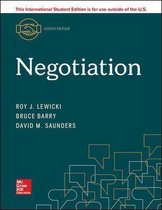
- book (Lewicki, Saunders & Barry, 2020) Negotiation, 8th international edition. New York:
McGraw-Hill education.
- 2 papers week 1
- 3 papers group assignment
Negotiation exercises:
- 4 simulations (see canvas for dates)
- negotiate with each other in Zoom
- this Friday you’ll be able to register for on out of three timeslots:
- Wednesday 9.00-11.00, 12.00-14.00, 15.00-17.00
- no need to prepare anything
- good negotiation results earn you a bonus of 0.5 on your grade.
B2B: When businesses do business with other businesses (Apple sells computers etc. to
universities and companies)
B2C: Retailers that sell to consumers (Apple, supermarkets)
Difference in type of market. B2B transaction of a consumer good.
Products that never make it to the end consumer, such as machinery that is only sold to other
businesses.
B2B markets:
- Cranes: very expensive, customer made, customized and specific. Important for a company.
, - Paper: commodity. Not much customization. Specify what type of paper you want, but that
is it. A lot of negotiation. Once it gets wet, it is destroyed, so who takes the risk.
- Mergers & Acquisitions: Microsoft LinkedIn. Facebook WhatsApp. AirFrance and
KLM going together.
B2B vs. B2C in terms of turnover: which one is bigger
B2B. because B2C costs a lot of transactions before they can sell it.
B2B has about three times more turnover (in volume and numbers)
Characteristics of B2B markets:
Alfred Zerres
Week 1: Business transactions and organizational buying behavior
Week 2-6: Negotiation management
- 4 negotiation exercises. (Week 2-5): sometimes in a group, and sometimes alone.
Individual essay: apply the theory to real world scenarios
Group Presentation: forces you to excess the negotiation literature
Week 1
Lecture 1. 29-03-2021
Negotiation lectures and workgroups.
Central point of the course is negotiating.
Group assignment (30%):
Pick a topic and work with 3 assigned negotiation research papers.
Science clip (max 8 minutes):
- present and discuss the three assigned papers scientifically
- extract the core learnings – how do they advance negotiation theory? What do they
contribute beyond previous knowledge? How and where do they fit in the general
literature/conversations?
- which questions remain/arise after all three papers?
Executive clip (max 3 minutes):
- what concrete advice would you give practitioners on these papers?
- present your advice in an (for executives) appealing and understanding fashion.
- ability to adjust this to the audience (executives and normal people) is important part
of the grade.
Best video is picked and will be played to his main corporate partners: Philips and another
company.
,Break-out room:
- What belongs in a science clip? What is its function?
Empirical research, literature that describes certain negotiation aspects and theories that could
in certain contexts.
longer
- What belongs in a knowledge clip? What is its function?
Practical implications and specific improvements focused on a certain area or company.
More to the point, less theoretical background, and more specific about the solutions etc.
advising
Individual essay (70%):
- get in touch with one negotiation professional
- become the consultant for one negotiation that is ongoing or coming up (coming up would
be perfect)
- develop specific advice for this negotiation, based on the course content and your knowledge
of the negotiation theory
- explain precisely and based on the available theory and empirical evidence why you give
this advice. Explain it in a way, that is scientifically correct and understandable for your
client.
- report three advices in your individual essay. You can choose which ones. Pick those that
are best suited to demonstrate your understanding of the negotiation theory and your ability to
apply it to a concrete case.
Form:
- Content:
- description negotiation situation and background (2000) (not graded)
- advice 1 (500 words, graded)
- advice 2 (500 words, graded)
- advice 3 (500 words, graded)
- References
- Appendix (transcript of interviews)
,Literature:
- book (Lewicki, Saunders & Barry, 2020) Negotiation, 8th international edition. New York:
McGraw-Hill education.
- 2 papers week 1
- 3 papers group assignment
Negotiation exercises:
- 4 simulations (see canvas for dates)
- negotiate with each other in Zoom
- this Friday you’ll be able to register for on out of three timeslots:
- Wednesday 9.00-11.00, 12.00-14.00, 15.00-17.00
- no need to prepare anything
- good negotiation results earn you a bonus of 0.5 on your grade.
B2B: When businesses do business with other businesses (Apple sells computers etc. to
universities and companies)
B2C: Retailers that sell to consumers (Apple, supermarkets)
Difference in type of market. B2B transaction of a consumer good.
Products that never make it to the end consumer, such as machinery that is only sold to other
businesses.
B2B markets:
- Cranes: very expensive, customer made, customized and specific. Important for a company.
, - Paper: commodity. Not much customization. Specify what type of paper you want, but that
is it. A lot of negotiation. Once it gets wet, it is destroyed, so who takes the risk.
- Mergers & Acquisitions: Microsoft LinkedIn. Facebook WhatsApp. AirFrance and
KLM going together.
B2B vs. B2C in terms of turnover: which one is bigger
B2B. because B2C costs a lot of transactions before they can sell it.
B2B has about three times more turnover (in volume and numbers)
Characteristics of B2B markets: