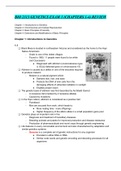
Genetics 2313 GENETICS EXAM 1 (CHAPTERS 1-4) REVIEW
BIO 2313 GENETICS EXAM 1 (CHAPTERS 1-4) REVIEW Chapter 1: Introductions to Genetics Chapter 2: Chromosomes and Cellular Reproduction Chapter 3: Basic Principles of Heredity Chapter 4: Extensions and Modifications of Basic Principles Chapter 1: Introductions to Genetics 1.1 Black Mesa is located in northeastern Arizona and considered as the home to the Hopi Native Americans - Oraibi is one of the oldest villages - Found in 1900, 11 people were found to be white (not Caucasian) ● Diagnosed with albinism (oculocutaneous type II, OCA2 defected gene on chromosome 15) Albinism is caused by a defect in one of the enzymes required to produce melanin - Melanin is a natural pigment which: ● Darkens skin, hair, and eyes ● Protects the DNA of skin cells from the damaging effects of ultraviolet radiation in sunlight ● Enables proper vision The genetic basis of albinism was first described by Archibald Garrod - A recessive trait (marked by 2 recessive alleles) - Caused by mutations In the Hopi culture, albinism is considered as a positive trait - Pureblood - Men are excused from work, which leads to: ● More mating time - more offsprings ● Higher frequency of the albino allele in a small population gene pool Genetics plays an important role in the: - Diagnosis and treatment of hereditary diseases - Breeding animals and plants for improved production and disease resistance - Production of pharmaceuticals and novel crops through genetic engineering Life features in every conceivable environment and also characterized by adaptation and similar genetics systems - Genome is a complete set of genetic instructions for any organism ● Encoded in either DNA or RNA ● Similar code words and genetic encoding and decoding processes for all organisms Evolution eventually results in diversity and adaptation - Caused by genetic changes over time The study of genetics consists of 3 traditional subdisciplines: 1. Transmission genetics (AKA classical genetics) - how genes are passed down from generation to generation ● Gene mapping and the arrangement of genes on chromosomes 2. Molecular genetics - how genetic information is encoded, replicated and expressed ● Structure, organization, and function of genes at a molecular level 3. Population genetics - genetic composition of groups and how it changes over time and space Model genetics organisms are organisms with traits that can make them particularly useful for genetics analysis, includes: - Drosophila melanogaster (fruit fly) - E.coli (bacteria) - Caenorhabditis elegans (roundworm) - Arabidopsis thaliana (plant) - Mus musculus (house mouse) - Saccharomyces cerevisiae (yeast) The model genetics organisms must have the following characteristics: - Short generation time - Large but manageable progeny - Adaptability to the lab environment - Inexpensive to be housed 1.2 People first understood genetics 10,000-12,000 years ago in the Middle East using date palms Greek first developed the idea of pangenesis, states: - Specific pieces of information travel from various parts of the body to reproductive organ, from which they are passed to the embryo ● Later confirmed INCORRECT The idea of pangenesis eventually gave rise to the idea of inheritance of acquired characteristics, proposes: - An organism can pass on acquired characteristics (such as pierced ears, ability to play the piano) during its lifetime to its offspring ● Was widely accepted at first, but later confirmed INCORRECT The invention of microscopes gave all scientists new visions, thus, the theory of preformationism postulates that: - The offspring results from a miniature adult form (called homunculus) already preformed in the sperm or egg ● Female offsprings exist in the form of eggs and male offsprings exist in the form of sperms ● Remained popular but later confirmed INCORRECT The blending inheritance theory proposes genes blend and mix (from parental traits) - For example, a blue-colored plant is crossed with a yellow-colored plant, resulting in F1 generation offspring of the green-colored plants ● Later confirmed INCORRECT Despite all the incorrect hypotheses, genetics is constantly explored by scientists such as Gregor Mendel and Nehemiah Grew by crossing plants In 1839, scientists Matthias Jacob Schleiden and Theodor Schwann proposed the cell theory, which states: 1. Living things are composed of one or more cells 2. A cell is the basic unit of life 3. All cells are produced from preexisting cells Scientist August Weismann proposed the germ-plasm theory, states: - All cells contain a complete set of genetic information ● Later confirmed CORRECT During this era, many other scientists were also trying to expand their knowledge on the study of genetics, includes: - Gregor Mendel ● Discovered the basic rules of inheritance - Watson and Crick ● Discovered the three-dimensional structure of DNA - Kary Mullis ● Developed the polymerase chain reaction, which is used to amplify small pieces of DNA Bacteria were also studied, and the first complete DNA sequence of a free-living organism - the bacterium Haemophilus influenzae was determined 1.3 A difference between prokaryotic and eukaryotic cells is that prokaryotic cells are more simple - no nuclear membrane and eukaryotic cells have a nucleus and membrane-bound organelles Gene is the fundamental unit of heredity - Comes in allelic form and confer genotypes Genetic information is carried in DNA and RNA - For DNA, there are four nitrogenous bases: adenine (A), thymine (T), cytosine (C), and guanine (G) ● For RNA, instead of thymine, uracil (U) is substituted Genes are located on chromosomes Replicated chromosomes separate through mitosis (body cells) and meiosis (sex cell) Genetic information is stored in DNA, transcribed into RNA then protein chain Mutations are changes in genes that can be passed down Many traits are affected by multiple factors Chapter 2: Chromosomes and Cellular Reproduction 2.1 Major differences between prokaryotes and eukaryotes: Characteristics Prokaryotic Eukaryotic Nucleus NO YES Membrane-bound organelles NO YES Shape of DNA Circular, naked DNA Linear Ribosomes YES, very small YES Cell wall composition Peptidoglycan present NO Peptidoglycan Size Smaller Larger Number of cells Unicellular Multicellular Prokaryotes are unicellular organisms that do not have nuclei Eukaryotes are organisms whose cells contain their genetic material inside a nucleus - Includes all life other than viruses, archaea, and bacteria Prokaryotes are usually divided into two domains: - Bacteria ● True bacteria or eubacteria - Archae ● Ancient bacteria However, some researches show that bacteria are closely related to eukaryotes even though they are classified as prokaryotes The basic similarities and differences between bacteria, archaea, and eukaryotes can be summarized in the following table: Prokaryotes Eukaryotes Bacteria Archaea Internal cell structure Simple (no internal membranes, nuclear membrane, and specific organelles) Complex (many cell organelles) Cell size Small (0.5–5 µm) Large (10–100 µm) Cell wall Peptidoglycan present to form a mesh-like layer outside the plasma membrane No Peptidoglycan Yes & No, chitin or cellulose Chromosome Circular chromosome in nucleoid region, smaller circular plasmids Multiple-Linear Transcription and Translation Simple More complex Reproduction Binary fission (identical offspring - no genetic variations) Meiosis and sexual reproduction (genetic variations) Multicellular Unicellular, some colonies Uni & multicellular Nucleus, nuclear envelope, histone (proteins that tightly packed chromosomes) - wrapped chromatin (all present in eukaryotes) are all keys to differentiate between prokaryotes and eukaryotes Viruses are not classified as prokaryotes or eukaryotes because they don't possess cellular structures, but they: - Are composed of an outer protein coat surrounding nucleic acid - Reproduce only when the host is present Viruses are often studied in genetics because of their small genome size and simplicity 2.2 There are three requirements for a cell to reproduce successfully: 1. All genetic information must be coped 2. The copies of the genetic information must be separated from each other 3. Cell must divide Prokaryotes divide through binary fission: - Cell replicates and divides - Replication starts at the origin of replication after a protein is binded to anchor the chromosomes to the opposite ends - Divides every 20 mins Eukaryotic production requires DNA replication, copy separation, and division of the cytoplasm - The nuclear matrix in the nucleus consists of ● A network of fibers that works in gene product modification before leaving the nucleus, expression of genes and DNA replication - Karyotype is a standard arrangement of the chromosome complement prepared for chromosome analysis - Humans have 46 chromosomes (23 pairs of homologous chromosomes that are usually alike in structure and size and each carries genetic information for the same set of hereditary characteristics) ● Each chromosome pair consists of two chromosomes, one from dad and one from mom - Cells that carry 2 sets of genetic information are diploid (2n) ● Single set: haploid (n), only present in sex cells ● More than 2 sets: polyploid DNA molecules are highly folded and condensed in a form of chromosomes - DNA molecules are coiled around histone proteins and tightly packed - Not visible until condensed - A functional eukaryotic chromosome should have the following structural elements: ● Centromere: the point of attachment of the kinetochore, a structure to which the microtubules of the mitotic spindle become anchored ● Telomeres: a region of repetitive nucleotide sequences at each end of a chromosome, which protects the end of the chromosome from deterioration or from fusion with neighboring chromosomes ● Origins of replication: serve as the starting place for DNA synthesis Based on the position of the centromere, eukaryotic chromosomes are divided into 4 major types: 1. Submetacentric ● Centromere off-center, leading to shorter arm relative to longer arm 2. Metacentric ● Centromere is in middle (remember the prefix “meta”), meaning the two arms are of comparable length 3. Telocentric ● Centromere found at end of chromosome, meaning no shorter arm exists ● Usually not found in human chromosomes 4. Acrocentric ● Centromere severely off-set from center, leading to much shorter arm The cell cycle is the series of events leading to its division and duplication of its DNA (DNA replication) to produce two identical daughter cells, includes interphase and M phase The interphase is divided into 3 phases: - G1: The cell grows, accumulates building blocks (proteins) of chromosomal DNA and energy to proceed to S phase ● G1/S checkpoint holds all the cell until all enzymes are synthesized ● Possible to go back to G0 phase, a nondividing cell phase ● Usually takes 10 hours ● 4 DNA molecules → 4 DNA molecules - S: Synthesis of DNA, results in the formation of identical pairs of DNA molecules called sister chromatids, also centrosomes (main microtubule-nucleating organelle, gives rise to mitotic spindles) are being replicated, later associated with centrioles (not present in plant cells) ● 4 DNA molecules → 8 DNA molecules - G2: Cell organelles are duplicated, and the cytoskeleton is dismantled to provide resources for the mitotic phase ● G2/M checkpoint passed if all DNA are replicated and good

Geschreven voor
- Instelling
- BIO 2313
- Vak
- BIO 2313
Documentinformatie
- Geüpload op
- 5 mei 2021
- Aantal pagina's
- 23
- Geschreven in
- 2020/2021
- Type
- Tentamen (uitwerkingen)
- Bevat
- Vragen en antwoorden
Onderwerpen
-
oculocutaneous type ii
-
genome
-
transmission genetics
-
pangenesis
-
theory of preformationism
-
germ plasm theory
-
kary mullis
-
ancient bacteria

Ook beschikbaar in voordeelbundel