Social Influence
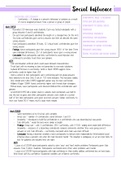
Conformity: Ash’s Research
Conformity: Asch’s research
- Conformity ~ A change in a person’s behaviour or opinions as a result
of real or imagined pressure from a person or group of people. types and explanations
Conformity to social roles
Asch (1951)
- Recruited 123 American male students. Each was tested individually with a Obedience
group between 6 and 8 confederates. situational variables
- On each trial participants identified the length of a standard line. On the first
few trials confederates gave correct answers but then all selected the same situational explanations
wrong answers. dispositional explanation
- Each participant completed 18 trials, 12 ‘critical trials’ confederates gave the
wrong answer. Resistance to social influence
- Findings: Naïve participants gave the wrong answer 36.8% of the time. There Minority influence
were individual differences, 25% of participants never gave a wrong answer.
Social influence and social change
- Concluded: Most participants said they conformed to avoid rejection and
continued to privately trust their own opinions.
AO3:
- Task and situation artificial which could cause demand characteristics
- Trivial task with no meaning so does not generalise to everyday situations.
- Cultural differences in conformity. Smith & Bond (1998) suggest China
conformity would be higher than USA.
+ Used a control to test participants were conforming and not giving answers
they believed to be true. Only 3 out of 720 were mistakes. This increases validity.
- Only tested men. Neto (1995) suggested women may be more conformist.
- Williams &Sogon (1984) found conformity higher with friends than strangers.
- Ethical issues, naïve participants were deceived. Believed the confederates were
genuine.
+ Crutchfield (1955) did a similar study in cubicles; each participant was told he
was the last to guess and other participants answers were visible on a screen.
Half of the time participants were given incorrect answers. Similar conformity to
Asch was found (30%). Makes Asch’s study more reliable.
Asch (1955)
- Same experiment as his first but with variables.
- Group size ~ number of confederates varied between 1 and 15.
- Unanimity ~ introduced a truthful confederate or a confederate who was dissenting but inaccurate.
- Task difficulty ~ made the lines more similar in length.
- Findings: Group size ~ with 2 confederates 13.6% conformity, with 3 31.8% adding more made little difference.
Unanimity ~ presence of a dissenting confederate reduced conformity whether they were giving correct
answers or not. Task difficulty ~ conformity increased when task was more difficult.
- Concluded: Having a dissenter enabled a naïve participants to behave more independently. Informational social
influence plays a greater role when the task becomes harder. The situation is ambiguous, so we are more likely to
look for guidance and assume they are right.
AO3:
+ Lucas et al. (2006) asked participants asked to solve ‘easy’ and ‘hard’ maths problems. Participants given fake
answers from 3 other ‘students’. Participants conformed more often when problems were harder.
- Lucas et al. (2006) found participants with high confidence in their maths abilities conformed less on hard tasks
than those with low confidence. Situational variables can influence conformity.
, Conformity: Types and explanations
- There are 3 types of conformity:
o Internalisation ~ when a person genuinely accepts group norms. It results in a private as well as
public change of behaviour.
o Identification ~ when we identify with a group that we value, we want to become part of it so
publicly changes views/behaviour, even without privately agreeing.
o Compliance ~ ‘going along with others’ on public but not privately, not changing opinions, only a
superficial change.
- Explanations for conformity:
1. Informational Social Influence
o Motivated by a desire to be correct, it is a cognitive process – to do with how you think.
o We conform because we are looking to others who we believe are right. We want to take
guidance from them.
o This is particularly the case if the situation is new or confusing or there is perceived expertise.
AO3:
+ Lucas et al. (2006) found more participants conformed to incorrect answers when the
maths problems were difficult. This was most true for students who rated their maths ability
as poor. This supports ISI.
- Individual differences, Asch (1955) found students were less conformist 28% than other
participants 37%. Perrin & Spencer (1980) also found less conformity in students. People who
are knowledgeable or confident are less influenced by ISI.
2. Normative Social Influence
o Motivated by a desire to be accepted.
o It is an emotional process – likely to occur in situations with strangers where you may feel
concerned about rejection.
o Norms regulate the behaviour of groups and individuals, so it is not surprising that we pay
attention to them.
AO3:
+ Asch (1951) asked participants why they agreed with the wrong answer. Some said they felt
self-conscious about giving the right answer and were afraid of disapproval. When participants
were asked to write answers down, conformity rates fell to 12.5%.
- nAffiliators – people who have a greater need for social relationships. McGhee & Teevan
(1967) found students who were nAffiliators were more likely to conform. The desire to be
liked underlies conformity for some people more than others.
AO3:
- It is sometimes unclear whether NSI or ISI is acting. They probably operate together in most real-life
scenarios.
Conformity: Ash’s Research
Conformity: Asch’s research
- Conformity ~ A change in a person’s behaviour or opinions as a result
of real or imagined pressure from a person or group of people. types and explanations
Conformity to social roles
Asch (1951)
- Recruited 123 American male students. Each was tested individually with a Obedience
group between 6 and 8 confederates. situational variables
- On each trial participants identified the length of a standard line. On the first
few trials confederates gave correct answers but then all selected the same situational explanations
wrong answers. dispositional explanation
- Each participant completed 18 trials, 12 ‘critical trials’ confederates gave the
wrong answer. Resistance to social influence
- Findings: Naïve participants gave the wrong answer 36.8% of the time. There Minority influence
were individual differences, 25% of participants never gave a wrong answer.
Social influence and social change
- Concluded: Most participants said they conformed to avoid rejection and
continued to privately trust their own opinions.
AO3:
- Task and situation artificial which could cause demand characteristics
- Trivial task with no meaning so does not generalise to everyday situations.
- Cultural differences in conformity. Smith & Bond (1998) suggest China
conformity would be higher than USA.
+ Used a control to test participants were conforming and not giving answers
they believed to be true. Only 3 out of 720 were mistakes. This increases validity.
- Only tested men. Neto (1995) suggested women may be more conformist.
- Williams &Sogon (1984) found conformity higher with friends than strangers.
- Ethical issues, naïve participants were deceived. Believed the confederates were
genuine.
+ Crutchfield (1955) did a similar study in cubicles; each participant was told he
was the last to guess and other participants answers were visible on a screen.
Half of the time participants were given incorrect answers. Similar conformity to
Asch was found (30%). Makes Asch’s study more reliable.
Asch (1955)
- Same experiment as his first but with variables.
- Group size ~ number of confederates varied between 1 and 15.
- Unanimity ~ introduced a truthful confederate or a confederate who was dissenting but inaccurate.
- Task difficulty ~ made the lines more similar in length.
- Findings: Group size ~ with 2 confederates 13.6% conformity, with 3 31.8% adding more made little difference.
Unanimity ~ presence of a dissenting confederate reduced conformity whether they were giving correct
answers or not. Task difficulty ~ conformity increased when task was more difficult.
- Concluded: Having a dissenter enabled a naïve participants to behave more independently. Informational social
influence plays a greater role when the task becomes harder. The situation is ambiguous, so we are more likely to
look for guidance and assume they are right.
AO3:
+ Lucas et al. (2006) asked participants asked to solve ‘easy’ and ‘hard’ maths problems. Participants given fake
answers from 3 other ‘students’. Participants conformed more often when problems were harder.
- Lucas et al. (2006) found participants with high confidence in their maths abilities conformed less on hard tasks
than those with low confidence. Situational variables can influence conformity.
, Conformity: Types and explanations
- There are 3 types of conformity:
o Internalisation ~ when a person genuinely accepts group norms. It results in a private as well as
public change of behaviour.
o Identification ~ when we identify with a group that we value, we want to become part of it so
publicly changes views/behaviour, even without privately agreeing.
o Compliance ~ ‘going along with others’ on public but not privately, not changing opinions, only a
superficial change.
- Explanations for conformity:
1. Informational Social Influence
o Motivated by a desire to be correct, it is a cognitive process – to do with how you think.
o We conform because we are looking to others who we believe are right. We want to take
guidance from them.
o This is particularly the case if the situation is new or confusing or there is perceived expertise.
AO3:
+ Lucas et al. (2006) found more participants conformed to incorrect answers when the
maths problems were difficult. This was most true for students who rated their maths ability
as poor. This supports ISI.
- Individual differences, Asch (1955) found students were less conformist 28% than other
participants 37%. Perrin & Spencer (1980) also found less conformity in students. People who
are knowledgeable or confident are less influenced by ISI.
2. Normative Social Influence
o Motivated by a desire to be accepted.
o It is an emotional process – likely to occur in situations with strangers where you may feel
concerned about rejection.
o Norms regulate the behaviour of groups and individuals, so it is not surprising that we pay
attention to them.
AO3:
+ Asch (1951) asked participants why they agreed with the wrong answer. Some said they felt
self-conscious about giving the right answer and were afraid of disapproval. When participants
were asked to write answers down, conformity rates fell to 12.5%.
- nAffiliators – people who have a greater need for social relationships. McGhee & Teevan
(1967) found students who were nAffiliators were more likely to conform. The desire to be
liked underlies conformity for some people more than others.
AO3:
- It is sometimes unclear whether NSI or ISI is acting. They probably operate together in most real-life
scenarios.