

Chapter 1
Defining Six Sigma
Lean Thinking focuses on enhancing value for the customer by improving and smoothing the process
flow.
- Lean was started since Henry Ford’s 1st production line
- Most developed by Toyota
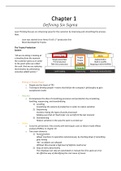
The Toyota Production
System
“All we are doing is looking at
a timeline from the moment
the customer gives us an order
to the point when we collect
the cash. And we are reducing
that timeline by eliminating
nonvalue-added wastes.”
- Picking on People Power
o People are the heart of TPS
o Training to develop people + teams that follow the company’s philosophy to gain
exceptional results
- Heijunka
o Encompasses the idea of smoothing processes and production by considering
levelling, sequencing, and standardizing
1) Levelling
Smoothing the volume of production in order to reduce variation
2) Sequencing
Involves mixing the types of works processed
Making sure that all ‘hard tasks’ are not left till the last moment
3) Standardizing
Reduce variation in the way the work is carried out
- Jidoka
o Concerns prevention: links closely with techniques such as failure mode effects
analysis (FMEA), in chapter 10
o Two main elements
1) Autonomation
Allows machines to operation autonomously, by shutting down if something
goes wrong
‘No’: no defects are allowed
Without this concept a high level of defects could occur
2) Stop at every abnormality
The employee can stop an automated or manual line if he spots an error
An effective way of identifying the root cause of issues
, - Just in Time
o Provide the customer with what’s needed, at the right time, in the right location,
and in the right quantity
o Applies to both internal and external customers
1) Single piece flow
Each person performs an operation and makes a quick quality check before
moving his output to the next person in the following processes
Defect detected -> Jidoka
2) Pull production
Each process takes only what it needs from the preceding process only when
it needs it and in the exact quantity
Reduces the need for potentially costly storage space
Prevents overproduction
3) Takt Time
Tells you how quickly to action things, given the volume of customer demand
Takt = German for precise interval of time
Taking the strain out of constraints
- The late Eliyah Goldratt’s theory of constraints
1) Identify the constraints
2) Exploit the constraint
3) Subordinate the other steps to the constraint
4) Elevate the constraint
5) Go back to step 1 and repeat the process
Lean thinking: 5 key principles
1) Understanding the customer and his perception of value
2) Identify and understand the value stream for each process and the waste within it
3) Enable the value flow
4) Let the customer pull the value through the process, according to his needs
5) Continuously pursue perfection (continuous improvement)
Sussing six sigma
- Jake Welch, former General Electric CEO, when he introduced six sigma:
“We are going to shift the paradigm from fixing products to fixing and developing processes,
so they produce nothing but perfection or close to it”
Considering the core of six sigma
- Sigma = standard deviation (σ)
- Critical to Quality (CTQs) = express the customer requirements in in a way that is measurable
o Provide the basis for your process management set
- Many organisations use averages as a convenient way of making their performance sound
better than it is
- Sigma calculation:
,Calculating process six sigma values
- Provides a way of comparing different processes’ performance, helping to prioritise projects
- Sigma values are often expressed as defects per million opportunities (DPMO)
- Sigma scores
- If you make an error, bur correct it before the order goes to the customer, you still count the
defect, as the rework costs you time and effort
o Unit: the item produced or processed
o Defect: any event that does not meet the specifications of a CTQ
o Defect opportunity: any event that provides a chance of not meeting a customer
CTQ. The number of defect opportunities will equal the number of CTQs.
o Defective: a unit with one or more defects
Six sigma: 5 key principles
1) Understand the CTQs of your customers and stakeholders
2) Understand your organisation’s processes and ensure they reflect your customer’s CTQs
3) Manage by fact and reduce variation
4) Involve and equip the people in the process
5) Undertake improvement activity in a systematic way
, Chapter 2
Understanding the Principles of Lean Six Sigma
7 key principles of lean six sigma
- Focus on the customer
- Identify and understand how the work gets done
- Manage, improve and smooth the process flow
- Remove non-value-adding steps and waste
- Manage by fact and reduce variation
- Involve and equip the people in the process
- Undertake improvement activity in a systematic way
Improving existing processes: DMAIC
- Defining your project
o Understand why you’re undertaking the project and what
you want to achieve
o Before you can solve a problem, you need to define it
o An output of the define phase is an improvement charter:
This is an agreed document defining the purpose and goals
for an improvement tea
o If your project is large and complex, an affinity diagram
prepares you for success
o Affinity and interrelationships diagrams provide definition for
your project and help the team understand what’s involved.
o Affinity diagram:
o Interrelationship diagram identifies the key
causal factors or drivers for your programme or
project, by enabling you to understand the
relationships between the themes or clusters.
o After identifying the causal factors, it should be presented in a graph like so:
Defining Six Sigma
Lean Thinking focuses on enhancing value for the customer by improving and smoothing the process
flow.
- Lean was started since Henry Ford’s 1st production line
- Most developed by Toyota
The Toyota Production
System
“All we are doing is looking at
a timeline from the moment
the customer gives us an order
to the point when we collect
the cash. And we are reducing
that timeline by eliminating
nonvalue-added wastes.”
- Picking on People Power
o People are the heart of TPS
o Training to develop people + teams that follow the company’s philosophy to gain
exceptional results
- Heijunka
o Encompasses the idea of smoothing processes and production by considering
levelling, sequencing, and standardizing
1) Levelling
Smoothing the volume of production in order to reduce variation
2) Sequencing
Involves mixing the types of works processed
Making sure that all ‘hard tasks’ are not left till the last moment
3) Standardizing
Reduce variation in the way the work is carried out
- Jidoka
o Concerns prevention: links closely with techniques such as failure mode effects
analysis (FMEA), in chapter 10
o Two main elements
1) Autonomation
Allows machines to operation autonomously, by shutting down if something
goes wrong
‘No’: no defects are allowed
Without this concept a high level of defects could occur
2) Stop at every abnormality
The employee can stop an automated or manual line if he spots an error
An effective way of identifying the root cause of issues
, - Just in Time
o Provide the customer with what’s needed, at the right time, in the right location,
and in the right quantity
o Applies to both internal and external customers
1) Single piece flow
Each person performs an operation and makes a quick quality check before
moving his output to the next person in the following processes
Defect detected -> Jidoka
2) Pull production
Each process takes only what it needs from the preceding process only when
it needs it and in the exact quantity
Reduces the need for potentially costly storage space
Prevents overproduction
3) Takt Time
Tells you how quickly to action things, given the volume of customer demand
Takt = German for precise interval of time
Taking the strain out of constraints
- The late Eliyah Goldratt’s theory of constraints
1) Identify the constraints
2) Exploit the constraint
3) Subordinate the other steps to the constraint
4) Elevate the constraint
5) Go back to step 1 and repeat the process
Lean thinking: 5 key principles
1) Understanding the customer and his perception of value
2) Identify and understand the value stream for each process and the waste within it
3) Enable the value flow
4) Let the customer pull the value through the process, according to his needs
5) Continuously pursue perfection (continuous improvement)
Sussing six sigma
- Jake Welch, former General Electric CEO, when he introduced six sigma:
“We are going to shift the paradigm from fixing products to fixing and developing processes,
so they produce nothing but perfection or close to it”
Considering the core of six sigma
- Sigma = standard deviation (σ)
- Critical to Quality (CTQs) = express the customer requirements in in a way that is measurable
o Provide the basis for your process management set
- Many organisations use averages as a convenient way of making their performance sound
better than it is
- Sigma calculation:
,Calculating process six sigma values
- Provides a way of comparing different processes’ performance, helping to prioritise projects
- Sigma values are often expressed as defects per million opportunities (DPMO)
- Sigma scores
- If you make an error, bur correct it before the order goes to the customer, you still count the
defect, as the rework costs you time and effort
o Unit: the item produced or processed
o Defect: any event that does not meet the specifications of a CTQ
o Defect opportunity: any event that provides a chance of not meeting a customer
CTQ. The number of defect opportunities will equal the number of CTQs.
o Defective: a unit with one or more defects
Six sigma: 5 key principles
1) Understand the CTQs of your customers and stakeholders
2) Understand your organisation’s processes and ensure they reflect your customer’s CTQs
3) Manage by fact and reduce variation
4) Involve and equip the people in the process
5) Undertake improvement activity in a systematic way
, Chapter 2
Understanding the Principles of Lean Six Sigma
7 key principles of lean six sigma
- Focus on the customer
- Identify and understand how the work gets done
- Manage, improve and smooth the process flow
- Remove non-value-adding steps and waste
- Manage by fact and reduce variation
- Involve and equip the people in the process
- Undertake improvement activity in a systematic way
Improving existing processes: DMAIC
- Defining your project
o Understand why you’re undertaking the project and what
you want to achieve
o Before you can solve a problem, you need to define it
o An output of the define phase is an improvement charter:
This is an agreed document defining the purpose and goals
for an improvement tea
o If your project is large and complex, an affinity diagram
prepares you for success
o Affinity and interrelationships diagrams provide definition for
your project and help the team understand what’s involved.
o Affinity diagram:
o Interrelationship diagram identifies the key
causal factors or drivers for your programme or
project, by enabling you to understand the
relationships between the themes or clusters.
o After identifying the causal factors, it should be presented in a graph like so:



