Problem 6 2.6
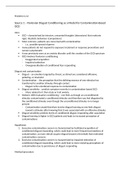
Source 1 – Pavlovian Disgust Conditioning as a Model for Contamination-Based
OCD
Intro
OCD –characterised by intrusive, unwanted thoughts (obsessions) that motivate
rigid, ritualistic behaviour (compulsions)
Most common- patients are concerned with contamination
- i.e., possible spread of germs
many patients do not respond to exposure treatment or response preventions and
remain symptomatic
it was previously seen as an anxiety disorder until the creation of the OCD spectrum
OCD involves Pavlovian conditioning
- Exaggerated acquisition
- Impaired extinction
- Overgeneralisation of conditioned fear responding
Disgust and contamination
Disgust – an emotion targeted by threat, as stimuli are considered offensive,
polluting, or shameful
Contamination – the perception that the defining essence of one stimulus has
transferred to another stimulus through contact
- Disgust is the emotional response to contamination
Disgust sensitivity – predicts symptom severity in contamination-based OCD
- More related to it than state or trait anxiety
Hedonic shift/evaluative conditioning – one feels as though an unconditioned
stimulus contaminated a conditioned stimulus and therefore you feel disgusted by
the conditioned stimulus even though the unconditioned stimulus is no longer
present
- Contamination would therefore involve disgust learning as one feels disgust
toward a stimulus after knowing that it was associated with an offensive stimulus
Disgust sensitivity predicts levels of conditioned disgust responding after acquisition
Disgust learning is higher in OCD patients and leads to increased perception of
contaminations
Hypotheses
1. Excessive contamination concern is characterised by facilitated acquisition of
conditioned disgust responding, which could lead to more frequent perceptions of
contamination, as more stimuli acquire disgust beyond a threshold that motivated
contamination concerns
2. Excessive contamination concern is characterised by impaired extinction of
conditioned disgust responding, which could lead to more enduring perceptions of
contamination due to persistence of disgust responding
Method/procedure
, Subjects had to rate scenarios in terms of disgustingness 0-4 and a contamination
concern score was found
The conditioned stimulus consisted of two neutral male faces (counterbalanced)
- The unconditioned stimulus consisted of 8 disgusting images (faeces, vomit,
rotting food etc.)
1. Habituation – ppt viewed 8 unreinforced presentations
2. Acquisition – the conditioned stimuli were presented and immediately after the
unconditioned stimulus was presented
3. Extinction – the acquisition procedure was repeated, but without the US
presentation
End – ppt rated how disgusted the CS made them feel and how much they expected
the US to follow the CS
- After the acquisition task, ppt rated how disgusted the US made them feel
Discussion/Findings
The high contamination group and low contamination group did not differ in
acquisition of conditioned disgust responding
- Did differ in conditioned disgust responding following the extinction procedure
- Did not differ in US expectancy after extinction
HC group’s US expectancy during the CS+ was resistant to extinction compared to
the LC group
- HC showed a smaller reduction in US expectancy to the CS+ from acquisition to
extinction
- Represents differences in cognitive processes between both groups
HC reported higher levels of self-reported disgust to the CS+ after extinction
compared to the LC
- Shows differences in affective processes between the groups
Disgust sensitivity was strongly correlated with self-reported disgust to the CS+ at
acquisition and extinction
- Group differences in self-reported disgust to the CS+ at acquisition and extinction
were mediated by disgust sensitivity
Some evidence that the cognitive and affective processes were related as the
reduced extinction of the CS-US contingency by the HC group partially accounted for
their elevated disgust towards the CS+ at extinction
Many of the symptoms of contamination-based OCS can be seen as a failure to
unlearn disgust responding due to associative learning
- As there were no group differences in disgust acquisition, it is suggested that
concerns about hygiene and the spread of contamination are normative
OCD may be shown in difficulty inhibiting conditioned disgust responding, rather
than the facility to acquire it
- The equal acquisition in both groups can reflect that conditioned fear responding
is adaptive and therefore shown in all individuals
- However, acquisition of disgust under unambiguous circumstances may be a
source of impairment in contamination-based OCD
Suggests that disgust sensitivity could contribute to contamination-based OCD by
causing stronger, longer lasting conditioned disgust responses
Source 1 – Pavlovian Disgust Conditioning as a Model for Contamination-Based
OCD
Intro
OCD –characterised by intrusive, unwanted thoughts (obsessions) that motivate
rigid, ritualistic behaviour (compulsions)
Most common- patients are concerned with contamination
- i.e., possible spread of germs
many patients do not respond to exposure treatment or response preventions and
remain symptomatic
it was previously seen as an anxiety disorder until the creation of the OCD spectrum
OCD involves Pavlovian conditioning
- Exaggerated acquisition
- Impaired extinction
- Overgeneralisation of conditioned fear responding
Disgust and contamination
Disgust – an emotion targeted by threat, as stimuli are considered offensive,
polluting, or shameful
Contamination – the perception that the defining essence of one stimulus has
transferred to another stimulus through contact
- Disgust is the emotional response to contamination
Disgust sensitivity – predicts symptom severity in contamination-based OCD
- More related to it than state or trait anxiety
Hedonic shift/evaluative conditioning – one feels as though an unconditioned
stimulus contaminated a conditioned stimulus and therefore you feel disgusted by
the conditioned stimulus even though the unconditioned stimulus is no longer
present
- Contamination would therefore involve disgust learning as one feels disgust
toward a stimulus after knowing that it was associated with an offensive stimulus
Disgust sensitivity predicts levels of conditioned disgust responding after acquisition
Disgust learning is higher in OCD patients and leads to increased perception of
contaminations
Hypotheses
1. Excessive contamination concern is characterised by facilitated acquisition of
conditioned disgust responding, which could lead to more frequent perceptions of
contamination, as more stimuli acquire disgust beyond a threshold that motivated
contamination concerns
2. Excessive contamination concern is characterised by impaired extinction of
conditioned disgust responding, which could lead to more enduring perceptions of
contamination due to persistence of disgust responding
Method/procedure
, Subjects had to rate scenarios in terms of disgustingness 0-4 and a contamination
concern score was found
The conditioned stimulus consisted of two neutral male faces (counterbalanced)
- The unconditioned stimulus consisted of 8 disgusting images (faeces, vomit,
rotting food etc.)
1. Habituation – ppt viewed 8 unreinforced presentations
2. Acquisition – the conditioned stimuli were presented and immediately after the
unconditioned stimulus was presented
3. Extinction – the acquisition procedure was repeated, but without the US
presentation
End – ppt rated how disgusted the CS made them feel and how much they expected
the US to follow the CS
- After the acquisition task, ppt rated how disgusted the US made them feel
Discussion/Findings
The high contamination group and low contamination group did not differ in
acquisition of conditioned disgust responding
- Did differ in conditioned disgust responding following the extinction procedure
- Did not differ in US expectancy after extinction
HC group’s US expectancy during the CS+ was resistant to extinction compared to
the LC group
- HC showed a smaller reduction in US expectancy to the CS+ from acquisition to
extinction
- Represents differences in cognitive processes between both groups
HC reported higher levels of self-reported disgust to the CS+ after extinction
compared to the LC
- Shows differences in affective processes between the groups
Disgust sensitivity was strongly correlated with self-reported disgust to the CS+ at
acquisition and extinction
- Group differences in self-reported disgust to the CS+ at acquisition and extinction
were mediated by disgust sensitivity
Some evidence that the cognitive and affective processes were related as the
reduced extinction of the CS-US contingency by the HC group partially accounted for
their elevated disgust towards the CS+ at extinction
Many of the symptoms of contamination-based OCS can be seen as a failure to
unlearn disgust responding due to associative learning
- As there were no group differences in disgust acquisition, it is suggested that
concerns about hygiene and the spread of contamination are normative
OCD may be shown in difficulty inhibiting conditioned disgust responding, rather
than the facility to acquire it
- The equal acquisition in both groups can reflect that conditioned fear responding
is adaptive and therefore shown in all individuals
- However, acquisition of disgust under unambiguous circumstances may be a
source of impairment in contamination-based OCD
Suggests that disgust sensitivity could contribute to contamination-based OCD by
causing stronger, longer lasting conditioned disgust responses