Problem 3 2.4
perception and decision making
psychophysics
Psychophysics – name given to the study of the relationship between the physical
stimuli in the world and the sensations that we experience
3 problems to solve in order to describe the relationship between the mind and body
1. detection- finding a way to measure the minimum intensity of a stimulus that we can
perceive
2. discrimination – devising a way to measure how different stimuli must be before
they no longer appear to be the same
3. scaling – finding a way to describe the intensity of the stimulus and the intensity of
our sensation
detection
our sensory systems are responsive to energy changes in the environment
- these changes can take the form of electromagnetic (light), mechanical (sound,
touch, movement, muscle tension), chemical (tastes, smells), or thermal (heat,
cold) stimulation
problem of detection – problem of how much of an
energy change, starting from 0, is necessary for a sensory
system to register its presents
- e.g. for an individual to see or hear
- absolute threshold – minimal amount of energy
change from 0
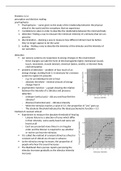
psychometric function – a graph showing the relation
between the intensity of a stimulus and presence
detection
- ordinate (vertical axis) – did you see/hear/feel the
stimulus?
- Abscissa (horizontal axis) – stimulus intensity
- When the stimulus reaches a value of 3.5, the proportion of “yes” goes up
- The absolute threshold indicated by this ideal psychometric function = 3.5
Method of constant stimuli
Experiment to measure the absolute threshold of hearing
- Listener listens to a selection of tones which differ
in their intensity, some easily heard and some not
heard at all
- Each are presented many times in an irregular
order and the listener is required to say whether
or not he can hear the stimulus
It is called the method of constant stimuli as a fixed or
constant set of stimuli are chosen in advance
As the stimulus energy increases, the proportion of
people who hear the sound increases
The likelihood that a person reports perceiving the
stimulus increases gradually as the stimulus intensity
increases
, Usually, would define the absolute threshold as the stimulus intensity that observers
detect 50% of the time i.e. probability of “yes” = probability of “no”
◊ Time consuming – many trials must be presented at each intensity level
Method of limits (Emil Kraepelin)
Present observer with stimulus (e.g. a tone) at an intensity high enough to be easily
heard and then decrease intensity in small steps until observer claims it is no longer
heard (descending series)
On alternate trials this is reversed so the observer first receives a tone that cannot
be heard and increases it until it can be heard (ascending series)
Assumed that the response changes when the threshold is crossed
- each series gives an estimate of the absolute threshold as an intensity
somewhere between the last two stimuli
find that the absolute threshold is not fixed
- sometimes in a descending series the observer can no longer detect the stimulus
at a tone of 50, but in the next descending order it would be only 43
- descending series yield lower thresholds than the ascending series
- Lapses of attention, slight fatigue, and other psychological changes could cause
fluctuation of the threshold
A constantly present and ever-changing background of sensation exists no matter
what stimulus we present to the observer
- if you block your ears with your hands you will hear something that sounds like a
distant sea
- if you sit in a room that is completely dark, the official field will be filled with a
greyish mist called “cortical grey”
- these endogenous or internally generated noises vary in intensity from moment
to moment
- as this noise level changes, so does our measured threshold
- the higher the noise intensity, the higher intensity a threshold sound must be to
be detected against it
- Some experiment is have introduced experimentally controlled background noise
caused by external stimuli other than they want to be detected
adaptive testing
Adaptive testing – adapting the sequence of stimulus presentations to the observer’s
responses, essentially keeping the stimuli “hovering around” the threshold
Staircase method
- May start with a descending series and each time the
observer says he can hear the stimulus; you decrease
the intensity by one step
- When the observer gets to the point where he can’t
hear it, the intensity is again increased by one step
- Continue with this for however long is necessary and
thus the threshold is more accurate
Signal detection theory
Catch trials – no stimulus is presented
- Accurate observers would always respond “no”
whereas others would guess and were cautioned
against guessing
perception and decision making
psychophysics
Psychophysics – name given to the study of the relationship between the physical
stimuli in the world and the sensations that we experience
3 problems to solve in order to describe the relationship between the mind and body
1. detection- finding a way to measure the minimum intensity of a stimulus that we can
perceive
2. discrimination – devising a way to measure how different stimuli must be before
they no longer appear to be the same
3. scaling – finding a way to describe the intensity of the stimulus and the intensity of
our sensation
detection
our sensory systems are responsive to energy changes in the environment
- these changes can take the form of electromagnetic (light), mechanical (sound,
touch, movement, muscle tension), chemical (tastes, smells), or thermal (heat,
cold) stimulation
problem of detection – problem of how much of an
energy change, starting from 0, is necessary for a sensory
system to register its presents
- e.g. for an individual to see or hear
- absolute threshold – minimal amount of energy
change from 0
psychometric function – a graph showing the relation
between the intensity of a stimulus and presence
detection
- ordinate (vertical axis) – did you see/hear/feel the
stimulus?
- Abscissa (horizontal axis) – stimulus intensity
- When the stimulus reaches a value of 3.5, the proportion of “yes” goes up
- The absolute threshold indicated by this ideal psychometric function = 3.5
Method of constant stimuli
Experiment to measure the absolute threshold of hearing
- Listener listens to a selection of tones which differ
in their intensity, some easily heard and some not
heard at all
- Each are presented many times in an irregular
order and the listener is required to say whether
or not he can hear the stimulus
It is called the method of constant stimuli as a fixed or
constant set of stimuli are chosen in advance
As the stimulus energy increases, the proportion of
people who hear the sound increases
The likelihood that a person reports perceiving the
stimulus increases gradually as the stimulus intensity
increases
, Usually, would define the absolute threshold as the stimulus intensity that observers
detect 50% of the time i.e. probability of “yes” = probability of “no”
◊ Time consuming – many trials must be presented at each intensity level
Method of limits (Emil Kraepelin)
Present observer with stimulus (e.g. a tone) at an intensity high enough to be easily
heard and then decrease intensity in small steps until observer claims it is no longer
heard (descending series)
On alternate trials this is reversed so the observer first receives a tone that cannot
be heard and increases it until it can be heard (ascending series)
Assumed that the response changes when the threshold is crossed
- each series gives an estimate of the absolute threshold as an intensity
somewhere between the last two stimuli
find that the absolute threshold is not fixed
- sometimes in a descending series the observer can no longer detect the stimulus
at a tone of 50, but in the next descending order it would be only 43
- descending series yield lower thresholds than the ascending series
- Lapses of attention, slight fatigue, and other psychological changes could cause
fluctuation of the threshold
A constantly present and ever-changing background of sensation exists no matter
what stimulus we present to the observer
- if you block your ears with your hands you will hear something that sounds like a
distant sea
- if you sit in a room that is completely dark, the official field will be filled with a
greyish mist called “cortical grey”
- these endogenous or internally generated noises vary in intensity from moment
to moment
- as this noise level changes, so does our measured threshold
- the higher the noise intensity, the higher intensity a threshold sound must be to
be detected against it
- Some experiment is have introduced experimentally controlled background noise
caused by external stimuli other than they want to be detected
adaptive testing
Adaptive testing – adapting the sequence of stimulus presentations to the observer’s
responses, essentially keeping the stimuli “hovering around” the threshold
Staircase method
- May start with a descending series and each time the
observer says he can hear the stimulus; you decrease
the intensity by one step
- When the observer gets to the point where he can’t
hear it, the intensity is again increased by one step
- Continue with this for however long is necessary and
thus the threshold is more accurate
Signal detection theory
Catch trials – no stimulus is presented
- Accurate observers would always respond “no”
whereas others would guess and were cautioned
against guessing