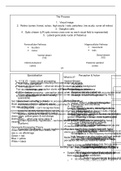
The Process
1. Visual image
2. Retina (cones: foveal, colour, high acuity / rods: periphery, low acuity, cover all retina)
3. Ganglion cells
4. Optic chiasm (L/R optic nerves cross over so each visual field is represented)
5. Lateral geniculate nuclei of thalamus
Parvocellular Pathway Magnocellular Pathway
location movement
cones rods
Ventral stream Dorsal stream
[V4] [V5]
Inferio-temporal Posterior parietal
cortex cortex
V1
Specialisation Perception & Action
What is it?
V1 & V2 – basic visual processing Ventral Stream
Perception – experiences
V3 – form perception resulting from stimulation of senses
Perception
Perceptual Organisation – what we should focusonAllocentric
V4 – colour vs what’s background
Top-up o processing – perception starts withFace
Achromatopsia Processing
knowledge & expectations
Conscious awareness
Bottom-down
V5 – motionprocessing – perception starts when Representations
receptors sustained
are stimulated, we accumulate detail
Faces carry info
Akinetopsia
o big
to build about social environment
picture. (motion visually) so we
are good
Damage: at holistically
visual form processing
agnosia them
(pareidolia)
Not Specialised – binding
Face inversion effectproblem Dorsal
– harder to process when Stream
upside down
Action Pattern &Gesalt’s
Object Recognition
Principles
Brain combines info from different areas
Part-whole effect – easier to identify part when it is presented with the whole
into one unitary store – can’t recognise faces Egocentric
Prosopagnosia Feature Figure/Ground
Theory – identity – divide
stimulifigure
by features
from
Not conscious
Easier to identify familiar faces, we process structural information
background that
Short lived representations doesn’t really change
Trichromacy
Neurons – cones specialised
sensitive to identityforand
colour
expression –Spatial atFrequency face– some cells respond to high
look happyoptic
Damage: and
ataxia then neutral, neutral looks
vision: blue, yellow-green & red-orange. spatial frequency
Proximity whereas
– things close
some together
to low spatial
are
sad
Dichromacy – when one cone class is frequency.
missingDomain Specificity Hypothesis – we have neural ✗not areasgrouped
distinct – they interconnect
responsible (V1) faces
for processing
(fusiform) Low = Magnoceullar
✗” movement info to ventral stream pathway
High
✗interactions Similarity
= Parvocellular
not – similar features
described pathwayseen as one
Opponent-Processing Theory
When Expertise
we move Hypothesis
our eyes from – neural
colour,markers
we ✗unclear
develop as a double
result ofdissociations
our experiences with optic
between faces
Good Continuation
Application:
ataxia and visual form agnosia Mona – assume
Lisa’s image is on
smile
see a –ve afterimage Smileobject
obvious in low frequency but foveal is in
Green = red high frequency so she smiles until you look at
Blue = yellow Muller Lyer Illusion – illusions
Multimodal use vision-for-
Closure
her lips
perception but we use in/ignore gaps inEffects
Crossmodal
Effects
– fillvision-for-action image
White = black
Marr’s Computational Interpreting
Theorydata through one
Binding input from Recognition-by-component
1+ sensory
sensory modality
modality
Primal sketch – light-intensity Theory
(e.g.changes
driving) in
input
Spatial An
2rule:½D object consists
integration
sketch more
– depth of&likely
geons (totalsourced
when
orientation 36)
of
from same 1. Edge
location
surfaces extraction
3d model 2. Detect
rep – non-accidental
object’s shape features
& position & in
fix
Temporal regions
rule: integration
observer’s of concavity
viewpointmore likely when
,
1. Visual image
2. Retina (cones: foveal, colour, high acuity / rods: periphery, low acuity, cover all retina)
3. Ganglion cells
4. Optic chiasm (L/R optic nerves cross over so each visual field is represented)
5. Lateral geniculate nuclei of thalamus
Parvocellular Pathway Magnocellular Pathway
location movement
cones rods
Ventral stream Dorsal stream
[V4] [V5]
Inferio-temporal Posterior parietal
cortex cortex
V1
Specialisation Perception & Action
What is it?
V1 & V2 – basic visual processing Ventral Stream
Perception – experiences
V3 – form perception resulting from stimulation of senses
Perception
Perceptual Organisation – what we should focusonAllocentric
V4 – colour vs what’s background
Top-up o processing – perception starts withFace
Achromatopsia Processing
knowledge & expectations
Conscious awareness
Bottom-down
V5 – motionprocessing – perception starts when Representations
receptors sustained
are stimulated, we accumulate detail
Faces carry info
Akinetopsia
o big
to build about social environment
picture. (motion visually) so we
are good
Damage: at holistically
visual form processing
agnosia them
(pareidolia)
Not Specialised – binding
Face inversion effectproblem Dorsal
– harder to process when Stream
upside down
Action Pattern &Gesalt’s
Object Recognition
Principles
Brain combines info from different areas
Part-whole effect – easier to identify part when it is presented with the whole
into one unitary store – can’t recognise faces Egocentric
Prosopagnosia Feature Figure/Ground
Theory – identity – divide
stimulifigure
by features
from
Not conscious
Easier to identify familiar faces, we process structural information
background that
Short lived representations doesn’t really change
Trichromacy
Neurons – cones specialised
sensitive to identityforand
colour
expression –Spatial atFrequency face– some cells respond to high
look happyoptic
Damage: and
ataxia then neutral, neutral looks
vision: blue, yellow-green & red-orange. spatial frequency
Proximity whereas
– things close
some together
to low spatial
are
sad
Dichromacy – when one cone class is frequency.
missingDomain Specificity Hypothesis – we have neural ✗not areasgrouped
distinct – they interconnect
responsible (V1) faces
for processing
(fusiform) Low = Magnoceullar
✗” movement info to ventral stream pathway
High
✗interactions Similarity
= Parvocellular
not – similar features
described pathwayseen as one
Opponent-Processing Theory
When Expertise
we move Hypothesis
our eyes from – neural
colour,markers
we ✗unclear
develop as a double
result ofdissociations
our experiences with optic
between faces
Good Continuation
Application:
ataxia and visual form agnosia Mona – assume
Lisa’s image is on
smile
see a –ve afterimage Smileobject
obvious in low frequency but foveal is in
Green = red high frequency so she smiles until you look at
Blue = yellow Muller Lyer Illusion – illusions
Multimodal use vision-for-
Closure
her lips
perception but we use in/ignore gaps inEffects
Crossmodal
Effects
– fillvision-for-action image
White = black
Marr’s Computational Interpreting
Theorydata through one
Binding input from Recognition-by-component
1+ sensory
sensory modality
modality
Primal sketch – light-intensity Theory
(e.g.changes
driving) in
input
Spatial An
2rule:½D object consists
integration
sketch more
– depth of&likely
geons (totalsourced
when
orientation 36)
of
from same 1. Edge
location
surfaces extraction
3d model 2. Detect
rep – non-accidental
object’s shape features
& position & in
fix
Temporal regions
rule: integration
observer’s of concavity
viewpointmore likely when
,