JUDICIAL REVIEW FULL NOTES
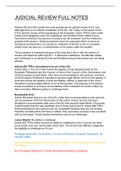
Articles 263 and 265 contain the main procedures for judicial review of EU Law.
Although there is no official constitution of the EU, the Treaty on European Union
(TEU) and the Treaty of the functioning of the European Union (TFEU) both confer
powers and obligations upon EU institutions, and therefore there needs to be a
mechanism whereby the exercise of powers can be reviewed, and the institutions
properly held account. These procedures have two purposes either to annul an
improperly enacted law or to compel an institution of the EU to act in a situation
where it has not done so, in contravention of its duties under the treaties.
This procedure is important because of the way that it fits in with the system of
checks and balances within the EU – it allows the institutions, the Member states
and individuals to scrutinise EU law and therefore ensure that powers are not being
abused.
Article 263 TFEU: annulment of an act of the EU:
Article 263(1): The COJ shall review the legality of Acts adopted jointly by the
European Parliament and the Council, of Acts of the Council, of the Commission and
of the European Central Bank, other than recommendations and opinions, and Acts
of the European Parliament intended to produce legal effects vis-à-vis third parties. It
shall also review the legality of Acts and Bodies, offices or agencies of the Union
intended to produce legal effects vis-à-vis third parties. The purpose of the judicial
review procedure is to ensure accountability of the institutions for actions taken by
them and allow different parties to challenge them.
Reviewable Acts:
Article 263 states that any act of the EU, other than recommendations and opinions,
can be reviewed. With the introduction of the Lisbon Treaty, the law has been
changed to accommodate other acts of the Eu that produce legal effects. Previously
it was thought that this was restricted only to those Acts found in Article 288 TFEU.
Recommendations and opinions are not reviewable because they are not binding,
therefore annulling them will have no effect. Only secondary sources of law are dealt
with by this treaty, Treaty articles themselves cannot be challenged.
Locus Standi: the ability to challenge:
Article 263 TFEU: there must be an ability to challenge an Act. If you do not have
locus standi, then you cannot take action here. There are three different categories
for eligibility to challenge an EU act:
Privileged applicants: Commission, Council of Ministers, European Parliament, all
member states
Semi-privileged applicants: European Central Bank, Court of Auditors, Committee of
the Regions
Non-Privileged Applicants: Private individuals (including companies)
, Privileged applicants:
Article 263(2) TFEU: Those in this category are deemed to have a general interest in
EU acts, and can therefore challenge any reviewable act. The fact that these parties
will have taken part in some way in passing these legislations, does not disqualify
them. This point was made in Italy v EC Council.
Semi-privileged applicants:
Article 263(3) TFEU: The Court of Auditors and the European Central Bank have
always been able to challenge an EU act if the law in question affects or changes
one of their powers. Now the committee of the Regions is also able to exercise this
power. The purpose of giving this group the ability to challenge Acts of the EU is to
allow them to protect themselves and their powers. Therefore, any action they bring
has to be because the Act in question has changed or challenged their powers in
some way. They therefore are not able to use this power in a general way.
Non-Privileged Applicants:
Article 263(4): Private persons and companies are classed as ‘non-privileged’
because they have to prove that they should be entitled to challenge an EU act. The
article allows an individual to challenge an act where:
• It concerns an Act or addressed to the person
• It concerns an Act addressed to another person which is of direct and
individual concern to the applicant or
• It concerns a regulatory act, which is of direct concern to the applicant and
which does not entail implementing measures.
The previous system under former Article 230 was very strict, and heavily restricted
the type of EU act which could be challenged. The new post-Lisbon system is
broader mainly because of the use of ‘act’ instead of ‘decision’ in the wording of
Article 263 - this opens up the possibilities of a wide range of EU acts being
challengeable.
Article 263(4): appears to have widened the scope of judicial review by an individual
of ‘regulatory act which is of direct concern to them and which does not entail
implementing measures.’ This would appear to remove the need for an applicant to
demonstrate individual concern and therefore avoids the difficulties applicants face
with establishing that a measure affects them in some unique way as per Plaumann.
Thus, where a regulatory act produces a legal effect Article 263 TFEU would appear
to grant locus standi.
The Right to challenge an act:
To see how the new system has liberalised judicial review by individuals, it is
necessary to examine the old system. This restricted individuals to challenge only
those acts equivalent to a decision. For example, in the International Fruit
Company case, it was held that if a regulation could be regarded as equivalent to a
decision (and therefore applied like one) then it could be challenged, but ordinarily
regulations have general application, and so cannot be challenged by an individual.
This is because it is very difficult to establish individual concern in a situation where
a regulation applies to everyone equally. Therefore, the CJEU would have to be
convinced that the regulation was merely a ‘disguised decision’ in order for that
person to show they were ‘individually concerned.”
Articles 263 and 265 contain the main procedures for judicial review of EU Law.
Although there is no official constitution of the EU, the Treaty on European Union
(TEU) and the Treaty of the functioning of the European Union (TFEU) both confer
powers and obligations upon EU institutions, and therefore there needs to be a
mechanism whereby the exercise of powers can be reviewed, and the institutions
properly held account. These procedures have two purposes either to annul an
improperly enacted law or to compel an institution of the EU to act in a situation
where it has not done so, in contravention of its duties under the treaties.
This procedure is important because of the way that it fits in with the system of
checks and balances within the EU – it allows the institutions, the Member states
and individuals to scrutinise EU law and therefore ensure that powers are not being
abused.
Article 263 TFEU: annulment of an act of the EU:
Article 263(1): The COJ shall review the legality of Acts adopted jointly by the
European Parliament and the Council, of Acts of the Council, of the Commission and
of the European Central Bank, other than recommendations and opinions, and Acts
of the European Parliament intended to produce legal effects vis-à-vis third parties. It
shall also review the legality of Acts and Bodies, offices or agencies of the Union
intended to produce legal effects vis-à-vis third parties. The purpose of the judicial
review procedure is to ensure accountability of the institutions for actions taken by
them and allow different parties to challenge them.
Reviewable Acts:
Article 263 states that any act of the EU, other than recommendations and opinions,
can be reviewed. With the introduction of the Lisbon Treaty, the law has been
changed to accommodate other acts of the Eu that produce legal effects. Previously
it was thought that this was restricted only to those Acts found in Article 288 TFEU.
Recommendations and opinions are not reviewable because they are not binding,
therefore annulling them will have no effect. Only secondary sources of law are dealt
with by this treaty, Treaty articles themselves cannot be challenged.
Locus Standi: the ability to challenge:
Article 263 TFEU: there must be an ability to challenge an Act. If you do not have
locus standi, then you cannot take action here. There are three different categories
for eligibility to challenge an EU act:
Privileged applicants: Commission, Council of Ministers, European Parliament, all
member states
Semi-privileged applicants: European Central Bank, Court of Auditors, Committee of
the Regions
Non-Privileged Applicants: Private individuals (including companies)
, Privileged applicants:
Article 263(2) TFEU: Those in this category are deemed to have a general interest in
EU acts, and can therefore challenge any reviewable act. The fact that these parties
will have taken part in some way in passing these legislations, does not disqualify
them. This point was made in Italy v EC Council.
Semi-privileged applicants:
Article 263(3) TFEU: The Court of Auditors and the European Central Bank have
always been able to challenge an EU act if the law in question affects or changes
one of their powers. Now the committee of the Regions is also able to exercise this
power. The purpose of giving this group the ability to challenge Acts of the EU is to
allow them to protect themselves and their powers. Therefore, any action they bring
has to be because the Act in question has changed or challenged their powers in
some way. They therefore are not able to use this power in a general way.
Non-Privileged Applicants:
Article 263(4): Private persons and companies are classed as ‘non-privileged’
because they have to prove that they should be entitled to challenge an EU act. The
article allows an individual to challenge an act where:
• It concerns an Act or addressed to the person
• It concerns an Act addressed to another person which is of direct and
individual concern to the applicant or
• It concerns a regulatory act, which is of direct concern to the applicant and
which does not entail implementing measures.
The previous system under former Article 230 was very strict, and heavily restricted
the type of EU act which could be challenged. The new post-Lisbon system is
broader mainly because of the use of ‘act’ instead of ‘decision’ in the wording of
Article 263 - this opens up the possibilities of a wide range of EU acts being
challengeable.
Article 263(4): appears to have widened the scope of judicial review by an individual
of ‘regulatory act which is of direct concern to them and which does not entail
implementing measures.’ This would appear to remove the need for an applicant to
demonstrate individual concern and therefore avoids the difficulties applicants face
with establishing that a measure affects them in some unique way as per Plaumann.
Thus, where a regulatory act produces a legal effect Article 263 TFEU would appear
to grant locus standi.
The Right to challenge an act:
To see how the new system has liberalised judicial review by individuals, it is
necessary to examine the old system. This restricted individuals to challenge only
those acts equivalent to a decision. For example, in the International Fruit
Company case, it was held that if a regulation could be regarded as equivalent to a
decision (and therefore applied like one) then it could be challenged, but ordinarily
regulations have general application, and so cannot be challenged by an individual.
This is because it is very difficult to establish individual concern in a situation where
a regulation applies to everyone equally. Therefore, the CJEU would have to be
convinced that the regulation was merely a ‘disguised decision’ in order for that
person to show they were ‘individually concerned.”