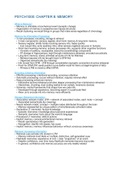
PSYCH1000: CHAPTER 8: MEMORY
What Is Memory?
• Memory is ultimately a biochemical event (synaptic change)
• Organization of memory is subjective (we impose structure)
• Recall clustering: we recall things in groups that make sense regardless of chronology
Memory As Information Processing
• 3 main processes: encoding, storage & retrieval
• 3 main components: sensory register, short-term memory & long-term memory
• Sensory register: briefly holds incoming sensory info, fades quickly
• Icon (visual info), echo (auditory info), other sensory registers are poor in humans
• Short-term/working memory: actively processes info, supports other cognitive functions
• Consists of auditory, visuospatial, executive (coordinating) components
• ST storage in hippocampus, kept through maintenance rehearsal, encoded acoustically
• Long-term memory: stores unlimited amounts of info for lifetimes
• Retrieval requires info be brought back to STM first
• Organized semantically (by meaning)
• Info moved from STM - LTM through consolidation (synaptic connection) & active rehearsal
• Proof for STM/LTM: serial position curve (better recall for items at beginning/end of lists)
• Primacy (LTM) vs recency effect (STM)
Encoding: Entering Information
• Effortful processing: intentional encoding, conscious attention
• Automatic processing: occurs without intention, requires minimal effort
• Deep processing enhances memory
• Elaborative (active) rehearsal promotes deeper processing than maintenance rehearsal
• Hierarchies, chunking, dual-coding (verbal & non-verbal), mnemonic devices
• Schemas: mental frameworks that shape how we code info
• Developed through experience, becoming expert in a particular field
• Allow us to encode info into memory more efficiently
Storage: Retaining Information
• Associative network model: LTM = network of associated nodes, each node = concept
• Associated semantically (by meaning)
• Neural network model: concept = multiple nodes distributed throughout the brain
• Memory represented by unique pattern of simultaneously activated nodes
• Declarative LT memories: factual knowledge
• Episodic memories: knowledge about personal experiences
• Semantic memories: facts about the world & language
• Procedural LT memories: skills & actions
• Explicit memory: conscious/intentional memory retrieval
• Recall: spontaneous info generation
• Recognition: identify info (easier, has cues)
• Implicit memory: memory influences behaviour without conscious awareness
Retrieval: Accessing Information
• Retrieval cues activate info stored in LTM
• Memory retrieval most likely w/ multiple, distinctive, self-generated cues
• Flashbulb memories: experience of vivd + clear “snapshots” of an event
• Despite confidence, over time many flashbulb memories become inaccurate
• In general, confidence and memory accuracy are only weakly related
What Is Memory?
• Memory is ultimately a biochemical event (synaptic change)
• Organization of memory is subjective (we impose structure)
• Recall clustering: we recall things in groups that make sense regardless of chronology
Memory As Information Processing
• 3 main processes: encoding, storage & retrieval
• 3 main components: sensory register, short-term memory & long-term memory
• Sensory register: briefly holds incoming sensory info, fades quickly
• Icon (visual info), echo (auditory info), other sensory registers are poor in humans
• Short-term/working memory: actively processes info, supports other cognitive functions
• Consists of auditory, visuospatial, executive (coordinating) components
• ST storage in hippocampus, kept through maintenance rehearsal, encoded acoustically
• Long-term memory: stores unlimited amounts of info for lifetimes
• Retrieval requires info be brought back to STM first
• Organized semantically (by meaning)
• Info moved from STM - LTM through consolidation (synaptic connection) & active rehearsal
• Proof for STM/LTM: serial position curve (better recall for items at beginning/end of lists)
• Primacy (LTM) vs recency effect (STM)
Encoding: Entering Information
• Effortful processing: intentional encoding, conscious attention
• Automatic processing: occurs without intention, requires minimal effort
• Deep processing enhances memory
• Elaborative (active) rehearsal promotes deeper processing than maintenance rehearsal
• Hierarchies, chunking, dual-coding (verbal & non-verbal), mnemonic devices
• Schemas: mental frameworks that shape how we code info
• Developed through experience, becoming expert in a particular field
• Allow us to encode info into memory more efficiently
Storage: Retaining Information
• Associative network model: LTM = network of associated nodes, each node = concept
• Associated semantically (by meaning)
• Neural network model: concept = multiple nodes distributed throughout the brain
• Memory represented by unique pattern of simultaneously activated nodes
• Declarative LT memories: factual knowledge
• Episodic memories: knowledge about personal experiences
• Semantic memories: facts about the world & language
• Procedural LT memories: skills & actions
• Explicit memory: conscious/intentional memory retrieval
• Recall: spontaneous info generation
• Recognition: identify info (easier, has cues)
• Implicit memory: memory influences behaviour without conscious awareness
Retrieval: Accessing Information
• Retrieval cues activate info stored in LTM
• Memory retrieval most likely w/ multiple, distinctive, self-generated cues
• Flashbulb memories: experience of vivd + clear “snapshots” of an event
• Despite confidence, over time many flashbulb memories become inaccurate
• In general, confidence and memory accuracy are only weakly related