

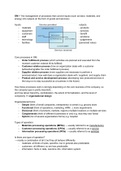
OM = “the management of processes that convert inputs (such as labor, materials, and
energy) into outputs (in the form of goods and services)
Inputs: outputs:
- materials - products
- equipment - services
- customers - benefit
- staff - emotions
- technology - judgements
- facilities (perceived value)
Core processes in OM:
- Order fulfillment process (which activities are planned and executed from the
moment customer ordered till its fulfilled)
- Customer relation process (how an organization deals with a customer
before/during/after the order fulfillment process)
- Supplier relation process (more suppliers are necessary to perform a
service/product, how well does a organization deals with ´suppliers` and supply chain
- Product and service development process (developing new products/services in
the long run to stay successful as a business in the future)
How these processes work is strongly depending on the core business of the company, so
the company type is pretty important…
and how about hierarchy, centralization, the extent of formalization, and the level of
complexity ⇒ organizational design
Organizational forms
- Simple (think of small companies, entrepreneur is owner) e.g. grocery store
- Functional (think of operations, marketing, HRM…) more departments
- Divisional (think of products, markets, regions) multiple locations or multiple services
- Conglomerate (think of different businesses in one) e.g. ikea they own forest
- Hybrid (mix of several organizations forms) e.g. hospital
Types of operation:
- Materials processing operations (MPOs) → usually referred to as manufacturing
- Customer processing operations (CPOs) → usually referred to as a service
- Information processing operations (IPOs) → usually referred to as services
Is there one type of operation?
→ mostly a combination of all 3 but they all behave differently
- materials: all kinds of sizes, specifics, but in general also predictable
- customers: all different, so are less predictable
- information: facts or data, real-time info, information system
,Differences between CPOs (services) and MPOs (manufacturing)
- Intangibility (directly experienced, no tangible proof)
- Heterogeneity (variability in services experiences)
- Perishability (services cannot be stored)
- Simultaneity (or inseparability) customer is intertwined in the process
Operations diagnosis: 4/5 V´s
- Volume of output (scale, how many customers, how many products)
e.g. Coca-Cola
- Variety of products or services offered (size of product range, number of services)
e.g. Cinema
- Variation in demand (demand changing over time, per day, per season)
e.g. restaurant
- Variability (customization possibility) e.g. VIP airport assistance
- Visibility (to what extent can the customer see the experience or be part of it)
Operations management as a system:
OM = what flows through
↪
understanding relationship
between customers,
information, production and
transformational input
, Servuction system → can help you to “process” your customers and offer a service
experience
Servuction system = service + production
community session 2:
Order qualify factors (OQ´s) are characteristics of a product/service that are required for
them even to be considered by a customer
Order winning factors (OW´s) are those characteristics which directly contribute to winning
business from customers (e.g. speed of delivery, flexibility, etc.)
How to compare OQ´s and OW´s: 5 internal performance objectives
- cost
- quality
- dependability
- flexibility
- speed
competing on cost
- value-added
- selling price
- running cost
- manufacturing cost
- service cost
competing on quality
- features - perceived quality
- performance - serviceability
- technical durability - conformance
- aesthetics - consistency
- value for money
- perceived quality
- serviceability
energy) into outputs (in the form of goods and services)
Inputs: outputs:
- materials - products
- equipment - services
- customers - benefit
- staff - emotions
- technology - judgements
- facilities (perceived value)
Core processes in OM:
- Order fulfillment process (which activities are planned and executed from the
moment customer ordered till its fulfilled)
- Customer relation process (how an organization deals with a customer
before/during/after the order fulfillment process)
- Supplier relation process (more suppliers are necessary to perform a
service/product, how well does a organization deals with ´suppliers` and supply chain
- Product and service development process (developing new products/services in
the long run to stay successful as a business in the future)
How these processes work is strongly depending on the core business of the company, so
the company type is pretty important…
and how about hierarchy, centralization, the extent of formalization, and the level of
complexity ⇒ organizational design
Organizational forms
- Simple (think of small companies, entrepreneur is owner) e.g. grocery store
- Functional (think of operations, marketing, HRM…) more departments
- Divisional (think of products, markets, regions) multiple locations or multiple services
- Conglomerate (think of different businesses in one) e.g. ikea they own forest
- Hybrid (mix of several organizations forms) e.g. hospital
Types of operation:
- Materials processing operations (MPOs) → usually referred to as manufacturing
- Customer processing operations (CPOs) → usually referred to as a service
- Information processing operations (IPOs) → usually referred to as services
Is there one type of operation?
→ mostly a combination of all 3 but they all behave differently
- materials: all kinds of sizes, specifics, but in general also predictable
- customers: all different, so are less predictable
- information: facts or data, real-time info, information system
,Differences between CPOs (services) and MPOs (manufacturing)
- Intangibility (directly experienced, no tangible proof)
- Heterogeneity (variability in services experiences)
- Perishability (services cannot be stored)
- Simultaneity (or inseparability) customer is intertwined in the process
Operations diagnosis: 4/5 V´s
- Volume of output (scale, how many customers, how many products)
e.g. Coca-Cola
- Variety of products or services offered (size of product range, number of services)
e.g. Cinema
- Variation in demand (demand changing over time, per day, per season)
e.g. restaurant
- Variability (customization possibility) e.g. VIP airport assistance
- Visibility (to what extent can the customer see the experience or be part of it)
Operations management as a system:
OM = what flows through
↪
understanding relationship
between customers,
information, production and
transformational input
, Servuction system → can help you to “process” your customers and offer a service
experience
Servuction system = service + production
community session 2:
Order qualify factors (OQ´s) are characteristics of a product/service that are required for
them even to be considered by a customer
Order winning factors (OW´s) are those characteristics which directly contribute to winning
business from customers (e.g. speed of delivery, flexibility, etc.)
How to compare OQ´s and OW´s: 5 internal performance objectives
- cost
- quality
- dependability
- flexibility
- speed
competing on cost
- value-added
- selling price
- running cost
- manufacturing cost
- service cost
competing on quality
- features - perceived quality
- performance - serviceability
- technical durability - conformance
- aesthetics - consistency
- value for money
- perceived quality
- serviceability



