Chapter 4 notes
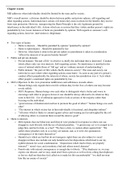
Mill addresses when individuality should be limited by the state and by society.
Mill’s overall answer: a division should be drawn between public and private spheres, self-regarding and
other regarding actions. Individuals have certain civil duties they must in return for the benefits they receive
from state protection. However, transgressing the Harm Principle is the only legitimate ground for
interference in the individual’s life. Actions which are so serious that they violate another person’s rights are
punishable by law; lesser instances of harm are punishable by opinion. With regards to someone’s self-
regarding actions, however, intervention is illegitimate.
• Two types of harms:
o Harm to interests - Should be punished by opinion “punished by opinion”
o Harm to rights/injures – Should be punished by law
o However, when harm is done in the private sphere no punishment is taken in consideration.
“affects the interests of no person besides himself”
▪ Public and private domains
o Private domain: The part of life ‘in which it is chiefly the individual that is interested’. Conduct
which affects only our own interests. Self-regarding actions. No interference is justified in the
cases of rational adults (those of ‘full age’ and an ‘ordinary amount of understanding’).
o Public domain: “the part (of life) which chiefly interests society”. The state and society can
intervene in cases where other-regarding actions cause harm: ‘As soon as any part of a person’s
conduct affects prejudicially the interests of others, society has jurisdiction over it.’Acts which
affect people’s constituted rights are punishable by law.
• Mill’s Objection: Is this view promotion indifference and selfishness towards others.
o Human beings only regards their own life without duty for the lives of others one may become
overly selfish.
o Mill’s Response: Human beings own each other to distinguish what is better and worse to
encourage each other to progress however one should be always allowed to do whatever they
want in their life. Use of utilitarian approach to look at actions of the majority rather than
focusing on the individual.
o “great increase of disinterested exertion to promote the good of others” “human beings owe each
other”
o “The interest in which society has in him individually is fractional, and altogether indirect”
o “All errors which is likely to commit against advice and warning are far outweighed by the evil
of allowing others to constrain them toward the deem is good”
• Harm to interests
o Mill explains that one behaviour and lifestyle were produced in response in others one can
disapprove such lifestyle with the use of natural penalties. “A person may act so to compel us to
judge him, and feel to him, as a fool” “We have a duty, to caution others against him” “He
suffers these penalties only in so as they are natural, and, as it were, the spontaneous
consequences of the faults themselves”
o Harmful acts which are bad but do not transgress rights there are also subject to social
disapproval these also include not only harmful acts but dispositions which lead to our my
rightful domain for social condemnation. “dispositions which lead to them, are properly
immoral” “ moral vices, and constitute a bad and odious moral character”
o Punish only with natural consequences is enough due to liberty . “If he displeases us, we may
express our distaste, and we may stand aloof from a person as well as from a thing that displeases
us but we shall not therefore feel called on to make his life uncomfortable” “we shall not treat
him like an enemy of society”
Mill addresses when individuality should be limited by the state and by society.
Mill’s overall answer: a division should be drawn between public and private spheres, self-regarding and
other regarding actions. Individuals have certain civil duties they must in return for the benefits they receive
from state protection. However, transgressing the Harm Principle is the only legitimate ground for
interference in the individual’s life. Actions which are so serious that they violate another person’s rights are
punishable by law; lesser instances of harm are punishable by opinion. With regards to someone’s self-
regarding actions, however, intervention is illegitimate.
• Two types of harms:
o Harm to interests - Should be punished by opinion “punished by opinion”
o Harm to rights/injures – Should be punished by law
o However, when harm is done in the private sphere no punishment is taken in consideration.
“affects the interests of no person besides himself”
▪ Public and private domains
o Private domain: The part of life ‘in which it is chiefly the individual that is interested’. Conduct
which affects only our own interests. Self-regarding actions. No interference is justified in the
cases of rational adults (those of ‘full age’ and an ‘ordinary amount of understanding’).
o Public domain: “the part (of life) which chiefly interests society”. The state and society can
intervene in cases where other-regarding actions cause harm: ‘As soon as any part of a person’s
conduct affects prejudicially the interests of others, society has jurisdiction over it.’Acts which
affect people’s constituted rights are punishable by law.
• Mill’s Objection: Is this view promotion indifference and selfishness towards others.
o Human beings only regards their own life without duty for the lives of others one may become
overly selfish.
o Mill’s Response: Human beings own each other to distinguish what is better and worse to
encourage each other to progress however one should be always allowed to do whatever they
want in their life. Use of utilitarian approach to look at actions of the majority rather than
focusing on the individual.
o “great increase of disinterested exertion to promote the good of others” “human beings owe each
other”
o “The interest in which society has in him individually is fractional, and altogether indirect”
o “All errors which is likely to commit against advice and warning are far outweighed by the evil
of allowing others to constrain them toward the deem is good”
• Harm to interests
o Mill explains that one behaviour and lifestyle were produced in response in others one can
disapprove such lifestyle with the use of natural penalties. “A person may act so to compel us to
judge him, and feel to him, as a fool” “We have a duty, to caution others against him” “He
suffers these penalties only in so as they are natural, and, as it were, the spontaneous
consequences of the faults themselves”
o Harmful acts which are bad but do not transgress rights there are also subject to social
disapproval these also include not only harmful acts but dispositions which lead to our my
rightful domain for social condemnation. “dispositions which lead to them, are properly
immoral” “ moral vices, and constitute a bad and odious moral character”
o Punish only with natural consequences is enough due to liberty . “If he displeases us, we may
express our distaste, and we may stand aloof from a person as well as from a thing that displeases
us but we shall not therefore feel called on to make his life uncomfortable” “we shall not treat
him like an enemy of society”