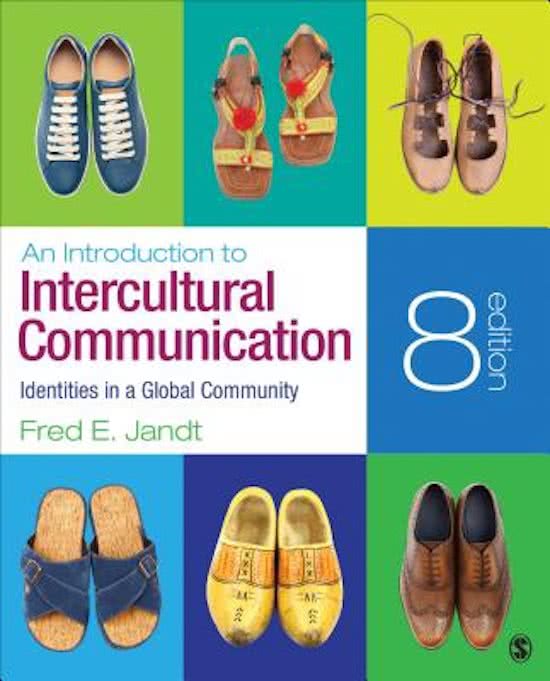
INTERCULTURAL COMMUNICATION SUMMARY AND CONCEPTS
Chapter 1 key terms
Channel = refers to the means by which the encoded message is transmitted. Aka. Media.
Co-culture = alternative for subculture. Was suggested to convey the idea that no one culture is
inherently superior to other coexisting cultures.
Communication = the means by which people interact, exchange feelings, information, thoughts,
ideas, norms and values. Two critical functions: the means by which individuals learn appropriate
behaviours and the means by which those behaviours are regulated & the means by which
indiviudals having one group identity interact with individuals with other group identities and on a
more general level the means by which the groups interact with one another as formal groups.
Confucianism = emphasises virtues, selflessness, duty, patriotism, hard work and respect for
hierarchy, both familial and societal. It guides social relationships and it considers balance and
harmony in human relationships to be the basis of society.
Context =the environment in which the communication takes place and helps define the
communication.
Cultural identity = the identification with and perceived acceptance into a group that has shared
system of symbols and meanings as well as norms for conduct
Culture = a totality or population sufficiently large enough to be self-sustaining – so to produce new
generations of members without relying on outside people. & the totality of that group’s thoughts,
experiences and patterns of behaviours and its concepts, values, assumptions about life. There are 4
elements of culture classified; symbols, values, rituals, heroes, myths.
Encoding = the process of putting your idea into a symbol. You can encode your thoughts into words,
or into non-spoken symbols.
Decoding = opposite process of encoding. The receiver is actively involved in the communication
process by assigning meaning to the symbols received.
Ethnic identity = refers to identification with and perceived acceptance into a group with shared
heritage and culture. Aka. Minority.
Ethnicity = refers to a group of people of the same descent and heritage who share a common and
distinctive culture passed on through generations. Aka. Tribes.
Feedback = refers to that portion of the receiver response of which the source has knowledge and to
which the source attends and assigns meaning. e.g. reading stuff, feedback is if you respond to survey
for example.
Heroes = real or imaginary people who serve as behaviour models within a culture (e.g. Willem van
Oranje for The Netherlands)
Honorific = a grammatical form of direct address to show respect.
Message = identifies the encoded thought. Encoding is the process, the message is the resulting
object.
, Myths = these can subjects to novels and other forms of literature. A culture’s hero is expressed in
the culture’s myths.
Noise =refers to anything that distorts a message the source encodes. Can take many forms;
- External noise: sights, sounds that draw your attention away. e.g. listening music while
studying.
- Internal noise: your thoughts and feelings that might interfere with the message. e.g. being
tired or hungry can stop you from paying attention to what someone’s saying.
- Semantic noise: refers to how alternative meanings of a source’s message can be distracting.
e.g. profanity.
Race = defined from two perspectives: biological and sociohistorical. Biological approach; race is the
result of the mating behaviour of ones ancestors. Sociohistorical approach; explains how racial
categories have varied over time and between cultures. Skin colour does not define race.
Receiver = person who attends to a message.
Receiver response = refers to anything the receiver does after having attended to and decoded the
message.
Reference group = refers to any group in which one aspires to attain membership. Aka. Wannabes.
Rituals = socially essential collective activities within a group
Social class = traditionally defined as a position in a society’s hierarchy based on income education,
occupation and neighbourhood.
Source = the person with an idea she desires to communicate.
Subculture = exist within dominant cultures and are often based on geographic region, ethnicity, or
economic or social class. Made up of large number of groups with which people identify and from
which are derived distinctive values and rules for behaviours.
Subgroup = exist within a dominant culture and are dependant on that culture. One important
subgroup category is occupation. Doesn’t usually involve lots of people. In some subgroups
membership is temporary (group for Mercedes cars) and some long lasting (gays).
Symbols = refer to verbal and non-verbal language (also hand gestures)
Values = feelings not open for discussions within a culture about what is good or bad, beautiful/ugly,
normal/abnormal, which are present in a majority of the members in a culture, or at least in those
who occupy pivotal positions
White privilege = superior traits are linked with Europeans (whites). Describes how a dominant
cultures empowers itself. => advantage based on race.
Chapter 2 key terms
Sensation = neurological process by which we become aware of our environment. Sight, hearing,
smell, taste, touch (incl. pain, temperature and pressure) are the most studied.
Field dependence = refers to the degree to which perception of an object is influenced by the
background or environment in which it appears.
Chapter 1 key terms
Channel = refers to the means by which the encoded message is transmitted. Aka. Media.
Co-culture = alternative for subculture. Was suggested to convey the idea that no one culture is
inherently superior to other coexisting cultures.
Communication = the means by which people interact, exchange feelings, information, thoughts,
ideas, norms and values. Two critical functions: the means by which individuals learn appropriate
behaviours and the means by which those behaviours are regulated & the means by which
indiviudals having one group identity interact with individuals with other group identities and on a
more general level the means by which the groups interact with one another as formal groups.
Confucianism = emphasises virtues, selflessness, duty, patriotism, hard work and respect for
hierarchy, both familial and societal. It guides social relationships and it considers balance and
harmony in human relationships to be the basis of society.
Context =the environment in which the communication takes place and helps define the
communication.
Cultural identity = the identification with and perceived acceptance into a group that has shared
system of symbols and meanings as well as norms for conduct
Culture = a totality or population sufficiently large enough to be self-sustaining – so to produce new
generations of members without relying on outside people. & the totality of that group’s thoughts,
experiences and patterns of behaviours and its concepts, values, assumptions about life. There are 4
elements of culture classified; symbols, values, rituals, heroes, myths.
Encoding = the process of putting your idea into a symbol. You can encode your thoughts into words,
or into non-spoken symbols.
Decoding = opposite process of encoding. The receiver is actively involved in the communication
process by assigning meaning to the symbols received.
Ethnic identity = refers to identification with and perceived acceptance into a group with shared
heritage and culture. Aka. Minority.
Ethnicity = refers to a group of people of the same descent and heritage who share a common and
distinctive culture passed on through generations. Aka. Tribes.
Feedback = refers to that portion of the receiver response of which the source has knowledge and to
which the source attends and assigns meaning. e.g. reading stuff, feedback is if you respond to survey
for example.
Heroes = real or imaginary people who serve as behaviour models within a culture (e.g. Willem van
Oranje for The Netherlands)
Honorific = a grammatical form of direct address to show respect.
Message = identifies the encoded thought. Encoding is the process, the message is the resulting
object.
, Myths = these can subjects to novels and other forms of literature. A culture’s hero is expressed in
the culture’s myths.
Noise =refers to anything that distorts a message the source encodes. Can take many forms;
- External noise: sights, sounds that draw your attention away. e.g. listening music while
studying.
- Internal noise: your thoughts and feelings that might interfere with the message. e.g. being
tired or hungry can stop you from paying attention to what someone’s saying.
- Semantic noise: refers to how alternative meanings of a source’s message can be distracting.
e.g. profanity.
Race = defined from two perspectives: biological and sociohistorical. Biological approach; race is the
result of the mating behaviour of ones ancestors. Sociohistorical approach; explains how racial
categories have varied over time and between cultures. Skin colour does not define race.
Receiver = person who attends to a message.
Receiver response = refers to anything the receiver does after having attended to and decoded the
message.
Reference group = refers to any group in which one aspires to attain membership. Aka. Wannabes.
Rituals = socially essential collective activities within a group
Social class = traditionally defined as a position in a society’s hierarchy based on income education,
occupation and neighbourhood.
Source = the person with an idea she desires to communicate.
Subculture = exist within dominant cultures and are often based on geographic region, ethnicity, or
economic or social class. Made up of large number of groups with which people identify and from
which are derived distinctive values and rules for behaviours.
Subgroup = exist within a dominant culture and are dependant on that culture. One important
subgroup category is occupation. Doesn’t usually involve lots of people. In some subgroups
membership is temporary (group for Mercedes cars) and some long lasting (gays).
Symbols = refer to verbal and non-verbal language (also hand gestures)
Values = feelings not open for discussions within a culture about what is good or bad, beautiful/ugly,
normal/abnormal, which are present in a majority of the members in a culture, or at least in those
who occupy pivotal positions
White privilege = superior traits are linked with Europeans (whites). Describes how a dominant
cultures empowers itself. => advantage based on race.
Chapter 2 key terms
Sensation = neurological process by which we become aware of our environment. Sight, hearing,
smell, taste, touch (incl. pain, temperature and pressure) are the most studied.
Field dependence = refers to the degree to which perception of an object is influenced by the
background or environment in which it appears.