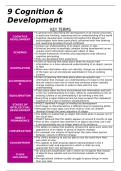
9 Cognition &
Development
KEY TERMS
A general term describing the development of all mental processes,
in particular thinking, reasoning and our understanding of the world
COGNITIVE
Cognitive development continues throughout the lifespan but
DEVELOPMENT psychologists have been particularly concerned with how thinking
and reasoning develops through childhood
Contain our understanding of an object, person or idea
Schemas become increasingly complex during development as we
acquire more information about each object or idea
SCHEMAS
A mental framework of beliefs and expectations that influence
cognitive processing
They are developed from experience
A form of learning that takes place when we acquire new
information or a more advanced understanding of an object, person
or idea
ASSIMILATION
When new information does not radically change our understanding
of the topic we can incorporate (assimilate) it into an existing
schema
A form of learning that takes place when we acquire new
information that changes our understanding of a topic to the extent
ACCOMMODATIO
that we need to form one or more new schemas and/or radically
N change existing schemas in order to deal with the new
understanding
Takes place when we have encountered new information and built
it into our understanding of a topic, either by assimilating it into an
EQUILIBRATION existing schema or accommodating it by forming a new one
Everything is again balanced and we have escaped the unpleasant
experience of a lack of balance (disequilibrium)
STAGES OF PIAGET identified 4 stages of intellectual development
Each stage is characterised by a different level of reasoning ability
INTELLECTUAL
Although the exact ages vary from child to child, all children
DEVELOPMENT develop through the same sequence of stages
The ability to realise that an object still exists when it passes out of
the visual field
OBJECT
PIAGET believed that this ability appears at around 8 months of age
PERMANENCE Prior to this, children lose interest in an object once they can’t see
it and presumably are no longer aware of its existence
The ability to realise that quantity remains the same even when the
appearance of an object or group of objects changes
CONSERVATION
For example, the volume of liquid stays the same when poured
between vessels of different shapes
The child’s tendency to only be able to see the world from their
own point of view
EGOCENTRISM This applies to both physical objects (demonstrated in the 3
mountains task) and arguments in which a child can only
appreciate their own perspective
An advanced classification skill in which we recognise that classes
of objects have subsets and are themselves subsets of larger
CLASS
classes
INCLUSION Pre-operational children usually struggle to place things in more
than one class
, PIAGET’S Theory of Cognitive Development
JEAN PIAGET
Biologist & psychologist from Switzerland
Piaget's (1936) theory of cognitive development explains how a child constructs
a mental model of the world. He disagreed with the idea that intelligence was a
fixed trait, and regarded cognitive development as a process which occurs due
to the biological maturation and interaction with the environment
Piaget's main assumptions…
o Intelligence is not fixed
o Cognitive development is a process by which we mature and interact
Before Piaget's work, the common assumption in Psychology was that children
are simply less competent thinkers than adults. Piaget demonstrated that young
children think in different ways to adults.
Piaget's Theory of Cognitive Development
Piaget proposed that the main cognitive structure which changes
during cognitive development is the schema.
A schema is a mental framework of knowledge and beliefs about a specific
place, object, person or time. Schemas influence our cognitive processing, by
providing ‘short-cuts’ (allowing us to process large volumes of data quickly and
efficiently, hence avoiding sensory overload), but can also lead to perceptual
errors through distorting sensory stimuli. Some schemas are innate (EG. all
babies are born with the schema for sucking and gripping reflexes). Schemas
become more sophisticated with time, allowing us to understand more aspects
of and increasingly complex situations.
Piaget suggested that there are two types of learning: accommodation
and assimilation.
Accommodation occurs when we are exposed to new information which
radically changes our existing knowledge, and so to deal with this information,
we accommodate it by forming a new schema.
o An example of accommodation would be when a child goes to a zoo and
mistakes a tiger for a cat. This is because they have not yet been exposed
to tigers and so use the most similar schema (i.e. a cat) in an effort to
understand the new scenario. As the child observes the tiger, and notices
the differences between a tiger and a cat, it will form a new sophisticated
‘tiger’ schema, with distinctions made between different types of cats.
Assimilation occurs when we are exposed to new information which does not
radically change our existing knowledge, and so we assimilate (incorporate) it
into an existing schema.
o An example of assimilation would be a child seeing a tabby cat, when it
has only seen black, white and ginger cats previously. The new
appearance of a cat does not radically change the child’s existing
knowledge of what a cat is, how it behaves etc. Therefore, the new
understanding of the physical difference between a tabby cat and other
types is assimilated into the child’s existing ‘cat’ schema.
Development
KEY TERMS
A general term describing the development of all mental processes,
in particular thinking, reasoning and our understanding of the world
COGNITIVE
Cognitive development continues throughout the lifespan but
DEVELOPMENT psychologists have been particularly concerned with how thinking
and reasoning develops through childhood
Contain our understanding of an object, person or idea
Schemas become increasingly complex during development as we
acquire more information about each object or idea
SCHEMAS
A mental framework of beliefs and expectations that influence
cognitive processing
They are developed from experience
A form of learning that takes place when we acquire new
information or a more advanced understanding of an object, person
or idea
ASSIMILATION
When new information does not radically change our understanding
of the topic we can incorporate (assimilate) it into an existing
schema
A form of learning that takes place when we acquire new
information that changes our understanding of a topic to the extent
ACCOMMODATIO
that we need to form one or more new schemas and/or radically
N change existing schemas in order to deal with the new
understanding
Takes place when we have encountered new information and built
it into our understanding of a topic, either by assimilating it into an
EQUILIBRATION existing schema or accommodating it by forming a new one
Everything is again balanced and we have escaped the unpleasant
experience of a lack of balance (disequilibrium)
STAGES OF PIAGET identified 4 stages of intellectual development
Each stage is characterised by a different level of reasoning ability
INTELLECTUAL
Although the exact ages vary from child to child, all children
DEVELOPMENT develop through the same sequence of stages
The ability to realise that an object still exists when it passes out of
the visual field
OBJECT
PIAGET believed that this ability appears at around 8 months of age
PERMANENCE Prior to this, children lose interest in an object once they can’t see
it and presumably are no longer aware of its existence
The ability to realise that quantity remains the same even when the
appearance of an object or group of objects changes
CONSERVATION
For example, the volume of liquid stays the same when poured
between vessels of different shapes
The child’s tendency to only be able to see the world from their
own point of view
EGOCENTRISM This applies to both physical objects (demonstrated in the 3
mountains task) and arguments in which a child can only
appreciate their own perspective
An advanced classification skill in which we recognise that classes
of objects have subsets and are themselves subsets of larger
CLASS
classes
INCLUSION Pre-operational children usually struggle to place things in more
than one class
, PIAGET’S Theory of Cognitive Development
JEAN PIAGET
Biologist & psychologist from Switzerland
Piaget's (1936) theory of cognitive development explains how a child constructs
a mental model of the world. He disagreed with the idea that intelligence was a
fixed trait, and regarded cognitive development as a process which occurs due
to the biological maturation and interaction with the environment
Piaget's main assumptions…
o Intelligence is not fixed
o Cognitive development is a process by which we mature and interact
Before Piaget's work, the common assumption in Psychology was that children
are simply less competent thinkers than adults. Piaget demonstrated that young
children think in different ways to adults.
Piaget's Theory of Cognitive Development
Piaget proposed that the main cognitive structure which changes
during cognitive development is the schema.
A schema is a mental framework of knowledge and beliefs about a specific
place, object, person or time. Schemas influence our cognitive processing, by
providing ‘short-cuts’ (allowing us to process large volumes of data quickly and
efficiently, hence avoiding sensory overload), but can also lead to perceptual
errors through distorting sensory stimuli. Some schemas are innate (EG. all
babies are born with the schema for sucking and gripping reflexes). Schemas
become more sophisticated with time, allowing us to understand more aspects
of and increasingly complex situations.
Piaget suggested that there are two types of learning: accommodation
and assimilation.
Accommodation occurs when we are exposed to new information which
radically changes our existing knowledge, and so to deal with this information,
we accommodate it by forming a new schema.
o An example of accommodation would be when a child goes to a zoo and
mistakes a tiger for a cat. This is because they have not yet been exposed
to tigers and so use the most similar schema (i.e. a cat) in an effort to
understand the new scenario. As the child observes the tiger, and notices
the differences between a tiger and a cat, it will form a new sophisticated
‘tiger’ schema, with distinctions made between different types of cats.
Assimilation occurs when we are exposed to new information which does not
radically change our existing knowledge, and so we assimilate (incorporate) it
into an existing schema.
o An example of assimilation would be a child seeing a tabby cat, when it
has only seen black, white and ginger cats previously. The new
appearance of a cat does not radically change the child’s existing
knowledge of what a cat is, how it behaves etc. Therefore, the new
understanding of the physical difference between a tabby cat and other
types is assimilated into the child’s existing ‘cat’ schema.