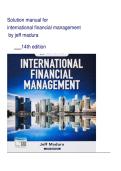
Solution manual for
international financial management
by jeff madura
14th edition
,Table of content
1. Multinational Financial Management: An Overview.
2. International Flow of Funds.
3. International Financial Markets.
4. Exchange Rate Determination.
5. Currency Derivatives.
6. Government Influence on Exchange Rates.
7. International Arbitrage and Interest Rate Parity.
8. Relationships among Inflation, Interest Rates, and Exchange Rates.
9. Forecasting Exchange Rates.
10. Measuring Exposure to Exchange Rate Fluctuations.
11. Managing Transaction Exposure.
12. Managing Economic Exposure and Translation Exposure.
13. Direct Foreign Investment.
14. Multinational Capital Budgeting.
15. International Corporate Governance and Control.
16. Country Risk Analysis.
17. Multinational Capital Structure and Cost of Capital.
18. Long-Term Debt Financing.
19. Financing International Trade.
20. Short-Term Financing.
21. International Cash Management.
,Chapter 1
Multinational Financial Management: An Overview
Lecture Outline
Managing The Mnc
How Business Disciplines Are Used To Manage The Mnc
Agency Problems
Management Structure Of An Mnc
Why Firms Pursue International Business
Theory Of Comparative Advantage
Imperfect Markets Theory
Product Cycle Theory
Methods To Conduct International Business
International Trade
Licensing
Franchising
Joint Ventures
Acquisitions Of Existing Operations
Establishing New Foreign Subsidiaries
Summary Of Methods
Valuation Model For An Mnc
Domestic Valuation Model
Multinational Valuation Model
Uncertainty Surrounding An Mnc’s Cash Flows
How Uncertainty Affects The Mnc’s Cost Of Capital
Organization Of The Text
, Multinational Financial Management: An Overview ❖ 2
Chapter Theme
This Chapter Introduces The Multinational Corporation As Having Similar Goals To The Purely Domestic
Corporation, But A Wider Variety Of Opportunities. With Additional Opportunities Come Potential
Increased Returns And Other Forms Of Risk To Consider. The Potential Benefits And Risks Are Introduced.
Topics To Stimulate Class Discussion
1. What Is The Appropriate Definition Of An Mnc?
2. Why Does An Mnc Expand Internationally?
3. What Are The Risks Of An Mnc Which Expands Internationally?
4. Why Must Purely Domestic Firms Be Concerned About The International Environment?
Point/Counter-Point:
Should An Mnc Reduce Its Ethical Standards To Compete Internationally?
Point: Yes. When A U.S.-Based Mnc Competes In Some Countries, It May Encounter Some Business
Norms There That Are Not Allowed In The U.S. For Example, When Competing For A Government
Contract, Firms Might Provide Payoffs To The Government Officials Who Will Make The Decision.
Yet, In The United States, A Firm Will Sometimes Take A Client On An Expensive Golf Outing Or
Provide Skybox Tickets To Events. This Is No Different Than A Payoff. If The Payoffs Are Bigger In
Some Foreign Countries, The Mnc Can Compete Only By Matching The Payoffs Provided By Its
Competitors.
Counter-Point: No. A U.S.-Based Mnc Should Maintain A Standard Code Of Ethics That Applies To
Any Country, Even If It Is At A Disadvantage In A Foreign Country That Allows Activities That Might
Be Viewed As Unethical. In This Way, The Mnc Establishes More Credibility Worldwide.
Who Is Correct? Use The Internet To Learn More About This Issue. Which Argument Do You Support?
Offer Your Own Opinion On This Issue.
Answer: The Issue Is Frequently Discussed. It Is Easy To Suggest That The Mnc Should Maintain A
Standard Code Of Ethics, But In Reality, That Means That It Will Not Be Able To Compete In Some
Cases. For Example, Even If It Submits The Lowest Bid On A Specific Foreign Government Project, It
Will Not Receive The Bid Without A Payoff To The Foreign Government Officials. The Issue Is
Especially A Concern For Large Projects That May Generate Substantial Cash Flows For The Firm That
Is Chosen To Do The Project. Ideally, The Mnc Can Clearly Demonstrate To Whoever Oversees The
Decision Process That It Deserves To Be Selected. If There Is Just One Decision-Maker With No
Oversight, An Mnc Can Not Ensure That The Decision Will Be Ethical. But If The Decision-Maker Must
Be Accountable To A Department Who Oversees The Decision, The Mnc May Be Able To Prompt The
Department To Ensure That The Process Is Ethical.
international financial management
by jeff madura
14th edition
,Table of content
1. Multinational Financial Management: An Overview.
2. International Flow of Funds.
3. International Financial Markets.
4. Exchange Rate Determination.
5. Currency Derivatives.
6. Government Influence on Exchange Rates.
7. International Arbitrage and Interest Rate Parity.
8. Relationships among Inflation, Interest Rates, and Exchange Rates.
9. Forecasting Exchange Rates.
10. Measuring Exposure to Exchange Rate Fluctuations.
11. Managing Transaction Exposure.
12. Managing Economic Exposure and Translation Exposure.
13. Direct Foreign Investment.
14. Multinational Capital Budgeting.
15. International Corporate Governance and Control.
16. Country Risk Analysis.
17. Multinational Capital Structure and Cost of Capital.
18. Long-Term Debt Financing.
19. Financing International Trade.
20. Short-Term Financing.
21. International Cash Management.
,Chapter 1
Multinational Financial Management: An Overview
Lecture Outline
Managing The Mnc
How Business Disciplines Are Used To Manage The Mnc
Agency Problems
Management Structure Of An Mnc
Why Firms Pursue International Business
Theory Of Comparative Advantage
Imperfect Markets Theory
Product Cycle Theory
Methods To Conduct International Business
International Trade
Licensing
Franchising
Joint Ventures
Acquisitions Of Existing Operations
Establishing New Foreign Subsidiaries
Summary Of Methods
Valuation Model For An Mnc
Domestic Valuation Model
Multinational Valuation Model
Uncertainty Surrounding An Mnc’s Cash Flows
How Uncertainty Affects The Mnc’s Cost Of Capital
Organization Of The Text
, Multinational Financial Management: An Overview ❖ 2
Chapter Theme
This Chapter Introduces The Multinational Corporation As Having Similar Goals To The Purely Domestic
Corporation, But A Wider Variety Of Opportunities. With Additional Opportunities Come Potential
Increased Returns And Other Forms Of Risk To Consider. The Potential Benefits And Risks Are Introduced.
Topics To Stimulate Class Discussion
1. What Is The Appropriate Definition Of An Mnc?
2. Why Does An Mnc Expand Internationally?
3. What Are The Risks Of An Mnc Which Expands Internationally?
4. Why Must Purely Domestic Firms Be Concerned About The International Environment?
Point/Counter-Point:
Should An Mnc Reduce Its Ethical Standards To Compete Internationally?
Point: Yes. When A U.S.-Based Mnc Competes In Some Countries, It May Encounter Some Business
Norms There That Are Not Allowed In The U.S. For Example, When Competing For A Government
Contract, Firms Might Provide Payoffs To The Government Officials Who Will Make The Decision.
Yet, In The United States, A Firm Will Sometimes Take A Client On An Expensive Golf Outing Or
Provide Skybox Tickets To Events. This Is No Different Than A Payoff. If The Payoffs Are Bigger In
Some Foreign Countries, The Mnc Can Compete Only By Matching The Payoffs Provided By Its
Competitors.
Counter-Point: No. A U.S.-Based Mnc Should Maintain A Standard Code Of Ethics That Applies To
Any Country, Even If It Is At A Disadvantage In A Foreign Country That Allows Activities That Might
Be Viewed As Unethical. In This Way, The Mnc Establishes More Credibility Worldwide.
Who Is Correct? Use The Internet To Learn More About This Issue. Which Argument Do You Support?
Offer Your Own Opinion On This Issue.
Answer: The Issue Is Frequently Discussed. It Is Easy To Suggest That The Mnc Should Maintain A
Standard Code Of Ethics, But In Reality, That Means That It Will Not Be Able To Compete In Some
Cases. For Example, Even If It Submits The Lowest Bid On A Specific Foreign Government Project, It
Will Not Receive The Bid Without A Payoff To The Foreign Government Officials. The Issue Is
Especially A Concern For Large Projects That May Generate Substantial Cash Flows For The Firm That
Is Chosen To Do The Project. Ideally, The Mnc Can Clearly Demonstrate To Whoever Oversees The
Decision Process That It Deserves To Be Selected. If There Is Just One Decision-Maker With No
Oversight, An Mnc Can Not Ensure That The Decision Will Be Ethical. But If The Decision-Maker Must
Be Accountable To A Department Who Oversees The Decision, The Mnc May Be Able To Prompt The
Department To Ensure That The Process Is Ethical.