NUR 2063 Final Exam Study Guide chapter 1-10 Final exam Topics complete solution Rasmussen College
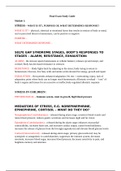
NUR 2063 Final Exam Study Guide chapter 1-10 Final exam Topics complete solution Rasmussen College Module 1: STRESS – WHAT IS IT?, PURPOSE OF, WHAT DETERMINES RESPONSE? WHAT IS IT? – physical, chemical or emotional factor that results in tension of body or mind, real or perceived threat to homeostasis, can be positive or negative PURPOSE – WHAT DETERMINES RESPONSE – SELYE GAP SYNDROME STAGES, BODY’S RESPONSES TO STAGES – ALARM, RESISTANCE, EXHAUSTION: ALARM – the stressor upsets homeostasis or cellular balance; releases epi and norepi, and cortisol; Body has decreased resistance to stressors RESISTANCE – Body fights back by adjusting to the stress; body trying to return to homeostasis; Glucose, free fatty acids and amino acids elevated for energy, growth and repair EXHAUSTION – Rest permits enhanced adaptation; No rest = overtraining, injury, lack of adaptation; point where body can no longer reach homeostasis; Allostatic overload – “cost” of body’s organs and tissues for an excessive or ineffectively regulated allostatic response STRESS IN CHILDREN: PHYSIOLOGICAL – Immune system, stunt in growth, high blood pressure MEDIATORS OF STRESS, E.G. NOREPINEPHRINE, EPINEPHRINE, CORTISOL – WHAT DO THEY DO? Norepinephrine (Catecholamines) – released during alarm stage; constricts blood vessels and raises blood pressure; reduces gastric secretions and increases night and far vision Epinephrine (Catecholamines) – released during the alarm stage; enhances myocardial contractibility, increases heart rate, and increases cardiac output; causes bronchodilation; increases the release of glucose from the liver(glycogenolysis) and elevates blood glucose levels Cortisol (Glucocorticoid) – released during alarm stage; primary glucocorticoid; may be synergistic or antagonistic to catecholamines; suppresses the immune system, decreases serotonin, increases blood sugar, increases blood pressure, decreases sensitivity to pain, and heightens memory and attention ALDOSTERONE (mineralocorticoid)– essential for sodium conservation in the kidneys, salivary glands, sweat glands, and colon LONG TERM GLUCOCORTICOID EFFECTS ON BODY: osteoporosis, inability to fight infection (comp host), can weaken muscle/atrophy of skeletal muscle ENDORPHINS AND ENKEPHALINS: ENDORPHINS- are an endogenous opioid peptide derived from cells in the hypothalamus, have analgesic properties ENKEPHALINS – One of two types of pain-suppressing pentapeptides; they are produced in the body and are located in the pituitary gland, brain, and GI tract.............continuers to module 10

Geschreven voor
- Instelling
- NUR 2063
- Vak
- NUR 2063
Documentinformatie
- Geüpload op
- 17 maart 2021
- Aantal pagina's
- 21
- Geschreven in
- 2020/2021
- Type
- Tentamen (uitwerkingen)
- Bevat
- Onbekend
Onderwerpen
-
nur 2063
-
real or perceive
-
nur 2063 final exam study guide chapter 1 10 final exam topics complete solution
-
what is it – physical
-
chemical or emotional factor that results in tension of body or mind

Ook beschikbaar in voordeelbundel