
Week 2 - Conflict and opportunity in hybrid work
1JV10 Organisational Behaviour for
IE
Topic 2 - Conflict and opportunity in hybrid
work
Book chapters:
12: Work–Family Interaction
13: Non- Standard Working Arrangements
14: Recovery from Work Stress
23: Job Crafting: A Powerful Job Redesign Approach
Slides: Lecture 2: Introduction to organisational
behaviour of IE:
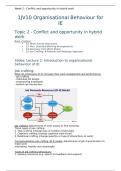
Job crafting:
What do employees do to increase their work engagement and performance:
- Job crafting
- individual job design
- empowering employees
- bottom-up intervention
Job crafting: Adjustments of a job (tasks) to find meaning.
Three types of job crafting:
1. Task crafting (change type of number of job tasks)
2. Cognitive crafting (change cognitive view of job)
3. Relational crafting (change quantity or type of interactions at work)
Conceptualization job crafting: JD-R model: Adjustments of job characteristics to
make work
motivating, healthy and meaningful
Types of job crafting behaviours:
1. Seeking resources (e.g. search for feedback and support)
,Week 2 - Conflict and opportunity in hybrid work
2. Seeking demands/challenges (e.g. new tasks or responsibilities)
3. Reducing demands (e.g. make job simpler and less strenuous)
4. Optimizing demands (e.g. make work more efficient
Job Crafting Scale
1. Seeking Resources
“ I ask my supervisor for advice”
2. Seeking Challenges
“ I ask for more responsibilities”
3. Reducing Demands
“ I make sure that I have less emotionally strenuous work”
4. Optimizing Demands
“‘I look for ways to do my work more efficiently”
Job crafting context:
JC is triggered by/occurs within:
• jobs combining high demands and resources
• organizational change & job insecurity
• unfavourable conditions/misfit
• proactive/empowering leaders
• crafting colleagues
Job crafting and outcomes
1. Expansion-oriented crafting has favourable outcomes (job performance, work
engagement)
2. Reduction-oriented crafting has unfavourable outcomes
3. It changes perceived job characteristics
4. It facilitates change/adaptive behavior (e.g. sustainability, use of technology )
,Week 2 - Conflict and opportunity in hybrid work
, Week 2 - Conflict and opportunity in hybrid work
Recovery from work:
1) Work and Stress:
a. Traditional models (JDR/DISC)
i. Stressors (demands) and resources
ii. No dynamic aspect nor involvement of recovery
b. Relation with excessive working times
2) What is recovery:
a. “A process whereby psycho-physiological systems that were activated during stress
exposure return to and stabilize at baseline level after the stressful situation has
ended.”
b. State versus experiences (outcome versus process)
c. Dynamic
d. Internal versus external
e. Active versus passive mechanisms
3) Recovery theories:
a. Effort Recovery model
b. Allostatic load theory
c. DISC-R Model
4) Going meta
5) Field application:
a. Work time control:
i. More flexibility and control
ii. May facilitate internal and external recovery
iii. Boundaryless work very contemporary
1JV10 Organisational Behaviour for
IE
Topic 2 - Conflict and opportunity in hybrid
work
Book chapters:
12: Work–Family Interaction
13: Non- Standard Working Arrangements
14: Recovery from Work Stress
23: Job Crafting: A Powerful Job Redesign Approach
Slides: Lecture 2: Introduction to organisational
behaviour of IE:
Job crafting:
What do employees do to increase their work engagement and performance:
- Job crafting
- individual job design
- empowering employees
- bottom-up intervention
Job crafting: Adjustments of a job (tasks) to find meaning.
Three types of job crafting:
1. Task crafting (change type of number of job tasks)
2. Cognitive crafting (change cognitive view of job)
3. Relational crafting (change quantity or type of interactions at work)
Conceptualization job crafting: JD-R model: Adjustments of job characteristics to
make work
motivating, healthy and meaningful
Types of job crafting behaviours:
1. Seeking resources (e.g. search for feedback and support)
,Week 2 - Conflict and opportunity in hybrid work
2. Seeking demands/challenges (e.g. new tasks or responsibilities)
3. Reducing demands (e.g. make job simpler and less strenuous)
4. Optimizing demands (e.g. make work more efficient
Job Crafting Scale
1. Seeking Resources
“ I ask my supervisor for advice”
2. Seeking Challenges
“ I ask for more responsibilities”
3. Reducing Demands
“ I make sure that I have less emotionally strenuous work”
4. Optimizing Demands
“‘I look for ways to do my work more efficiently”
Job crafting context:
JC is triggered by/occurs within:
• jobs combining high demands and resources
• organizational change & job insecurity
• unfavourable conditions/misfit
• proactive/empowering leaders
• crafting colleagues
Job crafting and outcomes
1. Expansion-oriented crafting has favourable outcomes (job performance, work
engagement)
2. Reduction-oriented crafting has unfavourable outcomes
3. It changes perceived job characteristics
4. It facilitates change/adaptive behavior (e.g. sustainability, use of technology )
,Week 2 - Conflict and opportunity in hybrid work
, Week 2 - Conflict and opportunity in hybrid work
Recovery from work:
1) Work and Stress:
a. Traditional models (JDR/DISC)
i. Stressors (demands) and resources
ii. No dynamic aspect nor involvement of recovery
b. Relation with excessive working times
2) What is recovery:
a. “A process whereby psycho-physiological systems that were activated during stress
exposure return to and stabilize at baseline level after the stressful situation has
ended.”
b. State versus experiences (outcome versus process)
c. Dynamic
d. Internal versus external
e. Active versus passive mechanisms
3) Recovery theories:
a. Effort Recovery model
b. Allostatic load theory
c. DISC-R Model
4) Going meta
5) Field application:
a. Work time control:
i. More flexibility and control
ii. May facilitate internal and external recovery
iii. Boundaryless work very contemporary



