Unit 5 – Chapter 6
Decision Making
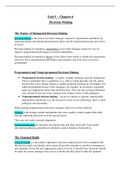
The Nature of Managerial Decision Making
Decision making is the process by which managers respond to opportunities and threats by
analysing options and making determinations about specific organisational goals and courses
of action.
Decision making in responds to opportunities occur when managers search for ways to
improve organisational performance to benefit stakeholders.
Decision making in responds to threats occurs when events inside or outside the organisation
adversely affect organisational performance and managers search for ways to increase
performance.
Programmed and Nonprogrammed Decision Making
• Programmed decision making – a routine, virtually automatic decision making that
follows established rules or guidelines. E.g. when a school principle asks the school
board to hire a new teacher whenever student enrolment increases by 40 students. It is
called programmed because office managers, for example, do not need to repeatedly
make new judgements about what should be done. They can rely on long-established
rules. Related to the day to day running of the business, there is little ambiguity.
• Nonprogrammed decision making – occurs in response to unusual, unpredictable
opportunities and threats. E.g. the decision to invest in new technology, there is much
ambiguity and uncertainty.
When making nonprogrammed decisions managers often rely on their intuition.
Intuition is the feelings, beliefs and hunches that come readily to mind, require little effort
and info gathering and result in on-the-spot decisions.
They may also make reasoned judgements.
Reasoned judgement are decisions that require time and effort and results from careful
information gathering, generation of alternatives and evaluation of alternatives.
The Classical Model
Classical model is a prescriptive approach to decision making based on the assumption that
the decision maker can identify and evaluate all possible alternatives and their consequences
and rationally choose the most appropriate course of action. It specifies how decisions should
be made. It assumes managers have access to all the info they need to make the optimum
, decision. It also assumes managers can easily list their own preferences for each alternative
and rank them from least to most preferred.
Optimum decision is the most appropriate decision in light of what manager believe to be the
most desirable consequences for the organisation.
The Administrative Model
Administrative model is an approach to decision making that explains why decision making
is inherently uncertain and risky and why managers usually make satisfactory rather than
optimum decisions.
The administrative model is based on the following important concepts:
• Bounded rationality – Cognitive limitations that constrain one’s ability to interpret,
process and act on information. People are not mentally capable to optimally process
and interpret info.
• Incomplete information – the full range of decision-making alternatives is
unknowable in most situations.
Decision Making
The Nature of Managerial Decision Making
Decision making is the process by which managers respond to opportunities and threats by
analysing options and making determinations about specific organisational goals and courses
of action.
Decision making in responds to opportunities occur when managers search for ways to
improve organisational performance to benefit stakeholders.
Decision making in responds to threats occurs when events inside or outside the organisation
adversely affect organisational performance and managers search for ways to increase
performance.
Programmed and Nonprogrammed Decision Making
• Programmed decision making – a routine, virtually automatic decision making that
follows established rules or guidelines. E.g. when a school principle asks the school
board to hire a new teacher whenever student enrolment increases by 40 students. It is
called programmed because office managers, for example, do not need to repeatedly
make new judgements about what should be done. They can rely on long-established
rules. Related to the day to day running of the business, there is little ambiguity.
• Nonprogrammed decision making – occurs in response to unusual, unpredictable
opportunities and threats. E.g. the decision to invest in new technology, there is much
ambiguity and uncertainty.
When making nonprogrammed decisions managers often rely on their intuition.
Intuition is the feelings, beliefs and hunches that come readily to mind, require little effort
and info gathering and result in on-the-spot decisions.
They may also make reasoned judgements.
Reasoned judgement are decisions that require time and effort and results from careful
information gathering, generation of alternatives and evaluation of alternatives.
The Classical Model
Classical model is a prescriptive approach to decision making based on the assumption that
the decision maker can identify and evaluate all possible alternatives and their consequences
and rationally choose the most appropriate course of action. It specifies how decisions should
be made. It assumes managers have access to all the info they need to make the optimum
, decision. It also assumes managers can easily list their own preferences for each alternative
and rank them from least to most preferred.
Optimum decision is the most appropriate decision in light of what manager believe to be the
most desirable consequences for the organisation.
The Administrative Model
Administrative model is an approach to decision making that explains why decision making
is inherently uncertain and risky and why managers usually make satisfactory rather than
optimum decisions.
The administrative model is based on the following important concepts:
• Bounded rationality – Cognitive limitations that constrain one’s ability to interpret,
process and act on information. People are not mentally capable to optimally process
and interpret info.
• Incomplete information – the full range of decision-making alternatives is
unknowable in most situations.