

Information and Communication-
Topic 1
Introduction
Discussion DIKW-pyramid
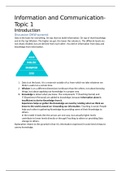
Data is the basis for everything. On top that we build Information. On top of that Knowledge
and at the top Wisdom. The higher we get, the lower the volume is. The different levels are
not clearly divided, but are derived from each other. You derive information from data and
knowledge from information.
1. Data is at the basis. It is a reservoir outside of us from which we take whatever we
think is useful at a certain time.
2. Wisdom is on a different dimension/continuum than the others, not about knowing
things, but about applying our knowledge in a proper way.
3. Knowledge is about what you know. The components ‘T’(Teaching=Social) and
‘E’(Experience=Personal) are added to knowledge, because Information alone is
insufficient to derive Knowledge from it.
Experience helps us gather the Knowledge we need by relating what we think we
know to the world around us= Grounding our information. Teaching is social. People
help each other in gathering Knowledge by providing some of their Knowledge to
others.
In the model it looks like the arrows are one-way, but actually higher levels
contribute to lower levels directly or through Teaching to others or providing Data
storage to others.
Explanation relates to the pyramid in that it is information expressed in some kind of data to
convey knowledge.
,Definitions Data, Information, Knowledge, Wisdom
Data, information, knowledge and wisdom cannot be clearly defined and an item can never
be placed exactly under one.
Data=
What you could know. Can take many forms. Measurements (numerical), symbols,
images, characters or videos.
On their own, data are meaningless, raw materials without inherent usefulness. A
number or series of numbers, can’t be interpreted without context (you need a
location and topic to understand what certain data about temperatures measured
somewhere mean).
Usually data was stored because somebody thought they might be useful.
Information=
What you want to know. Materials selected for their apparent usefulness. Selected
and processed bits of data which together represent something that you want to
know. Data first need to be related to context to be derived as information. It might
be necessary to process the data to get it into a form in which we can use it as we
want. For example, if you want to know if the earth is warming up, you need to
examine samples of temperature measurements at various times in specific key
locations.
Whether data is information for you, depends on whether you want to know it.
Whether you are interested in the data, which will then become information.
A teaching text is:
1. A series of symbols with a description Data
2. An organized collection of data that can be seen as information Information.
Context is needed to decide what to call this: data or information. What we call this, is
dependent on the viewpoint of the user rather than an inherent property of the
data/information. Involve user in analysis.
Knowledge/Understanding=
What you know. A product built from selected materials. Doesn’t exist as individual
bit (like information and data) but is integrated into a larger whole.
, You know how to get to work, but you cannot describe all the bits of information
collected to get this knowledge.
The more integrated information, the higher your level of knowledge. The less
integrated and thus easier to separate the knowledge into individual bits, the lower
your level of knowledge.
Most important criterium for integrating information into knowledge= Potential for
future use.
Knowledge is personal, it has been formed inside your mind through experiences.
Some part of your knowledge may be shared with others, but it is impossible to share
knowledge fully. All we can try to do is break down the part of our knowledge that
we want to share into bits of information and offer them to the learner.
Wisdom=
How you should use what you know.
Intuitions about the appropriateness of potential uses of available products.
Example concepts
1.100 years of hourly temperature measurements all over the world. = Data
2. Samples of temperature measurements in twenty representative locations on the first day
of each month at noon for last 100 years. = Information.
3. The earth is gradually getting warmer. = Knowledge.
4. We should try to stop to get the earth from getting warmer. = Wisdom.
Do entities other than humans have knowledge?
There has to be a mind to contain this knowledge. But we cannot see knowledge, all
we can see is behaviour that convinces us that the entity showing the behaviour
must have some kind of knowledge.
The mind containing the knowledge does not have to be aware of having it and
applying it consciously.
Knowledge is built from integration of experiences.
Animals show behaviour that implies knowledge, but it is unclear how knowledge
was gained.
Companies can also be seen as entities with knowledge, but this is more a
conglomeration of knowledge of the companies’ employees supported by
information systems.
Managing the joint knowledge of a company is the most important task, including
prevention of its loss and falling in the hands of the competition.
Do computers have knowledge?
Communication
Communication= A process in which a sender transfers a message to a receiver.
Sender holds knowledge they want to transfer to the receiver (belief or facts).
Knowledge itself can’t be transferred, only data. A message therefore consists of
some form of data transfer.
The receiver is supposed to recognize and absorb the information which the sender
attempts to highlight in the data of the message.
, In order for knowledge transfer to succeed: data transfer has to be carefully built
from selected bits of information in a logical order and represented optimally by
the right data representations.
If the sender suspects that the receiver is not expecting or wanting this knowledge:
sender has to put effort into adding elements to the data that will convince the
receiver to view the data as information and integrate it into their knowledge.
How messages (data) should be composed to be turned into knowledge, depends on the
communicative situation.
Face-to-face conversation
The receiver can show understanding to the sender by giving backchannels (signals).
The roles of sender and receiver shift during the conversation.
Distanced conversation (letters for example)
The receiver cannot give backchannels on the spot, so sender has to put more effort
in making themselves clear right away.
Mass communication
Most receivers never respond, so message has to be composed completely
understandable in first attempt.
Because messages in distanced communication are composed very clearly, this enables us
to derive information from messages that were never meant for us, but to which we have
access because they have been stored (websites, personal letters, ancient clay tablets).
We are able to learn things that the sender never intended to put into the messages and did
not intend for us.
Message qualities related to goals:
Teaching= Order and clarity.
Seduction= Attractiveness and selectivity
Deception= Acceptability and appeal to known beliefs
Socializing= Superficiality and lack of focus
Topic 1
Introduction
Discussion DIKW-pyramid
Data is the basis for everything. On top that we build Information. On top of that Knowledge
and at the top Wisdom. The higher we get, the lower the volume is. The different levels are
not clearly divided, but are derived from each other. You derive information from data and
knowledge from information.
1. Data is at the basis. It is a reservoir outside of us from which we take whatever we
think is useful at a certain time.
2. Wisdom is on a different dimension/continuum than the others, not about knowing
things, but about applying our knowledge in a proper way.
3. Knowledge is about what you know. The components ‘T’(Teaching=Social) and
‘E’(Experience=Personal) are added to knowledge, because Information alone is
insufficient to derive Knowledge from it.
Experience helps us gather the Knowledge we need by relating what we think we
know to the world around us= Grounding our information. Teaching is social. People
help each other in gathering Knowledge by providing some of their Knowledge to
others.
In the model it looks like the arrows are one-way, but actually higher levels
contribute to lower levels directly or through Teaching to others or providing Data
storage to others.
Explanation relates to the pyramid in that it is information expressed in some kind of data to
convey knowledge.
,Definitions Data, Information, Knowledge, Wisdom
Data, information, knowledge and wisdom cannot be clearly defined and an item can never
be placed exactly under one.
Data=
What you could know. Can take many forms. Measurements (numerical), symbols,
images, characters or videos.
On their own, data are meaningless, raw materials without inherent usefulness. A
number or series of numbers, can’t be interpreted without context (you need a
location and topic to understand what certain data about temperatures measured
somewhere mean).
Usually data was stored because somebody thought they might be useful.
Information=
What you want to know. Materials selected for their apparent usefulness. Selected
and processed bits of data which together represent something that you want to
know. Data first need to be related to context to be derived as information. It might
be necessary to process the data to get it into a form in which we can use it as we
want. For example, if you want to know if the earth is warming up, you need to
examine samples of temperature measurements at various times in specific key
locations.
Whether data is information for you, depends on whether you want to know it.
Whether you are interested in the data, which will then become information.
A teaching text is:
1. A series of symbols with a description Data
2. An organized collection of data that can be seen as information Information.
Context is needed to decide what to call this: data or information. What we call this, is
dependent on the viewpoint of the user rather than an inherent property of the
data/information. Involve user in analysis.
Knowledge/Understanding=
What you know. A product built from selected materials. Doesn’t exist as individual
bit (like information and data) but is integrated into a larger whole.
, You know how to get to work, but you cannot describe all the bits of information
collected to get this knowledge.
The more integrated information, the higher your level of knowledge. The less
integrated and thus easier to separate the knowledge into individual bits, the lower
your level of knowledge.
Most important criterium for integrating information into knowledge= Potential for
future use.
Knowledge is personal, it has been formed inside your mind through experiences.
Some part of your knowledge may be shared with others, but it is impossible to share
knowledge fully. All we can try to do is break down the part of our knowledge that
we want to share into bits of information and offer them to the learner.
Wisdom=
How you should use what you know.
Intuitions about the appropriateness of potential uses of available products.
Example concepts
1.100 years of hourly temperature measurements all over the world. = Data
2. Samples of temperature measurements in twenty representative locations on the first day
of each month at noon for last 100 years. = Information.
3. The earth is gradually getting warmer. = Knowledge.
4. We should try to stop to get the earth from getting warmer. = Wisdom.
Do entities other than humans have knowledge?
There has to be a mind to contain this knowledge. But we cannot see knowledge, all
we can see is behaviour that convinces us that the entity showing the behaviour
must have some kind of knowledge.
The mind containing the knowledge does not have to be aware of having it and
applying it consciously.
Knowledge is built from integration of experiences.
Animals show behaviour that implies knowledge, but it is unclear how knowledge
was gained.
Companies can also be seen as entities with knowledge, but this is more a
conglomeration of knowledge of the companies’ employees supported by
information systems.
Managing the joint knowledge of a company is the most important task, including
prevention of its loss and falling in the hands of the competition.
Do computers have knowledge?
Communication
Communication= A process in which a sender transfers a message to a receiver.
Sender holds knowledge they want to transfer to the receiver (belief or facts).
Knowledge itself can’t be transferred, only data. A message therefore consists of
some form of data transfer.
The receiver is supposed to recognize and absorb the information which the sender
attempts to highlight in the data of the message.
, In order for knowledge transfer to succeed: data transfer has to be carefully built
from selected bits of information in a logical order and represented optimally by
the right data representations.
If the sender suspects that the receiver is not expecting or wanting this knowledge:
sender has to put effort into adding elements to the data that will convince the
receiver to view the data as information and integrate it into their knowledge.
How messages (data) should be composed to be turned into knowledge, depends on the
communicative situation.
Face-to-face conversation
The receiver can show understanding to the sender by giving backchannels (signals).
The roles of sender and receiver shift during the conversation.
Distanced conversation (letters for example)
The receiver cannot give backchannels on the spot, so sender has to put more effort
in making themselves clear right away.
Mass communication
Most receivers never respond, so message has to be composed completely
understandable in first attempt.
Because messages in distanced communication are composed very clearly, this enables us
to derive information from messages that were never meant for us, but to which we have
access because they have been stored (websites, personal letters, ancient clay tablets).
We are able to learn things that the sender never intended to put into the messages and did
not intend for us.
Message qualities related to goals:
Teaching= Order and clarity.
Seduction= Attractiveness and selectivity
Deception= Acceptability and appeal to known beliefs
Socializing= Superficiality and lack of focus



