Use pastpapers like this to help you revise
Understand exam format and structure
Past papers show the types of questions, mark allocations, and time limits,
helping students know what to expect in the real exam.
Identify frequently tested topics
By reviewing several past papers, students can spot patterns and common
themes that appear regularly.
Practice time management
Completing past papers under timed conditions helps students learn how
to pace themselves during the exam.
Improve exam technique
Students learn how to interpret command words (e.g. explain, compare,
evaluate) and structure answers effectively.
Assess strengths and weaknesses
Marking answers using mark schemes highlights areas that need more
revision.
Build confidence
Familiarity with exam-style questions reduces anxiety and increases
confidence going into the exam.
Improve accuracy and clarity
Repeated practice helps students write clearer, more precise answers and
avoid common mistakes.
Track progress over time
Comparing results from different past papers shows improvement and
helps students adjust revision strategies.
TYRIONPAPERS.COM
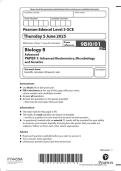
, Oxford Cambridge and RSA
Thursday 22 May 2025 – Morning
AS Level Biology A
H020/02 Depth in biology
Time allowed: 1 hour 30 minutes
You can use:
* 1 4 4 2 4 2 9 8 3 9 *
• a scientific or graphical calculator
• a ruler (cm/mm)
* H 0 2 0 0 2 *
Please write clearly in black ink. Do not write in the barcodes.
Centre number Candidate number
First name(s)
Last name
INSTRUCTIONS
• Use black ink. You can use an HB pencil, but only for graphs and diagrams.
• Write your answer to each question in the space provided. If you need extra space use
the lined pages at the end of this booklet. The question numbers must be clearly shown.
• Answer all the questions.
• Where appropriate, your answer should be supported with working. Marks might be
given for using a correct method, even if your answer is wrong.
INFORMATION
• The total mark for this paper is 70.
• The marks for each question are shown in brackets [ ].
• Quality of extended response will be assessed in questions marked with an asterisk (*).
• This document has 24 pages.
ADVICE
• Read each question carefully before you start your answer.
© OCR 2025 [601/4261/3] OCR is an exempt Charity
DC (PQ/SW) 350639/7 Turn over
for more: tyrionpapers.com
, 2
1
(a) The table describes features of molecules.
Complete the table. Use ticks (3) to identify if the feature describes starch or cellulose.
Description Starch Cellulose
Is made of amylose and amylopectin
Is a long unbranched chain
Is made from β glucose molecules
[3]
(b) Students complete paper chromatography on carbohydrates.
The table shows the Rf values for known carbohydrates.
© researchgate.net, ResearchGate. Item removed due to third party copyright restrictions. Link to material - www.researchgate.net/publication/261143652_Extraction_of_Sugars_from_Black_Gram_Peels_by_Reversed-Phase_Liquid_Chromatography_Systems_and_Identification_by_TLC_and_Mass_Analy
The measurements recorded for an unknown carbohydrate were:
Distance travelled by solvent = 8.50 cm
Distance travelled by carbohydrate = 4.34 cm
Calculate the Rf value of the unknown carbohydrate and use the table to identify it.
Give your answer to 2 decimal places.
Rf value = ...............................................................
Name of carbohydrate = ...............................................................
[2]
© OCR 2025
for more: tyrionpapers.com
Understand exam format and structure
Past papers show the types of questions, mark allocations, and time limits,
helping students know what to expect in the real exam.
Identify frequently tested topics
By reviewing several past papers, students can spot patterns and common
themes that appear regularly.
Practice time management
Completing past papers under timed conditions helps students learn how
to pace themselves during the exam.
Improve exam technique
Students learn how to interpret command words (e.g. explain, compare,
evaluate) and structure answers effectively.
Assess strengths and weaknesses
Marking answers using mark schemes highlights areas that need more
revision.
Build confidence
Familiarity with exam-style questions reduces anxiety and increases
confidence going into the exam.
Improve accuracy and clarity
Repeated practice helps students write clearer, more precise answers and
avoid common mistakes.
Track progress over time
Comparing results from different past papers shows improvement and
helps students adjust revision strategies.
TYRIONPAPERS.COM
, Oxford Cambridge and RSA
Thursday 22 May 2025 – Morning
AS Level Biology A
H020/02 Depth in biology
Time allowed: 1 hour 30 minutes
You can use:
* 1 4 4 2 4 2 9 8 3 9 *
• a scientific or graphical calculator
• a ruler (cm/mm)
* H 0 2 0 0 2 *
Please write clearly in black ink. Do not write in the barcodes.
Centre number Candidate number
First name(s)
Last name
INSTRUCTIONS
• Use black ink. You can use an HB pencil, but only for graphs and diagrams.
• Write your answer to each question in the space provided. If you need extra space use
the lined pages at the end of this booklet. The question numbers must be clearly shown.
• Answer all the questions.
• Where appropriate, your answer should be supported with working. Marks might be
given for using a correct method, even if your answer is wrong.
INFORMATION
• The total mark for this paper is 70.
• The marks for each question are shown in brackets [ ].
• Quality of extended response will be assessed in questions marked with an asterisk (*).
• This document has 24 pages.
ADVICE
• Read each question carefully before you start your answer.
© OCR 2025 [601/4261/3] OCR is an exempt Charity
DC (PQ/SW) 350639/7 Turn over
for more: tyrionpapers.com
, 2
1
(a) The table describes features of molecules.
Complete the table. Use ticks (3) to identify if the feature describes starch or cellulose.
Description Starch Cellulose
Is made of amylose and amylopectin
Is a long unbranched chain
Is made from β glucose molecules
[3]
(b) Students complete paper chromatography on carbohydrates.
The table shows the Rf values for known carbohydrates.
© researchgate.net, ResearchGate. Item removed due to third party copyright restrictions. Link to material - www.researchgate.net/publication/261143652_Extraction_of_Sugars_from_Black_Gram_Peels_by_Reversed-Phase_Liquid_Chromatography_Systems_and_Identification_by_TLC_and_Mass_Analy
The measurements recorded for an unknown carbohydrate were:
Distance travelled by solvent = 8.50 cm
Distance travelled by carbohydrate = 4.34 cm
Calculate the Rf value of the unknown carbohydrate and use the table to identify it.
Give your answer to 2 decimal places.
Rf value = ...............................................................
Name of carbohydrate = ...............................................................
[2]
© OCR 2025
for more: tyrionpapers.com