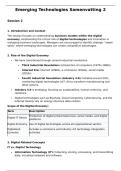
Emerging Technologies Samenvatting 2
Session 2
1. Introduction and Context
The session focuses on understanding business models within the digital
economy, emphasizing the critical role of digital technologies and innovation in
reshaping business landscapes. Managers are encouraged to identify strategic “sweet
spots” where emerging technologies can create competitive advantages.
2. Rise of the Digital Economy
We have transitioned through several industrial revolutions:
Third Industrial Revolution: Introduction of computers (1970s-1980s)
Internet Era: Internet (1990s), e-commerce (2010s), social media
(2010s)
Fourth Industrial Revolution (Industry 4.0): Initiated around 2011,
combining digital technologies (IoT, AI) to transform manufacturing and
other sectors.
Industry 5.0 is emerging, focusing on sustainability, human-centricity, and
resilience.
Digital technologies such as Big Data, Cloud Computing, Cybersecurity, and the
Internet heavily rely on energy-intensive data centers.
Scope of the Digital Economy:
Term Description
Production of digital products/services, social media, and digital
Digital IT Sector
platforms
Digital Economy Use of digital technologies across all organizational sectors
Digitalized Includes e-commerce and Industry 4.0 technology integration
Economy activities
3. Digital-Related Concepts
IT vs. Digital Technology
Information Technology (IT): Collecting, storing, processing, and transmitting
data, including hardware and software.
, Digital Technology: Broader definition emphasizing IT’s embeddedness in
products and services, making it inseparable from the infrastructure.
Digital Innovation
Defined as the continuous use of digital technologies to innovate products,
services, processes, or business models to gain competitive advantage.
Examples include:
Product Innovation: Transition from film rolls to smartphones.
Process Innovation: Automating manual, paper-based evaluations.
Business Model Innovation: Moving from physical video stores to
online streaming services.
Levels of Digital Innovation
Term Description Focus
Translation to
Digitization Converting analog data to digital
digital
Adapting and improving business
Digitalization Saving money
processes
Digital Creating new businesses and strategic
Earning money
Transformation shifts
4. Drivers and Implications of Digital Transformation
Digital transformation is often initiated by:
New markets and technological opportunities
Changing customer expectations and increased competition
Inefficient business processes
It leads to disruptions in:
Customer experience and market dynamics
Data usage
Value creation streams (business processes)
Corporate structure and culture
Digital skills requirements
Regulations and legislation such as GDPR, EU Digital Market Act, and AI Act
are significant constraints on digital innovation.
,5. Central Role of a Strategic Digital Business Model
A digital business model explains how an organization creates, delivers, and
captures value using digital technologies.
It differs from process models (operational workflows) and outcomes
(products/services), focusing strategically on value creation.
Value is the cornerstone and can be categorized as:
Value Type Description
Functional Values Basic utility and functionality
Emotional Values Feelings and experience associated with the product/service
Life-changing Values Transformational impact on customers’ lives
Social Impact Values Contribution to societal or community well-being
Value proposition is critical and should focus on benefits rather than features,
tailored to different stakeholders.
6. The Sweet Spot of Digital Innovation
The “sweet spot” is the intersection of:
Desirability: Customer needs and wants
Feasibility: Technological capability
Viability: Economic sustainability (costs and benefits)
Missing this sweet spot can lead to business failure or missed opportunities.
7. Business Model Canvas as a Tool
Popularized by Osterwalder et al. (2010), the business model canvas breaks
down a business model into nine interrelated building blocks:
Block Focus Area
Customer Segments Who the business serves
Value Propositions What value is delivered to customers
Channels How value propositions reach customers
Customer Relationships Types of relationships maintained with customers
Revenue Streams How the business earns money
Key Resources Assets required to deliver value
Key Activities Core activities necessary to create and deliver value
Key Partnerships External suppliers and partners
, Block Focus Area
Cost Structure Major costs incurred
The canvas helps clarify and test business ideas, align stakeholders, and plan
strategic execution through iterative validation.
8. Testing Business Models
Testing ensures alignment with the sweet spot and involves different methods:
Test Type Purpose Characteristics
Proof-of-Value Validate value to customers with Uses mock-ups and real
(POV) limited features and duration customers
Proof-of-Concept Limited features, no
Test technical feasibility of prototypes
(POC) customers
Return on Assess economic viability (gains vs.
Financial calculations
Investment (ROI) costs)
Iterative testing reduces risks and guides minimum viable product (MVP)
development.
9. Challenges in Digital Innovation and Transformation
Organizational culture can hinder innovation due to:
Slow decision-making
Inability to demonstrate business value
Overemphasis on technology rather than strategic change
Lack of understanding of operational issues
Fear of losing control
Successful transformation requires strategic change management and cross-
functional collaboration.
10. Practical Case Study: VELOCITY – A Digital Business Model Exercise
Company Profile:
Founded in 2002, VELOCITY manufactures various bicycles (city, mountain,
electric) and accessories, focusing on technology and style.
Operates mainly in Belgium and nearby European countries.
Session 2
1. Introduction and Context
The session focuses on understanding business models within the digital
economy, emphasizing the critical role of digital technologies and innovation in
reshaping business landscapes. Managers are encouraged to identify strategic “sweet
spots” where emerging technologies can create competitive advantages.
2. Rise of the Digital Economy
We have transitioned through several industrial revolutions:
Third Industrial Revolution: Introduction of computers (1970s-1980s)
Internet Era: Internet (1990s), e-commerce (2010s), social media
(2010s)
Fourth Industrial Revolution (Industry 4.0): Initiated around 2011,
combining digital technologies (IoT, AI) to transform manufacturing and
other sectors.
Industry 5.0 is emerging, focusing on sustainability, human-centricity, and
resilience.
Digital technologies such as Big Data, Cloud Computing, Cybersecurity, and the
Internet heavily rely on energy-intensive data centers.
Scope of the Digital Economy:
Term Description
Production of digital products/services, social media, and digital
Digital IT Sector
platforms
Digital Economy Use of digital technologies across all organizational sectors
Digitalized Includes e-commerce and Industry 4.0 technology integration
Economy activities
3. Digital-Related Concepts
IT vs. Digital Technology
Information Technology (IT): Collecting, storing, processing, and transmitting
data, including hardware and software.
, Digital Technology: Broader definition emphasizing IT’s embeddedness in
products and services, making it inseparable from the infrastructure.
Digital Innovation
Defined as the continuous use of digital technologies to innovate products,
services, processes, or business models to gain competitive advantage.
Examples include:
Product Innovation: Transition from film rolls to smartphones.
Process Innovation: Automating manual, paper-based evaluations.
Business Model Innovation: Moving from physical video stores to
online streaming services.
Levels of Digital Innovation
Term Description Focus
Translation to
Digitization Converting analog data to digital
digital
Adapting and improving business
Digitalization Saving money
processes
Digital Creating new businesses and strategic
Earning money
Transformation shifts
4. Drivers and Implications of Digital Transformation
Digital transformation is often initiated by:
New markets and technological opportunities
Changing customer expectations and increased competition
Inefficient business processes
It leads to disruptions in:
Customer experience and market dynamics
Data usage
Value creation streams (business processes)
Corporate structure and culture
Digital skills requirements
Regulations and legislation such as GDPR, EU Digital Market Act, and AI Act
are significant constraints on digital innovation.
,5. Central Role of a Strategic Digital Business Model
A digital business model explains how an organization creates, delivers, and
captures value using digital technologies.
It differs from process models (operational workflows) and outcomes
(products/services), focusing strategically on value creation.
Value is the cornerstone and can be categorized as:
Value Type Description
Functional Values Basic utility and functionality
Emotional Values Feelings and experience associated with the product/service
Life-changing Values Transformational impact on customers’ lives
Social Impact Values Contribution to societal or community well-being
Value proposition is critical and should focus on benefits rather than features,
tailored to different stakeholders.
6. The Sweet Spot of Digital Innovation
The “sweet spot” is the intersection of:
Desirability: Customer needs and wants
Feasibility: Technological capability
Viability: Economic sustainability (costs and benefits)
Missing this sweet spot can lead to business failure or missed opportunities.
7. Business Model Canvas as a Tool
Popularized by Osterwalder et al. (2010), the business model canvas breaks
down a business model into nine interrelated building blocks:
Block Focus Area
Customer Segments Who the business serves
Value Propositions What value is delivered to customers
Channels How value propositions reach customers
Customer Relationships Types of relationships maintained with customers
Revenue Streams How the business earns money
Key Resources Assets required to deliver value
Key Activities Core activities necessary to create and deliver value
Key Partnerships External suppliers and partners
, Block Focus Area
Cost Structure Major costs incurred
The canvas helps clarify and test business ideas, align stakeholders, and plan
strategic execution through iterative validation.
8. Testing Business Models
Testing ensures alignment with the sweet spot and involves different methods:
Test Type Purpose Characteristics
Proof-of-Value Validate value to customers with Uses mock-ups and real
(POV) limited features and duration customers
Proof-of-Concept Limited features, no
Test technical feasibility of prototypes
(POC) customers
Return on Assess economic viability (gains vs.
Financial calculations
Investment (ROI) costs)
Iterative testing reduces risks and guides minimum viable product (MVP)
development.
9. Challenges in Digital Innovation and Transformation
Organizational culture can hinder innovation due to:
Slow decision-making
Inability to demonstrate business value
Overemphasis on technology rather than strategic change
Lack of understanding of operational issues
Fear of losing control
Successful transformation requires strategic change management and cross-
functional collaboration.
10. Practical Case Study: VELOCITY – A Digital Business Model Exercise
Company Profile:
Founded in 2002, VELOCITY manufactures various bicycles (city, mountain,
electric) and accessories, focusing on technology and style.
Operates mainly in Belgium and nearby European countries.