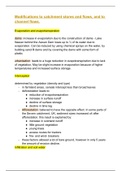
Modifications to catchment stores and flows, and to
channel flows.
Evaporation and evapotranspiration
dams: increase in evaporation due to the construction of dams - Lake
Nasser behind the Aswan Dam loses up to ⅓ of its water due to
evaporation. Can be reduced by using chemical sprays on the water, by
building sand-fil dams and by covering the dams with some form of
plastic
urbanisation: leads to a huge reduction in evapotranspiration due to lack
of vegetation, May be slight increase in evaporation because of higher
temperatures and increased surface storage.
Interception
determined by vegetation (density and type)
- in farmland areas, cereals intercept less than broad leaves
- deforestation leads to:
● reduction of evapotranspiration
● increase in surface runoff
● decline of surface storage
● decline in time lag
- Afforestation: believed to have the opposite effect. In some parts of
the Severn catchment, UK, sediment sizes increased x4 after
afforestation. this result is explained by:
● increase in overland runoff
● little ground vegetation
● young trees
● access routes for tractors
● fire- and wind- breakers
- these factors allowed a lot of bare ground, however in only 5 years
the amount of erosion decline.
Infiltration and soil water
,Land use: main factor controlling rate of infiltration
1) urbanised areas have reduced rate of infiltration due to
impermeable surfaces.
2) forested areas also allow 5x more infiltration than grassland as
stemflow and throughfall speed up this process.
● deforestation = less infiltration and more overland flow and
soil compaction.
3) farming practices also have a difference in the rate of infiltration:
- ploughing increases infiltration because it loosens the soil
- grazing causes soil compaction and ponding, decreasing
infiltration
Soil water:
- Waterlogging and salinisation are common if there is poor water
drainage.
- Impermeable crust: formed due to evaporation of water table close
to the surface, which causes salts to be left behind.
The impact of large-scale human activity (building dams) leads to:
● increased storage of water
● decreased flood peaks
● low flows in rivers
● decreased sediment yields
● increased losses due to evaporation and seepage = changes in
temperature and salinity of water
● decreased flooding of land
● triggering of earthquakes
● local changes in climate
Abstraction
Water availability problems: demand exceeds supply.
, - happens in areas with low rainfall and high population density, and
in areas with intensive agriculture/industry
- may lead to drying up of rivers, falling water tables and saltwater
intrusion.
- groundwater abstraction = big problem in Europe as it is the main
source of fresh water and it is being depleted.
- Mediterranean coast: Spain, Turkey… where demand of tourist
resorts are a major cause of abstraction.
- most groundwater in Malta cannot be used for domestic use or
irrigation as it has been contaminated by saltwater intrusion
Changing groundwater
High Plain of Texas:
- human activity has reduced the viability of irrigated agriculture in
this area
- groundwater in the area remained in a state of dynamic equilibrium
before the introduction of irrigation in the 1930s
- groundwater is now being used at a rapid rate to supply irrigation
systems
in some industrial areas, decrease in industry has resulted in a lower
rate of groundwater extraction; groundwater now has more time to
recharge:
- increase in spring anr river flows
- re-emergence of flow from dry springs
- surface water flooding
- pollution of surface waters and spread of underground pollution
- flooding of basements
- increased leakage into tunnels
- reduction of slope stability
methods of recharging water:
- permeable materials: water-spreading (a form of infiltration)
- impermeable layers: pump water into deep pits or wells.
Case study: Changing hydrology of the Aral Sea
channel flows.
Evaporation and evapotranspiration
dams: increase in evaporation due to the construction of dams - Lake
Nasser behind the Aswan Dam loses up to ⅓ of its water due to
evaporation. Can be reduced by using chemical sprays on the water, by
building sand-fil dams and by covering the dams with some form of
plastic
urbanisation: leads to a huge reduction in evapotranspiration due to lack
of vegetation, May be slight increase in evaporation because of higher
temperatures and increased surface storage.
Interception
determined by vegetation (density and type)
- in farmland areas, cereals intercept less than broad leaves
- deforestation leads to:
● reduction of evapotranspiration
● increase in surface runoff
● decline of surface storage
● decline in time lag
- Afforestation: believed to have the opposite effect. In some parts of
the Severn catchment, UK, sediment sizes increased x4 after
afforestation. this result is explained by:
● increase in overland runoff
● little ground vegetation
● young trees
● access routes for tractors
● fire- and wind- breakers
- these factors allowed a lot of bare ground, however in only 5 years
the amount of erosion decline.
Infiltration and soil water
,Land use: main factor controlling rate of infiltration
1) urbanised areas have reduced rate of infiltration due to
impermeable surfaces.
2) forested areas also allow 5x more infiltration than grassland as
stemflow and throughfall speed up this process.
● deforestation = less infiltration and more overland flow and
soil compaction.
3) farming practices also have a difference in the rate of infiltration:
- ploughing increases infiltration because it loosens the soil
- grazing causes soil compaction and ponding, decreasing
infiltration
Soil water:
- Waterlogging and salinisation are common if there is poor water
drainage.
- Impermeable crust: formed due to evaporation of water table close
to the surface, which causes salts to be left behind.
The impact of large-scale human activity (building dams) leads to:
● increased storage of water
● decreased flood peaks
● low flows in rivers
● decreased sediment yields
● increased losses due to evaporation and seepage = changes in
temperature and salinity of water
● decreased flooding of land
● triggering of earthquakes
● local changes in climate
Abstraction
Water availability problems: demand exceeds supply.
, - happens in areas with low rainfall and high population density, and
in areas with intensive agriculture/industry
- may lead to drying up of rivers, falling water tables and saltwater
intrusion.
- groundwater abstraction = big problem in Europe as it is the main
source of fresh water and it is being depleted.
- Mediterranean coast: Spain, Turkey… where demand of tourist
resorts are a major cause of abstraction.
- most groundwater in Malta cannot be used for domestic use or
irrigation as it has been contaminated by saltwater intrusion
Changing groundwater
High Plain of Texas:
- human activity has reduced the viability of irrigated agriculture in
this area
- groundwater in the area remained in a state of dynamic equilibrium
before the introduction of irrigation in the 1930s
- groundwater is now being used at a rapid rate to supply irrigation
systems
in some industrial areas, decrease in industry has resulted in a lower
rate of groundwater extraction; groundwater now has more time to
recharge:
- increase in spring anr river flows
- re-emergence of flow from dry springs
- surface water flooding
- pollution of surface waters and spread of underground pollution
- flooding of basements
- increased leakage into tunnels
- reduction of slope stability
methods of recharging water:
- permeable materials: water-spreading (a form of infiltration)
- impermeable layers: pump water into deep pits or wells.
Case study: Changing hydrology of the Aral Sea