Problem 2 – It’s just emotions taking me over
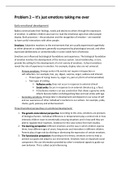
Early emotional development
Babies communicatie their feelings, needs and desires to others through the expression
of emotion. In addition children also learn to read the emotional signs that other people
display. Both processes – the production and the recognition of emotion – are essential
to have useful interactions with other people.
Emotions: Subjective reactions to the environment that are usually experienced cognitively
as either pleasant or unpleasant, generally accompanied by physiological arousal, and often
expressed (deliberately or unintentionally) in some visible form of behavior.
Emotions are influenced by biological foundations and experience. The biological foundation
of emotion involves the development of the nervous system. Social relationship, in turn,
provide the setting for the development of a rich variety of emotions. Cultural variations
reveal the role of experience in emotion. For example, display rules are not universal.
- Primary emotions: Emerge early in life and do not require introspection or
self-reflection. For example, fear, joy, digust, surprise, anger, sadness and interest.
o Three types of crying: basis cry, anger cry, pain cry (form of communication)
o Two types of smiling:
Reflexive smile: Does not occur in response to external stimuli
Social smile: Occurs in response to an external stimulus (e.g. a face)
A Duchenne marker is an eye constriction that shows a genuine smile.
Infants become better at distinguishing fake and real smiles with age.
- Secondary emotions: Emerge later in development and depend on our sense of self
and our awereness of other individual’s reactions to our actions. For example, pride,
shame, guilt, jealousy and embarrassment.
Three theoretical perspectives on emotional development:
1. The genetic-maturational perspective: According to this view, emotions are products
of biological factors. Individual differences in temperament play a central role in how
intensely children react to emotionally arousing situations and in how well they are
able to regulate their reactions. Evidence for this view comes from twin studies.
2. The learning perspective: Different emotions and the way in which children express
them, have different ages of onset, frequencies and intensities in different children.
Parents play a huge role by eliciting or dismissing the expression of certain emotions.
3. The functionalist perspective: According to this theory, emotions serve to help us
achieve our goals and adapt to our environment. Emotions have an important social
component: We use information provided by other’s emotional signals to guide our
own behavior. This is called social referencing.
, Chronology of development
Early weeks Shows distress by crying; reflex smiles
1 month Generalized distress; may be irritable by late afternoon
2 months Shows pleasure; midly aroused by sight of toy; social smile
3 months Excitement and boredom appear; smiles broadly and often; cries when bored;
may show wariness and frustration
4 months Laughs, especially at certain sounds; crying lessens; gurgles with pleasure;
shows beginnings of anger
5 months Usually gleeful and pleased but sometimes frustrated; shows primitive resistant
behaviors; turns head from disliked food; smiles at own image in mirror; some
babies may begin to show wariness of strangers
6 months Matches emotions to others, e.g. smiles and laughs when mother does; fear and
anger may appear now or later
7 months Fear and anger; defiance; affenction; shyness
8 months More individuality in emotional expression
9 months Shows negative emotions when restrained; frowns when annoyed; activily seeks
others’ comfort when tired; night-time crying may reappear; recognizes self in
mirror; most babies display real fear of strangers, called stranger anxiety.
Whether an infant shows stranger anxiety depends on the social context and
the characteristics of the stranger.
10 months Intensive positive and negative emotions; occasionally testy; uses reflection in
mirror – e.g. seeing toy in mirror, may move towards toy
11 months Greater variability in emotions; individual temperament is more evident;
learning to associate names of body parts; may insist on feeding self
12 months Becomes distressed when others are distressed; cries when something is not to
liking; may show signs of jealousy; laughs often at own cleverness; struts/preens
when walking; loves to look at self in mirror; wants to show mastery; plays on
own
15 months More mood swings; is more caring to age-mates; annoyed by dirty hands;
strongly prefers certain clothing; may fret or cry often, but usually briefly;
seperation anxiety when the mother is away
18 months Can be restless and stubborn; may sometimes have tantrums; sometimes shy;
shows shame; uses adjectives to refer to self; uses objects like a blanket or a
favorite stuffed animal to soothe self
21 months Makes some efforts to control negative emotions; can be flinicky and exacting;
makes more efforts to control situations; begins to understand parents’ values;
refers appropriately to self as good or bad
24 months Responds to others’ moods; very intense; may be overwhelmed by changes; can
be upset by dreams; refers to self by name; identifies self by gender; talks about
self by using I and a verb, such as hurt or need; keen to experience world on
own terms; begins to understand emotional display rules
30 months Begins to show shame, embarrassment
36 months Shows pride, guilt
48-60 months Shows increased understanding and use of emotional display rules
72 months Begins to understand how two or more emotions can occur simultaneously
Early emotional development
Babies communicatie their feelings, needs and desires to others through the expression
of emotion. In addition children also learn to read the emotional signs that other people
display. Both processes – the production and the recognition of emotion – are essential
to have useful interactions with other people.
Emotions: Subjective reactions to the environment that are usually experienced cognitively
as either pleasant or unpleasant, generally accompanied by physiological arousal, and often
expressed (deliberately or unintentionally) in some visible form of behavior.
Emotions are influenced by biological foundations and experience. The biological foundation
of emotion involves the development of the nervous system. Social relationship, in turn,
provide the setting for the development of a rich variety of emotions. Cultural variations
reveal the role of experience in emotion. For example, display rules are not universal.
- Primary emotions: Emerge early in life and do not require introspection or
self-reflection. For example, fear, joy, digust, surprise, anger, sadness and interest.
o Three types of crying: basis cry, anger cry, pain cry (form of communication)
o Two types of smiling:
Reflexive smile: Does not occur in response to external stimuli
Social smile: Occurs in response to an external stimulus (e.g. a face)
A Duchenne marker is an eye constriction that shows a genuine smile.
Infants become better at distinguishing fake and real smiles with age.
- Secondary emotions: Emerge later in development and depend on our sense of self
and our awereness of other individual’s reactions to our actions. For example, pride,
shame, guilt, jealousy and embarrassment.
Three theoretical perspectives on emotional development:
1. The genetic-maturational perspective: According to this view, emotions are products
of biological factors. Individual differences in temperament play a central role in how
intensely children react to emotionally arousing situations and in how well they are
able to regulate their reactions. Evidence for this view comes from twin studies.
2. The learning perspective: Different emotions and the way in which children express
them, have different ages of onset, frequencies and intensities in different children.
Parents play a huge role by eliciting or dismissing the expression of certain emotions.
3. The functionalist perspective: According to this theory, emotions serve to help us
achieve our goals and adapt to our environment. Emotions have an important social
component: We use information provided by other’s emotional signals to guide our
own behavior. This is called social referencing.
, Chronology of development
Early weeks Shows distress by crying; reflex smiles
1 month Generalized distress; may be irritable by late afternoon
2 months Shows pleasure; midly aroused by sight of toy; social smile
3 months Excitement and boredom appear; smiles broadly and often; cries when bored;
may show wariness and frustration
4 months Laughs, especially at certain sounds; crying lessens; gurgles with pleasure;
shows beginnings of anger
5 months Usually gleeful and pleased but sometimes frustrated; shows primitive resistant
behaviors; turns head from disliked food; smiles at own image in mirror; some
babies may begin to show wariness of strangers
6 months Matches emotions to others, e.g. smiles and laughs when mother does; fear and
anger may appear now or later
7 months Fear and anger; defiance; affenction; shyness
8 months More individuality in emotional expression
9 months Shows negative emotions when restrained; frowns when annoyed; activily seeks
others’ comfort when tired; night-time crying may reappear; recognizes self in
mirror; most babies display real fear of strangers, called stranger anxiety.
Whether an infant shows stranger anxiety depends on the social context and
the characteristics of the stranger.
10 months Intensive positive and negative emotions; occasionally testy; uses reflection in
mirror – e.g. seeing toy in mirror, may move towards toy
11 months Greater variability in emotions; individual temperament is more evident;
learning to associate names of body parts; may insist on feeding self
12 months Becomes distressed when others are distressed; cries when something is not to
liking; may show signs of jealousy; laughs often at own cleverness; struts/preens
when walking; loves to look at self in mirror; wants to show mastery; plays on
own
15 months More mood swings; is more caring to age-mates; annoyed by dirty hands;
strongly prefers certain clothing; may fret or cry often, but usually briefly;
seperation anxiety when the mother is away
18 months Can be restless and stubborn; may sometimes have tantrums; sometimes shy;
shows shame; uses adjectives to refer to self; uses objects like a blanket or a
favorite stuffed animal to soothe self
21 months Makes some efforts to control negative emotions; can be flinicky and exacting;
makes more efforts to control situations; begins to understand parents’ values;
refers appropriately to self as good or bad
24 months Responds to others’ moods; very intense; may be overwhelmed by changes; can
be upset by dreams; refers to self by name; identifies self by gender; talks about
self by using I and a verb, such as hurt or need; keen to experience world on
own terms; begins to understand emotional display rules
30 months Begins to show shame, embarrassment
36 months Shows pride, guilt
48-60 months Shows increased understanding and use of emotional display rules
72 months Begins to understand how two or more emotions can occur simultaneously