Actin, microtubules, cell-cell junction and cell polarisation
Learning objectives
1. Cytoskeleton
2. Actin
3. Microtubules
4. Intermediate filament
5. Cell-cell junction
Maintenance of tissue architecture: small intestine
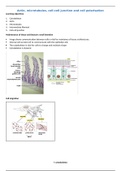
Image shows communication between cells is vital for maintance of tissue architectures.
Stromal cell secretes GF to communicate with the epithelial cells
The cytoskeleton is vital for cells to change and maintain shape
Cytoskeleton is dynamic
Cell migration
l- cytoskeleton
, 3 kinds of filaments:
1. Microtubules
2. Actin filaments
3. Intermediate filament
Functions of the cytoskeleton:
- Structure
- Attachment
- Compartmentalisation
- Motility
- Transport
- Cell division
Filamentous network that provides the structural framework of cells
Actin filaments Microtubules Intermediate filaments
Thin 25nm 8-10 nm
Microfilaments Thickest Less dynamic than actin and
6nm Highly dynamic like actin microtubules
The cytoskeleton is highly dynamic, it changes during change in cell shape
Image mainly represents actin and microtubule
Stat with small soluble subunit
- For actin, the small soluble subunit is called G-actin
- For microtubule, the small soluble subunit is called tubule
The small soluble subunit then self-assembles to form large filamentous polymer
GF trigger disassembly of filaments and rapid diffusion of subunits
Followed by reassembly of filaments at a new site to maintain cell polarity or structure of tissue
The cell responds rapidly to the GF by changing shape or migration
Microscopic image of cells
- The molecule, tubulin has been conjugated with rhodatin that has been introduced to the cell
- Therefore, the tubulin has been incorporated into the microtubule
Learning objectives
1. Cytoskeleton
2. Actin
3. Microtubules
4. Intermediate filament
5. Cell-cell junction
Maintenance of tissue architecture: small intestine
Image shows communication between cells is vital for maintance of tissue architectures.
Stromal cell secretes GF to communicate with the epithelial cells
The cytoskeleton is vital for cells to change and maintain shape
Cytoskeleton is dynamic
Cell migration
l- cytoskeleton
, 3 kinds of filaments:
1. Microtubules
2. Actin filaments
3. Intermediate filament
Functions of the cytoskeleton:
- Structure
- Attachment
- Compartmentalisation
- Motility
- Transport
- Cell division
Filamentous network that provides the structural framework of cells
Actin filaments Microtubules Intermediate filaments
Thin 25nm 8-10 nm
Microfilaments Thickest Less dynamic than actin and
6nm Highly dynamic like actin microtubules
The cytoskeleton is highly dynamic, it changes during change in cell shape
Image mainly represents actin and microtubule
Stat with small soluble subunit
- For actin, the small soluble subunit is called G-actin
- For microtubule, the small soluble subunit is called tubule
The small soluble subunit then self-assembles to form large filamentous polymer
GF trigger disassembly of filaments and rapid diffusion of subunits
Followed by reassembly of filaments at a new site to maintain cell polarity or structure of tissue
The cell responds rapidly to the GF by changing shape or migration
Microscopic image of cells
- The molecule, tubulin has been conjugated with rhodatin that has been introduced to the cell
- Therefore, the tubulin has been incorporated into the microtubule