

THEORY VERTEBRATE STRUCTURES
LECTURE 1: INTRODUCTION
Importance of the vertebrates
More than 200 different cell types have been distinguished and there are about 60.000 vertebrate species. Most species rich
phylum after: • Arthropoda (1-30 million) • Mollusca (100.000) and before • Nematoda (20.000) • Platyhelminthes (13.000).
The vertebrates consists of Fish (Agnatha, Chondrichtyes, Bony fishes), Amphibians, reptiles (birds, crocodiles, others) and
mammals.
Evolutionary theory: All living organisms are descendents from a single ancestor. Evolution occurs through natural selection
Principles : There is Variance – There is Heritability – There is Mortality – There is Selection.
Adaption:
Phylogenetic Reconstruction
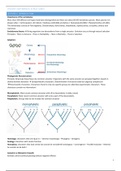
Principle; All groups (taxa) have one common ancestor. Organisms with the same ancestry are grouped together, based on
shared derived characters Synapomorphic characters. Determination of ancestral state by outgroup comparisson
Plesiomorphic characters. Characters found in only one specific group are called (Aut-)apomorphic characters. These
characters contain no information!
Monophyletic: Most recent common ancestor with all its descendents (=clade, taxon)
Paraphyletic: Most recent common ancestor with only a part of the descendents.
Polyphyletic: Groups that do not include the common ancestor
Homology: characters that are equal in: – General morphology – Phylogeny – Ontogeny
Analogy: characters with similar function
Homoplasy: characters that look similar but cannot be considered homologous – Convergence – Parallel evolution – Reversal
An animal can be both!
Isometric vs Allometric Growth:
Animals cannot continue growing without negative effects!
1
,Isometric growth (all body parts start small and grow bigger) leads to reduced surface-volume ratio. Solution: invagination (e.g.
lung and intestine) and implementation of a circulatory system. That is why isometric growth is only in small animals. Allometric
growth means that big parts (big organs) of the body start bigger like the head of a baby which is already big when they were
born. They are not growing the same amount (not isometric).
The Biogenetic Law: Adaption takes place in early stages. All embryo`s look the same. Adult forms (morphologies) are the result
of development.
Heterochrony: Variation in the start and/or duration of the development of a character (compared to other characters or even
body parts).
Paedomorphic (= resembles earlier stage)
• Progenesis (male stays smaller then female)
• Neoteny (sexual maturation that starts growing later)
• Post-Displacement (An alteration in the ontogeny of a
descendant such that some developmental process begins later
than in its ancestor, and may not have been completed by the
time maturity is reached) ontwikkeling voor en achterpoten. De
voorpoten gaan later groeien en zijn kleiner wanneer ze
geslachtsrijp zijn.
Peramorphic (= further developed) The other way around
• Hypermorphosis
• Acceleration
• Pre-Displacement
DISCUSSIE 1
1. Peadomorphic=child , Pheramorphis is later life. Progenese= vroegtijdig al geslachtsrijp. Neoteny= Wel gelachtsrijp maar
vertoond nog juvenile langzamere metamorfose
2
,2. Van buitenaf zien de dieren er allemaal anders uit (homoplasty) maar van binnen hebben ze de zelfde gemeenschappelijke
botten. Ze stammen af van dezelfde voorouder homology
Analogy: kieuwen en longen. Zelfde functie maar zien er niet hetzelfde uit.
3.Digital high speed video & emg. Comparison of our forelimb data to
previously collected data from slider hindlimp allows us to test whether limb
muscles with similar functional roles show quelitively similar modulations of
activity across habitats.
4. vertebrae; wervels. Vertebrates= an animal of a large group distinguished
by the possession of a backbone or spinal column. Notochord= is a flexible
chord made out of a material similar to cartilage. If a species has this any
stage of its life it is a chordate. In vertebrates the notochord becomes a part
of the vertebral column. It plays a key role in signaling and coordinating
development. In some chordates it persists throughout life as the main
structural support of the body, while In most it becomes the nucleous
pulpous.
5. Chordates and vertebrates are two groups of higher animals. Both are deuterostomes. Vertebrates are a type of advanced
chordates. Chordates are characterized by presence of a notochord. Both contain a nerve cord, pharyngeal gill slits and a post
anal tail at some points of their life. The main difference is that some chordates do not have a vertebral column whereas all
vertebrates have. In vertebrates the column surrounds and protects the nerve cord while the brain is protected by skull.
6. Are vultures a mono-, para- or polyphyletic group and why did they evolve this way?
Vultures are polyphyletic; the New world vultures (NWV) and old world vultures (OWV) have emerged separately.
Requirements that are met to be polyphyletic:
3
, 1. The most recent ancestor is not the same for both vulture groups.
2. Not all members of the Accipitridae are part of the vultures.
They are convergent species, because they share similar environments and life history. NWV live in North and South America
and find carcasses with their good sense of smell, whereas the OWV inhabit Africa and North America and find carcasses based
on sight only.
Monophyletic group: A clade, all organisms in a lineage plus the ancestor they have in common.
Paraphyletic group: An incomplete clade resulting from removal of one or more lineages.
Polyphyletic group: An artificial group characterised by features that are not homologous.
7. Discuss why you would pick a tree based on molecular data over a phylogenetic tree based on morphology and vice versa.
Nowadays, we base our phylogenetic trees mostly on molecular data, as it shows more accurately how animals are related.
Morphological data is susceptible for mistakes because of convergence and homoplasy. Example: position of turtles. Based on
temporal fenestrae they were placed as primitive retiles. However, based on molecular data they were found to be a sister
group of crocodiles. Fossils of lizard-like animals with turtle-like shells. Morphological data is not more accurate. However, it
used to be necessary to select genes for molecular analyses.
Nowadays, deep-sequencing is cheaper and a phylogenetic tree can be made based on molecular data only, although
researchers still use morphological data to explain shapes and function, which cannot be done with base-pairs only. E.g.
dinosaur research. Conclusion: you need morphological data to explain and complete a molecular phylogenetic tree.
LECTURE 2: ORIGINS
Eukarya (Plants Animals, Fungi,e.o)=Large number
of unicellular organisms with two groups with
multicellular organisms. Characters
Deuterostomia: Mouth forms secondly after the
formation of the anus.
Deuterostomia,
Ambulacraria
• Echinodermata
– Starfish
– Sea urchins
– Sea cucumbers
– Brittle stars
– Feather stars
• Hemichordata
– Enteropneusta
– Pterobranchia
Hemichordata
Synapomorpic (specific) characters:
• Tripartite body
– Proboscis
– Collar
– Trunk
Pterobranchia
Synapomorpic characters:
• Collar transformed into feeding arms
• U-shaped trunk, anus near feeding arms
• Collar ganglion
• Few pharyngeal slits
4
LECTURE 1: INTRODUCTION
Importance of the vertebrates
More than 200 different cell types have been distinguished and there are about 60.000 vertebrate species. Most species rich
phylum after: • Arthropoda (1-30 million) • Mollusca (100.000) and before • Nematoda (20.000) • Platyhelminthes (13.000).
The vertebrates consists of Fish (Agnatha, Chondrichtyes, Bony fishes), Amphibians, reptiles (birds, crocodiles, others) and
mammals.
Evolutionary theory: All living organisms are descendents from a single ancestor. Evolution occurs through natural selection
Principles : There is Variance – There is Heritability – There is Mortality – There is Selection.
Adaption:
Phylogenetic Reconstruction
Principle; All groups (taxa) have one common ancestor. Organisms with the same ancestry are grouped together, based on
shared derived characters Synapomorphic characters. Determination of ancestral state by outgroup comparisson
Plesiomorphic characters. Characters found in only one specific group are called (Aut-)apomorphic characters. These
characters contain no information!
Monophyletic: Most recent common ancestor with all its descendents (=clade, taxon)
Paraphyletic: Most recent common ancestor with only a part of the descendents.
Polyphyletic: Groups that do not include the common ancestor
Homology: characters that are equal in: – General morphology – Phylogeny – Ontogeny
Analogy: characters with similar function
Homoplasy: characters that look similar but cannot be considered homologous – Convergence – Parallel evolution – Reversal
An animal can be both!
Isometric vs Allometric Growth:
Animals cannot continue growing without negative effects!
1
,Isometric growth (all body parts start small and grow bigger) leads to reduced surface-volume ratio. Solution: invagination (e.g.
lung and intestine) and implementation of a circulatory system. That is why isometric growth is only in small animals. Allometric
growth means that big parts (big organs) of the body start bigger like the head of a baby which is already big when they were
born. They are not growing the same amount (not isometric).
The Biogenetic Law: Adaption takes place in early stages. All embryo`s look the same. Adult forms (morphologies) are the result
of development.
Heterochrony: Variation in the start and/or duration of the development of a character (compared to other characters or even
body parts).
Paedomorphic (= resembles earlier stage)
• Progenesis (male stays smaller then female)
• Neoteny (sexual maturation that starts growing later)
• Post-Displacement (An alteration in the ontogeny of a
descendant such that some developmental process begins later
than in its ancestor, and may not have been completed by the
time maturity is reached) ontwikkeling voor en achterpoten. De
voorpoten gaan later groeien en zijn kleiner wanneer ze
geslachtsrijp zijn.
Peramorphic (= further developed) The other way around
• Hypermorphosis
• Acceleration
• Pre-Displacement
DISCUSSIE 1
1. Peadomorphic=child , Pheramorphis is later life. Progenese= vroegtijdig al geslachtsrijp. Neoteny= Wel gelachtsrijp maar
vertoond nog juvenile langzamere metamorfose
2
,2. Van buitenaf zien de dieren er allemaal anders uit (homoplasty) maar van binnen hebben ze de zelfde gemeenschappelijke
botten. Ze stammen af van dezelfde voorouder homology
Analogy: kieuwen en longen. Zelfde functie maar zien er niet hetzelfde uit.
3.Digital high speed video & emg. Comparison of our forelimb data to
previously collected data from slider hindlimp allows us to test whether limb
muscles with similar functional roles show quelitively similar modulations of
activity across habitats.
4. vertebrae; wervels. Vertebrates= an animal of a large group distinguished
by the possession of a backbone or spinal column. Notochord= is a flexible
chord made out of a material similar to cartilage. If a species has this any
stage of its life it is a chordate. In vertebrates the notochord becomes a part
of the vertebral column. It plays a key role in signaling and coordinating
development. In some chordates it persists throughout life as the main
structural support of the body, while In most it becomes the nucleous
pulpous.
5. Chordates and vertebrates are two groups of higher animals. Both are deuterostomes. Vertebrates are a type of advanced
chordates. Chordates are characterized by presence of a notochord. Both contain a nerve cord, pharyngeal gill slits and a post
anal tail at some points of their life. The main difference is that some chordates do not have a vertebral column whereas all
vertebrates have. In vertebrates the column surrounds and protects the nerve cord while the brain is protected by skull.
6. Are vultures a mono-, para- or polyphyletic group and why did they evolve this way?
Vultures are polyphyletic; the New world vultures (NWV) and old world vultures (OWV) have emerged separately.
Requirements that are met to be polyphyletic:
3
, 1. The most recent ancestor is not the same for both vulture groups.
2. Not all members of the Accipitridae are part of the vultures.
They are convergent species, because they share similar environments and life history. NWV live in North and South America
and find carcasses with their good sense of smell, whereas the OWV inhabit Africa and North America and find carcasses based
on sight only.
Monophyletic group: A clade, all organisms in a lineage plus the ancestor they have in common.
Paraphyletic group: An incomplete clade resulting from removal of one or more lineages.
Polyphyletic group: An artificial group characterised by features that are not homologous.
7. Discuss why you would pick a tree based on molecular data over a phylogenetic tree based on morphology and vice versa.
Nowadays, we base our phylogenetic trees mostly on molecular data, as it shows more accurately how animals are related.
Morphological data is susceptible for mistakes because of convergence and homoplasy. Example: position of turtles. Based on
temporal fenestrae they were placed as primitive retiles. However, based on molecular data they were found to be a sister
group of crocodiles. Fossils of lizard-like animals with turtle-like shells. Morphological data is not more accurate. However, it
used to be necessary to select genes for molecular analyses.
Nowadays, deep-sequencing is cheaper and a phylogenetic tree can be made based on molecular data only, although
researchers still use morphological data to explain shapes and function, which cannot be done with base-pairs only. E.g.
dinosaur research. Conclusion: you need morphological data to explain and complete a molecular phylogenetic tree.
LECTURE 2: ORIGINS
Eukarya (Plants Animals, Fungi,e.o)=Large number
of unicellular organisms with two groups with
multicellular organisms. Characters
Deuterostomia: Mouth forms secondly after the
formation of the anus.
Deuterostomia,
Ambulacraria
• Echinodermata
– Starfish
– Sea urchins
– Sea cucumbers
– Brittle stars
– Feather stars
• Hemichordata
– Enteropneusta
– Pterobranchia
Hemichordata
Synapomorpic (specific) characters:
• Tripartite body
– Proboscis
– Collar
– Trunk
Pterobranchia
Synapomorpic characters:
• Collar transformed into feeding arms
• U-shaped trunk, anus near feeding arms
• Collar ganglion
• Few pharyngeal slits
4



