NMR: Beyond structure
Learning objective:
1. NMR able to determine the solution structure of small proteins
2. NMR can also determine binding sites, affinity, PH dependence of molecule, pKa of side chains, exchange rates (on/off rates),
binding (kinetics), dynamics, (flexibility) hydrogen bonding, intact body fluids
NMR
Has the ability to study the function of the protein as well as the structure
Anything in solution can be studies by NMR
- Do not need to purify can remain in situ (= in the reaction mixture)
Can use any fluid from the body i.e. urine, blood, saliva, snot#
Monitoring drug binding to protein
NMR can be used to monitor the binding of a substrate (i.e. drug, hormone, enzyme inhibitor, do-factor, vitamin, metal,
fatty acid etc) to the protein or other macromolecule
The affinity, stoichiometry and rate of reaction can be monitored using any NMR active nuclei
The binding process may cause a peak close which feels the effect of binding to gradually change its chemical shift
position (fast exchange) or drop in intensity and re-appear in a new position (slow exchange)
From the binding curve, affinity, stoichiometry of binding and the rate of the reaction can be monitored
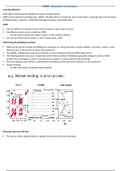
Image showing:
- As add more nickel , peak goes down intensity
Exchange rates (on/off rate)
The rate at which a ligand binds to a protein and comes off can be measured
, Measuring pKa’s
Nuclei close to a titration group can directly measure the pKa of that group
For example, the imidazole ring of histidine can be protonated or deprotonated depending on the PH
PKa is the midpoint of the sigmoidal curve, where half the histidine is protonated and half deprotonated
Learning objective:
1. NMR able to determine the solution structure of small proteins
2. NMR can also determine binding sites, affinity, PH dependence of molecule, pKa of side chains, exchange rates (on/off rates),
binding (kinetics), dynamics, (flexibility) hydrogen bonding, intact body fluids
NMR
Has the ability to study the function of the protein as well as the structure
Anything in solution can be studies by NMR
- Do not need to purify can remain in situ (= in the reaction mixture)
Can use any fluid from the body i.e. urine, blood, saliva, snot#
Monitoring drug binding to protein
NMR can be used to monitor the binding of a substrate (i.e. drug, hormone, enzyme inhibitor, do-factor, vitamin, metal,
fatty acid etc) to the protein or other macromolecule
The affinity, stoichiometry and rate of reaction can be monitored using any NMR active nuclei
The binding process may cause a peak close which feels the effect of binding to gradually change its chemical shift
position (fast exchange) or drop in intensity and re-appear in a new position (slow exchange)
From the binding curve, affinity, stoichiometry of binding and the rate of the reaction can be monitored
Image showing:
- As add more nickel , peak goes down intensity
Exchange rates (on/off rate)
The rate at which a ligand binds to a protein and comes off can be measured
, Measuring pKa’s
Nuclei close to a titration group can directly measure the pKa of that group
For example, the imidazole ring of histidine can be protonated or deprotonated depending on the PH
PKa is the midpoint of the sigmoidal curve, where half the histidine is protonated and half deprotonated