Biology Nikhil 12Y Topic 3 Full Notes
TOPIC 3 – Cells & Cellular Activity
Eukaryotic Cells & Organelles:
Organisms can either be EUKARYOTES or PROKARYOTES.
Prokaryotes are organisms that are single-cell prokaryotes. They
include bacteria.
Eukaryotes are composed of
eukaryotic cells. There are more
complex and include all animal
and plant cells.
Organelles are parts/components within
cells. Each organelle has a specific
function.
These organelles can be seen
through an electron microscope.
These microscopes can show cell
ultra structure.
The following list shows eukaryotic organelles, physical properties and their function:
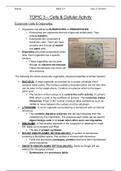
NUCLEUS: A large organelle surrounded by a nuclear envelope which
contains many pores. The nucleus contains chromatin which are the dots that
can be seen in the image above. Contains a nucleolus which is the larger
black spot.
The function of the nucleus is to control the cell’s activity. It contains
DNA which is used in the synthesis of proteins. The nucleolus makes
ribosomes. Pores in the nuclear envelope allow substances such as
mRNA to move between the nucleus and the cytoplasm.
LYSOSOME: A round organelle surrounded by a membrane with no internal
structures.
This contains digestive enzymes that are kept separate from the
cytoplasm by the membrane. The enzymes kept inside can be used to
digest foreign cells or to break down other worn out organelles.
RIBOSOME: A free-floating organelle in the cytoplasm or attached to rough
ER. Made up of proteins and RNA.
The site of protein synthesis.
ROUGH ENDOPLASMIC RETICULUM (ER): A system of membranes
enclosing a fluid-filled space. The surface is covered with ribosomes.
Folds and processes (packages) proteins that have been synthesised
at the ribosomes.
SMOOTH ENDOPLASMIC RETICULUM (ER): Same as Rough ER but
without the ribosomal surface.
Synthesises and processes lipids.
, Biology Nikhil 12Y Topic 3 Full Notes
GOLGI APPARATUS: A group of fluid-filled and membrane-bound sacs that
are flattened.
Processes and packages new lipids and proteins. Also make
lysosomes.
MITOCHONDIRA: Elliptical-shaped organelles with a double-membrane, with
the inner one being folded to form spiky-looking structures within the
organelle. Within the mitochondrion is the matrix, containing enzymes
involved in respiration.
The site of aerobic respiration where ATP is produced. Found in large
numbers in cells that are very active and require lots of energy.
CENTRIOLES: Small hollow cylinders that often appear as a T-shape when
cut laterally. Found in all animal but not all plant cells.
Involved in separating chromosomes during cell division.
Organelles play a major role in protein production and transport:
Proteins are synthesised at the ribosomes.
Ribosomes on rough ER make proteins to be excreted or for the cell
membrane. Free-floating ribosomes make proteins to stay in the
cytoplasm.
New proteins produced at the rough ER are folded and processed by the
rough ER.
They are then transported to the golgi apparatus via vesicles.
At the Golgi apparatus some proteins undergo further processing.
The proteins enter more vesicles to be transported around the cell.
Prokaryotic Cells:
Prokaryotic cells are simpler and smaller than eukaryotic cells.
TOPIC 3 – Cells & Cellular Activity
Eukaryotic Cells & Organelles:
Organisms can either be EUKARYOTES or PROKARYOTES.
Prokaryotes are organisms that are single-cell prokaryotes. They
include bacteria.
Eukaryotes are composed of
eukaryotic cells. There are more
complex and include all animal
and plant cells.
Organelles are parts/components within
cells. Each organelle has a specific
function.
These organelles can be seen
through an electron microscope.
These microscopes can show cell
ultra structure.
The following list shows eukaryotic organelles, physical properties and their function:
NUCLEUS: A large organelle surrounded by a nuclear envelope which
contains many pores. The nucleus contains chromatin which are the dots that
can be seen in the image above. Contains a nucleolus which is the larger
black spot.
The function of the nucleus is to control the cell’s activity. It contains
DNA which is used in the synthesis of proteins. The nucleolus makes
ribosomes. Pores in the nuclear envelope allow substances such as
mRNA to move between the nucleus and the cytoplasm.
LYSOSOME: A round organelle surrounded by a membrane with no internal
structures.
This contains digestive enzymes that are kept separate from the
cytoplasm by the membrane. The enzymes kept inside can be used to
digest foreign cells or to break down other worn out organelles.
RIBOSOME: A free-floating organelle in the cytoplasm or attached to rough
ER. Made up of proteins and RNA.
The site of protein synthesis.
ROUGH ENDOPLASMIC RETICULUM (ER): A system of membranes
enclosing a fluid-filled space. The surface is covered with ribosomes.
Folds and processes (packages) proteins that have been synthesised
at the ribosomes.
SMOOTH ENDOPLASMIC RETICULUM (ER): Same as Rough ER but
without the ribosomal surface.
Synthesises and processes lipids.
, Biology Nikhil 12Y Topic 3 Full Notes
GOLGI APPARATUS: A group of fluid-filled and membrane-bound sacs that
are flattened.
Processes and packages new lipids and proteins. Also make
lysosomes.
MITOCHONDIRA: Elliptical-shaped organelles with a double-membrane, with
the inner one being folded to form spiky-looking structures within the
organelle. Within the mitochondrion is the matrix, containing enzymes
involved in respiration.
The site of aerobic respiration where ATP is produced. Found in large
numbers in cells that are very active and require lots of energy.
CENTRIOLES: Small hollow cylinders that often appear as a T-shape when
cut laterally. Found in all animal but not all plant cells.
Involved in separating chromosomes during cell division.
Organelles play a major role in protein production and transport:
Proteins are synthesised at the ribosomes.
Ribosomes on rough ER make proteins to be excreted or for the cell
membrane. Free-floating ribosomes make proteins to stay in the
cytoplasm.
New proteins produced at the rough ER are folded and processed by the
rough ER.
They are then transported to the golgi apparatus via vesicles.
At the Golgi apparatus some proteins undergo further processing.
The proteins enter more vesicles to be transported around the cell.
Prokaryotic Cells:
Prokaryotic cells are simpler and smaller than eukaryotic cells.