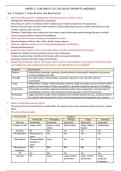
PAPER 2: CONTINUITY OF LIFE BLURT PROMPTS ANSWERS
Year 1 Chapter 7: Classification and Biodiversity
Define the following terms: Phylogenetic, Hierchical, Discrete, Tentative, Taxon
Phylogenetic: Reflecting evolutionary relatedness
Hierarchical: A system of ranking in which small groups of nested components of larger groups
Discrete: Discrete traits are those which maintain a distinct phenotypes and are usually controlled by a small
number of genes, often only one.
Tentative: Classification may change and is not fixed as more information and knowledge becomes available
Taxon: Any group within a system of classification
Write down the hierarchy of biological classification in order
Domain, Kingdom, Phylum, Class, Order, Family, Genus, Species
What two adjectives would you use to describe phylogenetic classification?
Discrete and hierarchical
Explain the three-domain system, the groups within it and the characteristics of each group
Eubacteria: Familiar/common bacteria such as E.coli. Prokaryotes.
Archaea: bacteria living in hostile environments with an unusual metabolism.
Eukaryota: Plantae, Animalia, Fungi and Protoctista
Explain the five-kingdom system, the groups within it and the characteristics of each group. The following table
may be filled out: (just include some basic features, the table fill later is more detailed)
Kingdom Key Features
Plantae Multicellular eukaryotic organisms, photosynthesise (autotrophs), reproduce using spores
or seeds, cellulose cell walls
Animalia Are multi-cellular, heterotrophic, eukaryotic organisms. Lack cell walls. Nervous
coordination.
Fungi Multicellular or single celled eukaryotic organisms. Body of moulds consist of threads called
hyphae, cell wall made of chitin, saprophytic or parasitic. Reproduce by spores or budding.
Prokaryotes Microscopic unicellular organisms including bacteria and cyanobacteria. Cell wall made of
peptidoglycan (murein). Lack membrane-bound organelles. Small 70S ribosomes.
Protoctista Algae and slime moulds. Some unicellular and resemble animal cells (e.g., Amoeba). Others
are colonial and have plant like-cells. Contain membrane bound organelles and a nucleus.
What is the binomial naming system?
The genus is the first word and has a capital letter. The species name comes second and does not have a capital
letter.
Fill out the following table:
Characteristic Kingdom
Prokaryote Protoctista Plantae Fungi Animalia
Cell type Prokaryotic Eukaryotic Eukaryotic Eukaryotic Eukaryotic
Number of cells Single-celled Single or multi- Multi-cellular Single-celled or Multicellular
celled hyphal
Nucleus No Yes Yes Yes Yes
Mitochondria Mesosomes in Yes Yes Yes Yes
some
Chloroplasts Photosynthetic some Yes No No
lamellae in
some
Ribosomes in 70S 80S 80S 80S 80S
cytoplasm
ER No Yes Yes Yes Yes
Vacuole No Some Large, central, Large, central, Small,
permanent permanent scattered,
temporary
, Cell wall Peptidoglycan Some – Cellulose Chitin No
cellulose
Nutrition Saprotrophic, Autotrophic or Autotrophic Saprotrophic or Heterotrophic
parasitic or heterotrophic parasitic
autotrophic
Nervous No No No No Yes
coordination
Define the following terms: Homologous structures, Pentadactyl, Analogous structures, convergent evolution,
divergent evolution
Homologous structures: Structures in different species with a similar anatomical position and developmental
origin, derived from a common ancestor
Pentadactyl: having five digits. A good examples of homologous structures
Analogous structures: Have a corresponding function and similar shape, but have a different developmental
origin
Convergent evolution: The development of similar features in unrelated organisms over long periods of time,
related to natural selection of similar features in a common environment
Divergent evolution: The development of different structures over long periods of time, from the equivalent
structures in related organisms
What three different ways can you assess relatedness of species?
1. Comparing physical features
2. Immunology – comparing proteins and antibodies
3. DNA fingerprinting and sequencing
Explain the two things that biologists mean when they say ‘Species’ (The concept of species)
Morphological definition: If two organisms look very similar they are likely to be in the same species. There may
be differences between sex (sexual dimorphism) which must be taken into account.
Reproductive definition: are able to interbreed to produce fertile offspring.
Explain the four ways you can assess relatedness with genetic evidence?
1. DNA sequences – More closely related species show more similarity in their DNA base sequence
2. DNA hybridisation – comparing the DNA base sequences of two species. DNA from both is extracted,
separated, and cut into fragments, fragments are mixed and where they have complementary sequences
they will hybridise together.
3. Amino acid sequences – the degree of similarity in the amino acid sequences of the same protein in two
species will reflect how closely related they are.
4. Immunology – proteins of different species can be compared by mixing antigens of one species with specific
antibodies of another, they will make a precipitate. The closer the relationship, the more precipitate will be
made.
What is the definition of biodiversity?
The number of species and the number of individuals of each species in a specified region.
What are the three factors affecting biodiversity?
1. Succession: the composition of a community changes over time
2. Natural selection
3. Human activity
Why is reduced biodiversity a concern for humans?
A small number of plant species provide staple foods such as wheat and rice, medicinal drugs are derived from
plants and fungi, living organisms provide important raw materials such as rubber and cotton.
How has biodiversity been generated?
Natural selection
What three ways can biodiversity be assessed?
1. At the population level (e.g., Simpson’s index)
2. With polymorphic loci (Number and proportion of alleles of a gene in a gene pool)
3. Molecular assessment (DNA fingerprints and profiles)
How can biodiversity be assessed within a species?
At a genetic level by looking at the variety of alleles in the gene pool of a population.
, Complete the following table describing the method for sampling different types of populations
Population Technique Method
Terrestrial animals Mark-release-recapture Animals are captured and marked (important to
(Lincoln Index) make sure marking is permanent but not more
visible to predators), then released and later
recaptured to estimate the total population size.
Have to assume no deaths, births, immigration etc.
Freshwater Kick-sampling and Simpsons Collect and identify invertebrates from a given
invertebrates Index area using a quadrat and a net. Kick or rake the
area. Collect invertebrates down-stream. Release
carefully.
Plants Quadrats and transects Estimate percentage cover of different plants using
a quadrat divided into 100 sections. Measure plant
diversity by counting number of plants in quadrat.
A transect is a length of rope that can be used to
measure intervals along an environmental
gradient, e.g., distance from woodland.
What are the three types of adaptations that organisms can have to their environment? Give an example for
each
1. Anatomical e.g., beak shape in finches
2. Physiological e.g., haemoglobin affinity in llamas at high altitudes
3. Behavioural e.g., nocturnal animals
Year 1 Chapter 6: The cell cycle and cell division
Draw diagrams for, name and explain the main stages of mitosis
1. Prophase
2. Metaphase
3. Anaphase
4. Telophase
Draw diagrams for, name and explain the main stages of meiosis
1. Prophase I (chromosomes condense, synapsis, crossing over,
spindle formation, nuclear envelope breakdown)
2. Metaphase I (pairs of chromosomes arrange at metaphase
plate, attach to microtubules)
3. Anaphase I (spindle moves homologs to opposite poles)
4. Telophase I (chromosome consists of two sister chromatids,
no chromosome replication between meiosis I and II)
5. Cytokinesis (plant cell = cell plate, animal cell = cleavage
furrow)
6. Prophase II (spindle apparatus forms, chromosomes move
towards metaphase II plate)
7. Metaphase II (crossing over means sister chromatids are NOT
identical, kinetochores attached to microtubules)
8. Anaphase II (breakdown of proteins in centromere allows
chromatids to separate, pulled to opposite poles)
9. Telophase II (nuclei form, chromosomes decondense)
10. Cytokinesis (4 genetically distinct cells formed)
Year 1 Chapter 7: Classification and Biodiversity
Define the following terms: Phylogenetic, Hierchical, Discrete, Tentative, Taxon
Phylogenetic: Reflecting evolutionary relatedness
Hierarchical: A system of ranking in which small groups of nested components of larger groups
Discrete: Discrete traits are those which maintain a distinct phenotypes and are usually controlled by a small
number of genes, often only one.
Tentative: Classification may change and is not fixed as more information and knowledge becomes available
Taxon: Any group within a system of classification
Write down the hierarchy of biological classification in order
Domain, Kingdom, Phylum, Class, Order, Family, Genus, Species
What two adjectives would you use to describe phylogenetic classification?
Discrete and hierarchical
Explain the three-domain system, the groups within it and the characteristics of each group
Eubacteria: Familiar/common bacteria such as E.coli. Prokaryotes.
Archaea: bacteria living in hostile environments with an unusual metabolism.
Eukaryota: Plantae, Animalia, Fungi and Protoctista
Explain the five-kingdom system, the groups within it and the characteristics of each group. The following table
may be filled out: (just include some basic features, the table fill later is more detailed)
Kingdom Key Features
Plantae Multicellular eukaryotic organisms, photosynthesise (autotrophs), reproduce using spores
or seeds, cellulose cell walls
Animalia Are multi-cellular, heterotrophic, eukaryotic organisms. Lack cell walls. Nervous
coordination.
Fungi Multicellular or single celled eukaryotic organisms. Body of moulds consist of threads called
hyphae, cell wall made of chitin, saprophytic or parasitic. Reproduce by spores or budding.
Prokaryotes Microscopic unicellular organisms including bacteria and cyanobacteria. Cell wall made of
peptidoglycan (murein). Lack membrane-bound organelles. Small 70S ribosomes.
Protoctista Algae and slime moulds. Some unicellular and resemble animal cells (e.g., Amoeba). Others
are colonial and have plant like-cells. Contain membrane bound organelles and a nucleus.
What is the binomial naming system?
The genus is the first word and has a capital letter. The species name comes second and does not have a capital
letter.
Fill out the following table:
Characteristic Kingdom
Prokaryote Protoctista Plantae Fungi Animalia
Cell type Prokaryotic Eukaryotic Eukaryotic Eukaryotic Eukaryotic
Number of cells Single-celled Single or multi- Multi-cellular Single-celled or Multicellular
celled hyphal
Nucleus No Yes Yes Yes Yes
Mitochondria Mesosomes in Yes Yes Yes Yes
some
Chloroplasts Photosynthetic some Yes No No
lamellae in
some
Ribosomes in 70S 80S 80S 80S 80S
cytoplasm
ER No Yes Yes Yes Yes
Vacuole No Some Large, central, Large, central, Small,
permanent permanent scattered,
temporary
, Cell wall Peptidoglycan Some – Cellulose Chitin No
cellulose
Nutrition Saprotrophic, Autotrophic or Autotrophic Saprotrophic or Heterotrophic
parasitic or heterotrophic parasitic
autotrophic
Nervous No No No No Yes
coordination
Define the following terms: Homologous structures, Pentadactyl, Analogous structures, convergent evolution,
divergent evolution
Homologous structures: Structures in different species with a similar anatomical position and developmental
origin, derived from a common ancestor
Pentadactyl: having five digits. A good examples of homologous structures
Analogous structures: Have a corresponding function and similar shape, but have a different developmental
origin
Convergent evolution: The development of similar features in unrelated organisms over long periods of time,
related to natural selection of similar features in a common environment
Divergent evolution: The development of different structures over long periods of time, from the equivalent
structures in related organisms
What three different ways can you assess relatedness of species?
1. Comparing physical features
2. Immunology – comparing proteins and antibodies
3. DNA fingerprinting and sequencing
Explain the two things that biologists mean when they say ‘Species’ (The concept of species)
Morphological definition: If two organisms look very similar they are likely to be in the same species. There may
be differences between sex (sexual dimorphism) which must be taken into account.
Reproductive definition: are able to interbreed to produce fertile offspring.
Explain the four ways you can assess relatedness with genetic evidence?
1. DNA sequences – More closely related species show more similarity in their DNA base sequence
2. DNA hybridisation – comparing the DNA base sequences of two species. DNA from both is extracted,
separated, and cut into fragments, fragments are mixed and where they have complementary sequences
they will hybridise together.
3. Amino acid sequences – the degree of similarity in the amino acid sequences of the same protein in two
species will reflect how closely related they are.
4. Immunology – proteins of different species can be compared by mixing antigens of one species with specific
antibodies of another, they will make a precipitate. The closer the relationship, the more precipitate will be
made.
What is the definition of biodiversity?
The number of species and the number of individuals of each species in a specified region.
What are the three factors affecting biodiversity?
1. Succession: the composition of a community changes over time
2. Natural selection
3. Human activity
Why is reduced biodiversity a concern for humans?
A small number of plant species provide staple foods such as wheat and rice, medicinal drugs are derived from
plants and fungi, living organisms provide important raw materials such as rubber and cotton.
How has biodiversity been generated?
Natural selection
What three ways can biodiversity be assessed?
1. At the population level (e.g., Simpson’s index)
2. With polymorphic loci (Number and proportion of alleles of a gene in a gene pool)
3. Molecular assessment (DNA fingerprints and profiles)
How can biodiversity be assessed within a species?
At a genetic level by looking at the variety of alleles in the gene pool of a population.
, Complete the following table describing the method for sampling different types of populations
Population Technique Method
Terrestrial animals Mark-release-recapture Animals are captured and marked (important to
(Lincoln Index) make sure marking is permanent but not more
visible to predators), then released and later
recaptured to estimate the total population size.
Have to assume no deaths, births, immigration etc.
Freshwater Kick-sampling and Simpsons Collect and identify invertebrates from a given
invertebrates Index area using a quadrat and a net. Kick or rake the
area. Collect invertebrates down-stream. Release
carefully.
Plants Quadrats and transects Estimate percentage cover of different plants using
a quadrat divided into 100 sections. Measure plant
diversity by counting number of plants in quadrat.
A transect is a length of rope that can be used to
measure intervals along an environmental
gradient, e.g., distance from woodland.
What are the three types of adaptations that organisms can have to their environment? Give an example for
each
1. Anatomical e.g., beak shape in finches
2. Physiological e.g., haemoglobin affinity in llamas at high altitudes
3. Behavioural e.g., nocturnal animals
Year 1 Chapter 6: The cell cycle and cell division
Draw diagrams for, name and explain the main stages of mitosis
1. Prophase
2. Metaphase
3. Anaphase
4. Telophase
Draw diagrams for, name and explain the main stages of meiosis
1. Prophase I (chromosomes condense, synapsis, crossing over,
spindle formation, nuclear envelope breakdown)
2. Metaphase I (pairs of chromosomes arrange at metaphase
plate, attach to microtubules)
3. Anaphase I (spindle moves homologs to opposite poles)
4. Telophase I (chromosome consists of two sister chromatids,
no chromosome replication between meiosis I and II)
5. Cytokinesis (plant cell = cell plate, animal cell = cleavage
furrow)
6. Prophase II (spindle apparatus forms, chromosomes move
towards metaphase II plate)
7. Metaphase II (crossing over means sister chromatids are NOT
identical, kinetochores attached to microtubules)
8. Anaphase II (breakdown of proteins in centromere allows
chromatids to separate, pulled to opposite poles)
9. Telophase II (nuclei form, chromosomes decondense)
10. Cytokinesis (4 genetically distinct cells formed)