

Engels
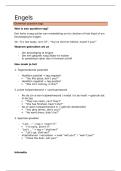
Grammar question tags
Wat is een question tag?
Een korte vraag achter een mededeling om te checken of iets klopt of om
bevestiging te krijgen.
Vb. “It’s hot today, isn’t it?”, “You’ve met her before, haven’t you?”
Waarom gebruiken we ze
- Om bevestiging te krijgen
- Om een gesprek natuurlijker te maken
- In spreektaal vaker dan in formeel schrift
Hoe maak je het
1. Tegenstellende polariteit
- Hoofdzin positief → tag negatief
“You like pizza, don’t you?”
- Hoofdzin negatief → tag positief
“She isn’t coming, is she?”
2. Juiste hulpwerkwoord + voornaamwoord
- Als de zin al een hulpwerkwoord / modal / to be heeft → gebruik dat
in de tag
“They can swim, can’t they?”
“She has finished, hasn’t she?”
- Als er geen hulpwerkwoord is → gebruik do/does/did
“You play tennis, don’t you?”
“He went there, didn’t he?”
3. Speciale gevallen
- “I am …” → tag = “aren’t I?”
“I’m early, aren’t I?”
- “Let’s …” → tag = “shall we?”
“Let’s go, shall we?”
- Imperatieven / verzoeken → vaak “will you?” / “won’t you?”
“Close the door, will you?”
Intonatie
, - Stijgend → echte vraag, je verwacht antwoord
- Dalend → bevestiging, retorisch, minder verwachting van antwoord
Voorbeelden
Grammar reported speech
Direct speech
- Je citeert exact wat iemand zei met aanhaaltekens
- Vb. she said: “i like ice cream”
Indirect/reported speech
- Zet inhoud om naar jouw keuze of iemand anders woorden.
- Geen aanhalingstekens en je past werkwoordstijden,
voornaamwoorden, tijd/plaats – uitdrukkingen, … aan
- Je gebruikt het wanneer je wil navertellen wat iemand zei
Indirect speech - 2 delen
- Reporting clause: vb. “he said…,”
- Reported clause: inhoud van wat gezegd werd, aangepast naar juiste
vorm
Direct speech Indirect speech
Present simple past simple “I work” he said (that) he worked
Present Continuous → Past “I am reading” → She said she was
Continuous reading
Present Perfect → Past Perfect “I have finished” → He said he had
finished
Past Simple → Past Perfect “I bought a car” → He said he had
bought a car
Past Continuous → Past Perfect “I was walking” → He said he had
Continuous been walking
, Soms veranderd tijd niet- als wat gezegd werd nog steeds waar is, of als
de spreker een gewoonte beschrijft.
Voornaamwoorden, bezittelijke voornaamwoorden
Moet meestal voornaamwoorden aanpassen aan nieuw perspectief
- “I” → “he / she / they” (als de spreker verandert)
- “You” → “I / we / he / she / they”, afhankelijk van wie er wordt
aangesproken.
Voorbeelden
Tijdsaanduidingen & plaats-/aanwijzende woorden
(Time/place/expressions & demonstratives)
Direct speech Indirect speech
now → then “I’m leaving now.” → She said
(that) she was leaving then
today → that day / that night “I’ll call you today.” → He said he
would call me that day
tomorrow → the next/following day “We’ll meet tomorrow.” → They
said they would meet the next day
yesterday → the day before / the “I saw her yesterday.” → He said he
previous day had seen her the day before
here → there “Come here.” → She told me to
come there
this → that / these → those “This book is great,” she said →
She said (that) that book was great
Modale werkwoorden (modal verbs) & andere werkwoordsvormen
Sommige modale werkwoorden veranderen bij indirect speech
- Will could
- Can could
- May might
- Must kan had to (afhankelijk van context)
- Andere modalen zoals should, could, would, might blijven vaak
hetzelfde
Voorbeeld
Grammar question tags
Wat is een question tag?
Een korte vraag achter een mededeling om te checken of iets klopt of om
bevestiging te krijgen.
Vb. “It’s hot today, isn’t it?”, “You’ve met her before, haven’t you?”
Waarom gebruiken we ze
- Om bevestiging te krijgen
- Om een gesprek natuurlijker te maken
- In spreektaal vaker dan in formeel schrift
Hoe maak je het
1. Tegenstellende polariteit
- Hoofdzin positief → tag negatief
“You like pizza, don’t you?”
- Hoofdzin negatief → tag positief
“She isn’t coming, is she?”
2. Juiste hulpwerkwoord + voornaamwoord
- Als de zin al een hulpwerkwoord / modal / to be heeft → gebruik dat
in de tag
“They can swim, can’t they?”
“She has finished, hasn’t she?”
- Als er geen hulpwerkwoord is → gebruik do/does/did
“You play tennis, don’t you?”
“He went there, didn’t he?”
3. Speciale gevallen
- “I am …” → tag = “aren’t I?”
“I’m early, aren’t I?”
- “Let’s …” → tag = “shall we?”
“Let’s go, shall we?”
- Imperatieven / verzoeken → vaak “will you?” / “won’t you?”
“Close the door, will you?”
Intonatie
, - Stijgend → echte vraag, je verwacht antwoord
- Dalend → bevestiging, retorisch, minder verwachting van antwoord
Voorbeelden
Grammar reported speech
Direct speech
- Je citeert exact wat iemand zei met aanhaaltekens
- Vb. she said: “i like ice cream”
Indirect/reported speech
- Zet inhoud om naar jouw keuze of iemand anders woorden.
- Geen aanhalingstekens en je past werkwoordstijden,
voornaamwoorden, tijd/plaats – uitdrukkingen, … aan
- Je gebruikt het wanneer je wil navertellen wat iemand zei
Indirect speech - 2 delen
- Reporting clause: vb. “he said…,”
- Reported clause: inhoud van wat gezegd werd, aangepast naar juiste
vorm
Direct speech Indirect speech
Present simple past simple “I work” he said (that) he worked
Present Continuous → Past “I am reading” → She said she was
Continuous reading
Present Perfect → Past Perfect “I have finished” → He said he had
finished
Past Simple → Past Perfect “I bought a car” → He said he had
bought a car
Past Continuous → Past Perfect “I was walking” → He said he had
Continuous been walking
, Soms veranderd tijd niet- als wat gezegd werd nog steeds waar is, of als
de spreker een gewoonte beschrijft.
Voornaamwoorden, bezittelijke voornaamwoorden
Moet meestal voornaamwoorden aanpassen aan nieuw perspectief
- “I” → “he / she / they” (als de spreker verandert)
- “You” → “I / we / he / she / they”, afhankelijk van wie er wordt
aangesproken.
Voorbeelden
Tijdsaanduidingen & plaats-/aanwijzende woorden
(Time/place/expressions & demonstratives)
Direct speech Indirect speech
now → then “I’m leaving now.” → She said
(that) she was leaving then
today → that day / that night “I’ll call you today.” → He said he
would call me that day
tomorrow → the next/following day “We’ll meet tomorrow.” → They
said they would meet the next day
yesterday → the day before / the “I saw her yesterday.” → He said he
previous day had seen her the day before
here → there “Come here.” → She told me to
come there
this → that / these → those “This book is great,” she said →
She said (that) that book was great
Modale werkwoorden (modal verbs) & andere werkwoordsvormen
Sommige modale werkwoorden veranderen bij indirect speech
- Will could
- Can could
- May might
- Must kan had to (afhankelijk van context)
- Andere modalen zoals should, could, would, might blijven vaak
hetzelfde
Voorbeeld


