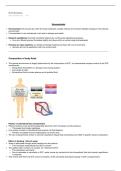
Homeostasis
Friday, 7 November 2025 15:35
Homeostasis
• Homeostasis: the process by which the body maintains a stable internal environment despite changes in the external
environment.
• If homeostasis is not maintained it can lead to disease and death.
• Dynamic equilibrium: the body maintains balance by continuously adjusting processes.
• Example: Blood glucose fluctuates slightly but stays within a normal range (homeostasis).
• Humans are open systems; our bodies exchange material and heat with our environment.
→ Humans are not at equilibrium with our environment.
---------------------------------------------------------------------------------------------------------------------------------------
Composition of body fluids
• The internal environment is largely determined by the composition of ECF, so homeostasis requires control of the ECF
constituents.
→ Extracellular fluid (ECF) is a transport and mixing system.
→ Surrounds all cells.
→ Extracellular fluid includes plasma and interstitial fluid.
Plasma vs interstitual fluid composistion
• Plasma contains more proteins (especially albumin) which increases oncotic pressure
→ This keeps fluid inside capillaries.
• Low protein content in interstitual fluid ensures net fluid balance.
→ Filtration at arterial end and reabsorption at venous end.
• The two compartments remain in osmotic equilibrium (equal total osmolarity), but differ in specific solute composition.
Effect of drinking 1 litre of water:
• Water is absorbed through small intestine into the plasma.
→ This increases extracellular fluid (ECF) volume.
• The added water contains no solutes, so it dilutes the ECF.
→ This decreases osmolarity.
→ Due to decrease in osmolarity in ECF, water moves by osmosis into the intracellular fluid until osmotic equilibrium
is restored.
• This means both ECF and ICF volume increases, whilst osmolarity decreases equally in both compartments.
1. Percentgae of water content is determined by:
2. Gender: males have a higher water content than females.
→ Due to men having more lean mass (which contains water), and women having more adipose tissue.
, → This decreases osmolarity.
→ Due to decrease in osmolarity in ECF, water moves by osmosis into the intracellular fluid until osmotic equilibrium
is restored.
• This means both ECF and ICF volume increases, whilst osmolarity decreases equally in both compartments.
1. Percentgae of water content is determined by:
2. Gender: males have a higher water content than females.
→ Due to men having more lean mass (which contains water), and women having more adipose tissue.
→ The more fat, the less total body water as a percentage of body mass.
3. Age: decreases with age
→ Decreases from infant to adult due to increase in fat and bone mass.
→ Decrease in the elderly due to loss of muscle mass and decreased kidney function.
---------------------------------------------------------------------------------------------------------------------------------------
Metabolism
• All chemical reactions in the body.
• It converts oxygen, water and food into excretory products.
○ Anabolism: Building (requires energy)
○ Catabolism: Breaking down (releases energy)
• Heat is a byproduct of metabolism, which helps maintain body temperature
• Resting metabolic rate can be measured by determining heat production.
• Nutrients, water and oxygen must be transported to each of our body
cells.
• Cellular metabolism produces heat and wastes, which must be transported away from cells.
---------------------------------------------------------------------------------------------------------------------------------------
Nutrients of Life
Nutrients are the substances essential for survival.
• Essential nutrients: required for physiological function but cannot be syntheised by our body.
→ Includes micronutrients, certain amino acids and certain fatty acids.
• Includes:
1. Macronutrients
→ Includes carbohydrates (fibres), lipids, proteins
→ Needed in large quantities.
2. Micronutrients
→ Includes vitamins and minerals.
→ Needed in small quantities.
→ Types of minerals: macro and trace minerals.
→ They are cofactors for metabolic reactions.
3. Water
→ Used a a solvent, for temperature regulation and transport.
4. Oxygen
---------------------------------------------------------------------------------------------------------------------------------------
Energy
• Calorie: Measure of energy released by food oxidation.
→ 1 Calorie = 4.18 kilojoules (kJ)
• Energy yield:
○ Carbohydrates: 4 kcal/g
○ Proteins: 4 kcal/g
○ Fats: 9 kcal/g
• Daily energy requirement is impacted by resting daily energy expenditure (proportional to lean body mass), physical
activity and digestion.
→ Maintaining body temperature in cold environment has an influence.
Body excretion
• Removal of metabolic waste to maintain chemical balance.
• Organ systems and excretory products involved:
Friday, 7 November 2025 15:35
Homeostasis
• Homeostasis: the process by which the body maintains a stable internal environment despite changes in the external
environment.
• If homeostasis is not maintained it can lead to disease and death.
• Dynamic equilibrium: the body maintains balance by continuously adjusting processes.
• Example: Blood glucose fluctuates slightly but stays within a normal range (homeostasis).
• Humans are open systems; our bodies exchange material and heat with our environment.
→ Humans are not at equilibrium with our environment.
---------------------------------------------------------------------------------------------------------------------------------------
Composition of body fluids
• The internal environment is largely determined by the composition of ECF, so homeostasis requires control of the ECF
constituents.
→ Extracellular fluid (ECF) is a transport and mixing system.
→ Surrounds all cells.
→ Extracellular fluid includes plasma and interstitial fluid.
Plasma vs interstitual fluid composistion
• Plasma contains more proteins (especially albumin) which increases oncotic pressure
→ This keeps fluid inside capillaries.
• Low protein content in interstitual fluid ensures net fluid balance.
→ Filtration at arterial end and reabsorption at venous end.
• The two compartments remain in osmotic equilibrium (equal total osmolarity), but differ in specific solute composition.
Effect of drinking 1 litre of water:
• Water is absorbed through small intestine into the plasma.
→ This increases extracellular fluid (ECF) volume.
• The added water contains no solutes, so it dilutes the ECF.
→ This decreases osmolarity.
→ Due to decrease in osmolarity in ECF, water moves by osmosis into the intracellular fluid until osmotic equilibrium
is restored.
• This means both ECF and ICF volume increases, whilst osmolarity decreases equally in both compartments.
1. Percentgae of water content is determined by:
2. Gender: males have a higher water content than females.
→ Due to men having more lean mass (which contains water), and women having more adipose tissue.
, → This decreases osmolarity.
→ Due to decrease in osmolarity in ECF, water moves by osmosis into the intracellular fluid until osmotic equilibrium
is restored.
• This means both ECF and ICF volume increases, whilst osmolarity decreases equally in both compartments.
1. Percentgae of water content is determined by:
2. Gender: males have a higher water content than females.
→ Due to men having more lean mass (which contains water), and women having more adipose tissue.
→ The more fat, the less total body water as a percentage of body mass.
3. Age: decreases with age
→ Decreases from infant to adult due to increase in fat and bone mass.
→ Decrease in the elderly due to loss of muscle mass and decreased kidney function.
---------------------------------------------------------------------------------------------------------------------------------------
Metabolism
• All chemical reactions in the body.
• It converts oxygen, water and food into excretory products.
○ Anabolism: Building (requires energy)
○ Catabolism: Breaking down (releases energy)
• Heat is a byproduct of metabolism, which helps maintain body temperature
• Resting metabolic rate can be measured by determining heat production.
• Nutrients, water and oxygen must be transported to each of our body
cells.
• Cellular metabolism produces heat and wastes, which must be transported away from cells.
---------------------------------------------------------------------------------------------------------------------------------------
Nutrients of Life
Nutrients are the substances essential for survival.
• Essential nutrients: required for physiological function but cannot be syntheised by our body.
→ Includes micronutrients, certain amino acids and certain fatty acids.
• Includes:
1. Macronutrients
→ Includes carbohydrates (fibres), lipids, proteins
→ Needed in large quantities.
2. Micronutrients
→ Includes vitamins and minerals.
→ Needed in small quantities.
→ Types of minerals: macro and trace minerals.
→ They are cofactors for metabolic reactions.
3. Water
→ Used a a solvent, for temperature regulation and transport.
4. Oxygen
---------------------------------------------------------------------------------------------------------------------------------------
Energy
• Calorie: Measure of energy released by food oxidation.
→ 1 Calorie = 4.18 kilojoules (kJ)
• Energy yield:
○ Carbohydrates: 4 kcal/g
○ Proteins: 4 kcal/g
○ Fats: 9 kcal/g
• Daily energy requirement is impacted by resting daily energy expenditure (proportional to lean body mass), physical
activity and digestion.
→ Maintaining body temperature in cold environment has an influence.
Body excretion
• Removal of metabolic waste to maintain chemical balance.
• Organ systems and excretory products involved: