The Nervous System
Saturday, 25 October 2025 15:50
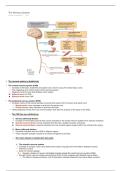
• The nervous system is divided into:
→ The central nervous system (CNS)
• Consists of the brain, brainstem and spinal cord, which occupy the dorsal body cavity.
• The integrating and control center of the nervous system.
→ Interprets sensory input and dictates motor output.
► Afferent nerve: to CNS
► Efferent nerve: from CNS
→ The peripheral nervous system (PNS)
• Consists mainly of the nerves (bundles of axons) that extend from the brain and spinal cord.
→ Spinal nerves: carry impulses to and from the spinal cord.
→ Cranial nerves: carry impulses to and from the brain.
• These peripheral nerves serve as communication lines that link all parts of the body to the CNS.
• The PNS has two subdivisions:
1. Sensory (afferent) division
→ Consists of nerve fibers (axons) that convey impulses to the central nervous system from sensory receptors.
► Somatic sensory fibers: convey impulses from the skin, skeletal muscles, and joints.
► Visceral sensory fibers: transmit impulses from the visceral organs (organs within the ventral body cavity).
2. Motor (efferent) division
→ Transmits impulses from the CNS to effector organs.
→ These impulses activate muscles to contract and glands to secrete.
→ The motor division is divided into two parts:
1.The somatic nervous system
→ Consists of somatic motor nerve fibers that conduct impulses from the CNS to skeletal muscles.
→ Voluntary control
→ Does not contain ganglia.
→ Ganglia: clusters of neuron cell bodies located outside the central nervous system (CNS).
→ Somatic motor neurons release acetylcholine (ACh) at their synapses with skeletal muscle fibers.
→ The effect is always excitatory, and if stimulation reaches threshold, the muscle fibers contract.
2. The autonomic nervous system (ANS)
→ Consists of visceral motor nerve fibers that regulate the activity of smooth muscles, cardiac muscles,
and glands.
→ Involuntary control.
, → Does not contain ganglia.
→ Ganglia: clusters of neuron cell bodies located outside the central nervous system (CNS).
→ Somatic motor neurons release acetylcholine (ACh) at their synapses with skeletal muscle fibers.
→ The effect is always excitatory, and if stimulation reaches threshold, the muscle fibers contract.
2. The autonomic nervous system (ANS)
→ Consists of visceral motor nerve fibers that regulate the activity of smooth muscles, cardiac muscles,
and glands.
→ Involuntary control.
→ Autonomic postganglionic fibers release two neurotransmitters.
→ Norepinephrine secreted by most sympathetic fibers, and ACh secreted by parasympathetic fibers.
→ The effect may be excitatory or inhibitory (depending on type of receptor).
---------------------------------------------------------------------------------------------------------------------------------------
The autonomic nervous system
• Regulates involuntary body functions, to maintain homeostasis.
→ This includes heart rate, digestion, respiration, blood vessel diameter, and gland secretion.
→ It acts below conscious control, though the hypothalamus modulate it.
• The ANS uses a two-neuron chain to reach effectors:
1. Preganglionic neuron:
→ Cell body in the CNS.
→ Axon exits to synapse with the postganglionic neuron (autonomic ganglion).
► Thin and lightly myelinated fibers.
2. Postganglionic neuron:
→ Cell body is in the ganglion (outside the CNS)
→ Axon projects to the effector organ.
► Even thinner and nonmyelinated fibers.
→ Many pre- and postganglionic fibers are incorporated into spinal or cranial nerves.
→ Conduction through the autonomic efferent chain is slower than conduction in the somatic motor system (due to thin
and minimal myelination).
• The ANS has three functional subdivisions:
→ The sympathetic and parasympathetic divisions work in opposition to each other (whatever one stimulates, the other
inhibits).
1. Sympathetic division
• “Fight or Flight”.
, and minimal myelination).
• The ANS has three functional subdivisions:
→ The sympathetic and parasympathetic divisions work in opposition to each other (whatever one stimulates, the other
inhibits).
1. Sympathetic division
• “Fight or Flight”.
• Prepares the body for activity, stress, or emergencies.
• Catabolic.
• Norepinephrine/ epinephrine are neurotransmitters in post-ganglionic neurons.
• Functions:
→ Increases heart rate, blood pressure, and breathing rate.
→ Dilates pupils for better distance vision.
→ Shunts blood to skeletal muscles and the heart.
→ Dilates bronchioles to improve oxygen intake.
→ Releases glucose from the live.
→ Inhibits digestion and other nonessential processes during activity.
• Example: Running from danger or feeling stressed.
• Nickname: E division → Exercise, Excitement, Emergency, Embarrassment.
• Structure:
→ Origin is the thoracolumbar part (spinal chord)(T1-L2).
→ Ganglia are in paravertebral chain.
► Sympathetic trunk ganglia: alongside vertebral column
► Collateral (prevertabral) ganglia: anterior to vertebral column.
→ Short preganglionic and long postganglionic fiber.
→ Extensive branching.
• All preganglionic fibers release ACh.
• Postganglionic fibers release norepinephrine, except for ones that serve sweat glands, which release Ach.
• Neurotransmitter activity is enhanced by release of adrenal medullary hormones (norepinephrine and epinephrine).
• Contain rami communicantes.
→ Small nerve branches that form links between the peripheral nerves and the sympathetic system, allowing signals
to travel to and from the spinal cord.
Type Fiber Type Color Function Location
(appearance)
White rami Preganglionic White due to Carry impulses from spinal Only found at T1–L2 spinal
communicantes sympathetic myelin nerve to sympathetic levels (where sympathetic
fibers(myelinated) ganglion outflow originates)
Gray rami Postganglionic Gray (no myelin) Carry impulses from Found at all spinal levels
communicantes sympathetic sympathetic ganglion to
fibers(unmyelinated) spinal nerve to target
organs (like skin, blood
vessels)
• Contains the adrenal medulla, which acts as a modified sympathetic ganglion.
→ When the sympathetic nervous system is activated ,the adrenal medulla releases epinephrine (≈
80%) and norepinephrine (≈20%) into the blood.
→ Sympathetic neurons travel through the splanchnic nerves to the adrenal medulla.
→ Instead of synapsing with a postganglionic neuron, they stimulate chromaffin cells which act as a postganglionic
neuron (release epinephrine and norepinephrine).
→ Unlike direct sympathetic nerves, the hormonal release lasts longer and reaches all organs simultaneously,
ensuring a coordinated whole-body response.
Feature Sympathetic Neurons Adrenal Medulla
Location Chain & prevertebral ganglia Inside adrenal gland (above kidneys)
Signal type Neural (neurotransmitter) Hormonal (via bloodstream)
Chemical released Norepinephrine Epinephrine & norepinephrine
Duration of effect Short (milliseconds–seconds) Longer (minutes)
Effect range Local (specific organs) Widespread (entire body)
Significance Rapid activation Reinforces & prolongs sympathetic effects
2. Parasympathetic division
• “Rest and Digest”.
• Conserves energy and maintains normal body functions during rest.
• Anabolic.
• Acetylcholine is the neurotransmitter in post-ganglionic neurons.
Saturday, 25 October 2025 15:50
• The nervous system is divided into:
→ The central nervous system (CNS)
• Consists of the brain, brainstem and spinal cord, which occupy the dorsal body cavity.
• The integrating and control center of the nervous system.
→ Interprets sensory input and dictates motor output.
► Afferent nerve: to CNS
► Efferent nerve: from CNS
→ The peripheral nervous system (PNS)
• Consists mainly of the nerves (bundles of axons) that extend from the brain and spinal cord.
→ Spinal nerves: carry impulses to and from the spinal cord.
→ Cranial nerves: carry impulses to and from the brain.
• These peripheral nerves serve as communication lines that link all parts of the body to the CNS.
• The PNS has two subdivisions:
1. Sensory (afferent) division
→ Consists of nerve fibers (axons) that convey impulses to the central nervous system from sensory receptors.
► Somatic sensory fibers: convey impulses from the skin, skeletal muscles, and joints.
► Visceral sensory fibers: transmit impulses from the visceral organs (organs within the ventral body cavity).
2. Motor (efferent) division
→ Transmits impulses from the CNS to effector organs.
→ These impulses activate muscles to contract and glands to secrete.
→ The motor division is divided into two parts:
1.The somatic nervous system
→ Consists of somatic motor nerve fibers that conduct impulses from the CNS to skeletal muscles.
→ Voluntary control
→ Does not contain ganglia.
→ Ganglia: clusters of neuron cell bodies located outside the central nervous system (CNS).
→ Somatic motor neurons release acetylcholine (ACh) at their synapses with skeletal muscle fibers.
→ The effect is always excitatory, and if stimulation reaches threshold, the muscle fibers contract.
2. The autonomic nervous system (ANS)
→ Consists of visceral motor nerve fibers that regulate the activity of smooth muscles, cardiac muscles,
and glands.
→ Involuntary control.
, → Does not contain ganglia.
→ Ganglia: clusters of neuron cell bodies located outside the central nervous system (CNS).
→ Somatic motor neurons release acetylcholine (ACh) at their synapses with skeletal muscle fibers.
→ The effect is always excitatory, and if stimulation reaches threshold, the muscle fibers contract.
2. The autonomic nervous system (ANS)
→ Consists of visceral motor nerve fibers that regulate the activity of smooth muscles, cardiac muscles,
and glands.
→ Involuntary control.
→ Autonomic postganglionic fibers release two neurotransmitters.
→ Norepinephrine secreted by most sympathetic fibers, and ACh secreted by parasympathetic fibers.
→ The effect may be excitatory or inhibitory (depending on type of receptor).
---------------------------------------------------------------------------------------------------------------------------------------
The autonomic nervous system
• Regulates involuntary body functions, to maintain homeostasis.
→ This includes heart rate, digestion, respiration, blood vessel diameter, and gland secretion.
→ It acts below conscious control, though the hypothalamus modulate it.
• The ANS uses a two-neuron chain to reach effectors:
1. Preganglionic neuron:
→ Cell body in the CNS.
→ Axon exits to synapse with the postganglionic neuron (autonomic ganglion).
► Thin and lightly myelinated fibers.
2. Postganglionic neuron:
→ Cell body is in the ganglion (outside the CNS)
→ Axon projects to the effector organ.
► Even thinner and nonmyelinated fibers.
→ Many pre- and postganglionic fibers are incorporated into spinal or cranial nerves.
→ Conduction through the autonomic efferent chain is slower than conduction in the somatic motor system (due to thin
and minimal myelination).
• The ANS has three functional subdivisions:
→ The sympathetic and parasympathetic divisions work in opposition to each other (whatever one stimulates, the other
inhibits).
1. Sympathetic division
• “Fight or Flight”.
, and minimal myelination).
• The ANS has three functional subdivisions:
→ The sympathetic and parasympathetic divisions work in opposition to each other (whatever one stimulates, the other
inhibits).
1. Sympathetic division
• “Fight or Flight”.
• Prepares the body for activity, stress, or emergencies.
• Catabolic.
• Norepinephrine/ epinephrine are neurotransmitters in post-ganglionic neurons.
• Functions:
→ Increases heart rate, blood pressure, and breathing rate.
→ Dilates pupils for better distance vision.
→ Shunts blood to skeletal muscles and the heart.
→ Dilates bronchioles to improve oxygen intake.
→ Releases glucose from the live.
→ Inhibits digestion and other nonessential processes during activity.
• Example: Running from danger or feeling stressed.
• Nickname: E division → Exercise, Excitement, Emergency, Embarrassment.
• Structure:
→ Origin is the thoracolumbar part (spinal chord)(T1-L2).
→ Ganglia are in paravertebral chain.
► Sympathetic trunk ganglia: alongside vertebral column
► Collateral (prevertabral) ganglia: anterior to vertebral column.
→ Short preganglionic and long postganglionic fiber.
→ Extensive branching.
• All preganglionic fibers release ACh.
• Postganglionic fibers release norepinephrine, except for ones that serve sweat glands, which release Ach.
• Neurotransmitter activity is enhanced by release of adrenal medullary hormones (norepinephrine and epinephrine).
• Contain rami communicantes.
→ Small nerve branches that form links between the peripheral nerves and the sympathetic system, allowing signals
to travel to and from the spinal cord.
Type Fiber Type Color Function Location
(appearance)
White rami Preganglionic White due to Carry impulses from spinal Only found at T1–L2 spinal
communicantes sympathetic myelin nerve to sympathetic levels (where sympathetic
fibers(myelinated) ganglion outflow originates)
Gray rami Postganglionic Gray (no myelin) Carry impulses from Found at all spinal levels
communicantes sympathetic sympathetic ganglion to
fibers(unmyelinated) spinal nerve to target
organs (like skin, blood
vessels)
• Contains the adrenal medulla, which acts as a modified sympathetic ganglion.
→ When the sympathetic nervous system is activated ,the adrenal medulla releases epinephrine (≈
80%) and norepinephrine (≈20%) into the blood.
→ Sympathetic neurons travel through the splanchnic nerves to the adrenal medulla.
→ Instead of synapsing with a postganglionic neuron, they stimulate chromaffin cells which act as a postganglionic
neuron (release epinephrine and norepinephrine).
→ Unlike direct sympathetic nerves, the hormonal release lasts longer and reaches all organs simultaneously,
ensuring a coordinated whole-body response.
Feature Sympathetic Neurons Adrenal Medulla
Location Chain & prevertebral ganglia Inside adrenal gland (above kidneys)
Signal type Neural (neurotransmitter) Hormonal (via bloodstream)
Chemical released Norepinephrine Epinephrine & norepinephrine
Duration of effect Short (milliseconds–seconds) Longer (minutes)
Effect range Local (specific organs) Widespread (entire body)
Significance Rapid activation Reinforces & prolongs sympathetic effects
2. Parasympathetic division
• “Rest and Digest”.
• Conserves energy and maintains normal body functions during rest.
• Anabolic.
• Acetylcholine is the neurotransmitter in post-ganglionic neurons.