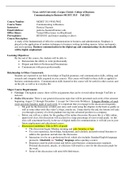
Advanced Pathophysiology study guide
Week 4: Advanced Pathophysiology © 2017 South University Lecture Summaries Cell Biology /Cellular response/Cell environment Cell Biology/Adaptation Cells become specialized through the process of differentiation or maturation. The eight specialized cellular functions are movement, conductivity, metabolic absorption, secretion, excretion, respiration, reproduction, and communication. The eukaryotic cell consists of three general components: plasma membrane, cytoplasm, and intracellular organelles. The nucleus is the largest membrane-bound organelle and is usually found in the cell's center. Vaults are cytoplasmic organelles. They are carrying messengers of ribonucleic acid (mRNA) from the nucleus to the ribosomal sites of protein synthesis. The plasma membrane encloses the cell and, by controlling the movement of substances across it, exerts a powerful influence on metabolic pathways. Atrophy is a decrease in cellular size. Hypertrophy is an increase in the size of cells by increased work demands or hormonal stimulation. Hyperplasia is an increase in the number of cells caused by an increased rate of cellular division. Dysplasia, or atypical hyperplasia, is an abnormal change in the size, shape, and organization of mature tissue cells. Metaplasia is the reversible replacement of one mature cell type by another less mature cell type. Cellular Environment Body fluids are distributed among functional compartments and are classified as intracellular fluid (ICF) or extracellular fluid (ECF). The sum of all fluids is the total body water (TBW), which varies with age and the amount of body fat. Water moves between the plasma and interstitial fluid by osmosis and hydrostatic pressure. Edema is a problem of fluid distribution that results in the accumulation of fluid in the interstitial spaces. (Please refer to figure 3-2 in your textbook, which shows the mechanisms of edema formation.) Immunologic/Infectious Two types of human defense mechanisms exist: (1) innate resistance or immunity conferred by natural barriers, and (2) the inflammatory response and the adaptive (acquired) immune system. First, let’s look at the mechanisms related to the inflammatory response. Vascular response in acute inflammation includes vasodilation, increased capillary permeability, and adherence of white blood cells to inner vessel walls and their migration through the vessel walls. Three plasma protein systems provide a biochemical barrier against invading pathogens in the circulation. Types of cells involved in the inflammatory process, including mast cells, granulocytes (neutrophils, eosinophils, and basophils), monocytes or macrophages, natural killer (NK) cells, lymphocytes, and cellular fragments (platelets). The inflammatory response is initiated upon tissue injury or pathogen-associated molecular patterns that are recognized by pattern recognition receptors on cells of the innate immune system. Local manifestations of inflammation are the result of vascular vasodilation and increased capillary permeability. The symptoms include redness, heat, swelling, and pain. Immunity Cells of the innate system most often initiate the adaptive immune response. These cells process and present portions of invading pathogens (e.g., antigens) to lymphocytes in peripheral lymphoid tissue. Adaptive immunity can be either active or passive, depending on whether the immune response components originated in the host or came from a donor. Hypersensitivity Disorders There is a wide range of pathologic alterations in the immune response and are covered extensively in the textbook Pathophysiology: The Biologic Basis for Disease in Adults and Children. There are four types of common disorders, I‒IV. These hypersensitivity disorders are an "exaggeration" of the immune response, resulting in a variety of disorders. The two more common include type I and type IV. Type I is the immediate hypersensitivity disorder and is mediated by IgE, i.e., allergic rhinitis and asthma. Type IV is delayed hypersensitivity and is from direct contact. ……………………………………………….CONTINUED………………………………………………………
Geschreven voor
- Instelling
- South University
- Vak
- NSG 6006 (NSG6006)
Documentinformatie
- Geüpload op
- 22 februari 2021
- Aantal pagina's
- 33
- Geschreven in
- 2020/2021
- Type
- Overig
- Persoon
- Onbekend
Onderwerpen
-
cell biology cellular responsecell environment
-
cell biologyadaptation
-
immunologicinfectious
-
hypersensitivity disorders
-
geneticsgenomics
-
week 4 advanced pathophysiology

Ook beschikbaar in voordeelbundel