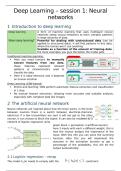
Deep Learning – session 1: Neural
networks
1 Introduction to deep learning
Deep learning A form of machine learning that uses multilayer neural
networks (deep neural networks) to learn complex patterns
in large amounts of data.
When deep learning? Powerful for dealing with unstructured data (can be
applied to structured data), it will find patterns in this data,
where the human won’t see anything
Scalable as a function of the amount of training data.
the more examples you give the better the model gets.
traditionial machine learning:
Here you need humans to manually
extract features from raw data,
these features represent relevant
patterns or characteristics used to
classify the data
Here it is labor-intensive and it depends
on human intuition
Deep Learning (CNN-based):
End-to-end learning: CNN perform automatic feature extraction and classification
in 1 step
No manual feature extraction, allowing more accurate and scalable analysis,
especially with complext data like images
2 The artificial neural network
Neural networks are inspired about how the brain works. In the brain
between neurons there is a switch between electrical-chemical-
electrical: if a few transmitters are sent it will not get to the other
neuron, it can choose to block the signal. It can also be modeled as a
network of logistic regression units.
green block = perception (=artificial neuron)
here 3 inputs with each a different weight, this is
how the neuron assigns the importance of the
input. With this info you can solve the summing
function, after this you will implement the
outcome in the activation function to get a
percentage of the probability, this will be the
output automatically.
2.1 Logistic regression – recap
The model hw(x) needs to comply with the constraint:
, hw(x) = estimated probability that y=1 with input x
Ex: hw(x) =0.80 => model is 80% confident that the sample belongs to class 1
(in service)
Logistic regression vs neural networks (in case of non-linearly separable data):
Use higher order features
Neural networks make new representations of existing
features
2.2 Properties of a neural network
Network architecture
You want the NN to
Learning algorithm
adapt & generalize to
Activation functions
the data
2.2.1Network architectures
properties:
1 or more (hidden) layers
Each neuron in a layer is connected to every
neuron in the next layer
networks
1 Introduction to deep learning
Deep learning A form of machine learning that uses multilayer neural
networks (deep neural networks) to learn complex patterns
in large amounts of data.
When deep learning? Powerful for dealing with unstructured data (can be
applied to structured data), it will find patterns in this data,
where the human won’t see anything
Scalable as a function of the amount of training data.
the more examples you give the better the model gets.
traditionial machine learning:
Here you need humans to manually
extract features from raw data,
these features represent relevant
patterns or characteristics used to
classify the data
Here it is labor-intensive and it depends
on human intuition
Deep Learning (CNN-based):
End-to-end learning: CNN perform automatic feature extraction and classification
in 1 step
No manual feature extraction, allowing more accurate and scalable analysis,
especially with complext data like images
2 The artificial neural network
Neural networks are inspired about how the brain works. In the brain
between neurons there is a switch between electrical-chemical-
electrical: if a few transmitters are sent it will not get to the other
neuron, it can choose to block the signal. It can also be modeled as a
network of logistic regression units.
green block = perception (=artificial neuron)
here 3 inputs with each a different weight, this is
how the neuron assigns the importance of the
input. With this info you can solve the summing
function, after this you will implement the
outcome in the activation function to get a
percentage of the probability, this will be the
output automatically.
2.1 Logistic regression – recap
The model hw(x) needs to comply with the constraint:
, hw(x) = estimated probability that y=1 with input x
Ex: hw(x) =0.80 => model is 80% confident that the sample belongs to class 1
(in service)
Logistic regression vs neural networks (in case of non-linearly separable data):
Use higher order features
Neural networks make new representations of existing
features
2.2 Properties of a neural network
Network architecture
You want the NN to
Learning algorithm
adapt & generalize to
Activation functions
the data
2.2.1Network architectures
properties:
1 or more (hidden) layers
Each neuron in a layer is connected to every
neuron in the next layer