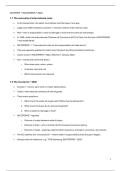
CHAPTER 1 INCOTERMS ® 2020
1.1 The necessity of international rules
• In all transactions, the seller must deliver and the buyer must pay.
• Legal rules differ between countries → need for uniform international rules.
• Risk = who is responsible in case of damage or loss (not the same as ownership).
• In 1936, under the International Chamber of Commerce (ICC) in Paris, the first set of INCOTERMS
® was established.
• INCOTERMS ® = “international rules for the interpretation of trade terms”.
• They are regularly updated to match new transport and documentation practices.
• Latest version: INCOTERMS ® 2020, effective 1 January 2020.
• Aim → clarity and uniformity about
o Who does what, when, where
o At whose cost and risk
o Which documents are required
1.2 The incoterms ® 2020
• Contain 11 terms, each with a 3-letter abbreviation.
• Used in international contracts of sale of goods.
• Three main questions:
1. What must the seller do to get paid? (When has he delivered?)
2. What must the buyer do to receive the goods?
3. Who is liable for damage or loss?
• INCOTERMS ® regulate
o Division of costs between seller & buyer
o Division of risks – who is entitled to the transport insurance policy
o Division of tasks – packing, export/import clearance, transport, insurance, documents
• The ICC defines the “critical point” = where seller’s responsibility ends & buyer’s begins.
• Always write full reference: e.g. “FOB Hamburg, INCOTERMS ® 2020”.
1
,Four groups (based on main carriage & seller’s obligations):
Group Meaning Terms
Seller’s minimum obligation.
Delivery is at the seller’s factory or depot.
E – Departure EXW= Ex works
This is also where the buyer must collect
the goods.
Main carriage is not paid by the seller, but FCA= Free Carrier
F – Main carriage
delivery is generally not far from his home FAS= Free alongside ship
unpaid
base. FOB= Free on Board
CPT= carriage paid to CIP=
carriage and insurance paid
C – Main carriage Seller pays main transport, risk transfers
to
paid earlier
CFR= cost and freight
CIF= cost, insurance, freight
DAP= delivered at place
DPU= delivered at place
D – Arrival Seller delivers far from home base
unloaded
DDP= delivered duty paid
• EXW = minimum obligation for seller, DDP = maximum obligation for seller.
• E-, F- & C-groups = “shipment contracts” →seller’s risk ends in or near his home country.
• D-group = “arrival contracts” → risk ends in buyer’s country.
• Under some Incoterms, the seller will have to provide documents beyond his critical point.
1.3 The incoterms ® 2020 by mode of transport
• Initially for sea transport → now adapted to modern multimodal transport and Electronic Data
Interchange (EDI).
• Any mode of transport (multimodal):
o EXW / FCA / CPT / CIP / DAP / DPU / DDP
• Sea & inland waterways:
o FAS / FOB / CFR / CIF
Incoterms DO Incoterms do NOT
• Determine who bears risk of transport • Replace a sales contract
• Determine who pays which costs • Indicate which documents are needed
• Determine who does what in a delivery of goods • Determine payment conditions
• Oblige buyer or seller to arrange for transport • Determine transfer of property or title
and export/import licenses • Oblige the buyer to insure goods
• Oblige seller to insure (in case of CIF and CIP)
2
, 1.4 The application of the incoterms ®
• INCOTERMS ® are not law → only apply if explicitly referred to in the contract.
• They do not cover ownership → only transfer of risk.
• Part of the contract between buyer & seller; no direct effect on carrier, bank, insurer.
• Normally:
o Seller → export clearance
o Buyer → import clearance
o Exceptions: EXW, DAP, DDP
• CIF & FOB = most used terms (geared to sea transport).
• General rule: seller handles export customs clearance, buyer handles import customs clearance.
• Avoid mixing sea terms (CIF/FOB) with air/road transport.
• Do not change INCOTERMS or add clauses like “liner terms” or “landed” (ICC advice).
• Normally: the point at which costs and risks pass from one party to the other is identical.
o C-group exception: risk passes when goods are handed to first carrier / on board, even
though seller pays freight further.
• Insurance: CIF & CIP must follow Institute Cargo Clauses; buyers may add “insurance all risks”.
• DDP = ‘delivered’ at home; rarely used for far-away countries due to changing import duties.
• Within Europe, ≈ 80 % of goods are “delivered”.
1.5 Interpretation of incoterms ® 2020
Costs: Incoterms determine up to which point the seller has to bear certain costs , and is supposed to
include these costs in his sales price.
• Shipment
• Loading / unloading / handling
• Packing (as per requirements of transport mode)
• Insurance
• Customs formalities (import/export/transit)
Risks: Up to which point seller bears damage or loss of goods.
Tasks: Who is responsible for customs formalities and all other customs-related issues.
• Who organizes transport, loading & unloading.
• Who acts as “exporter” and “importer”.
3
1.1 The necessity of international rules
• In all transactions, the seller must deliver and the buyer must pay.
• Legal rules differ between countries → need for uniform international rules.
• Risk = who is responsible in case of damage or loss (not the same as ownership).
• In 1936, under the International Chamber of Commerce (ICC) in Paris, the first set of INCOTERMS
® was established.
• INCOTERMS ® = “international rules for the interpretation of trade terms”.
• They are regularly updated to match new transport and documentation practices.
• Latest version: INCOTERMS ® 2020, effective 1 January 2020.
• Aim → clarity and uniformity about
o Who does what, when, where
o At whose cost and risk
o Which documents are required
1.2 The incoterms ® 2020
• Contain 11 terms, each with a 3-letter abbreviation.
• Used in international contracts of sale of goods.
• Three main questions:
1. What must the seller do to get paid? (When has he delivered?)
2. What must the buyer do to receive the goods?
3. Who is liable for damage or loss?
• INCOTERMS ® regulate
o Division of costs between seller & buyer
o Division of risks – who is entitled to the transport insurance policy
o Division of tasks – packing, export/import clearance, transport, insurance, documents
• The ICC defines the “critical point” = where seller’s responsibility ends & buyer’s begins.
• Always write full reference: e.g. “FOB Hamburg, INCOTERMS ® 2020”.
1
,Four groups (based on main carriage & seller’s obligations):
Group Meaning Terms
Seller’s minimum obligation.
Delivery is at the seller’s factory or depot.
E – Departure EXW= Ex works
This is also where the buyer must collect
the goods.
Main carriage is not paid by the seller, but FCA= Free Carrier
F – Main carriage
delivery is generally not far from his home FAS= Free alongside ship
unpaid
base. FOB= Free on Board
CPT= carriage paid to CIP=
carriage and insurance paid
C – Main carriage Seller pays main transport, risk transfers
to
paid earlier
CFR= cost and freight
CIF= cost, insurance, freight
DAP= delivered at place
DPU= delivered at place
D – Arrival Seller delivers far from home base
unloaded
DDP= delivered duty paid
• EXW = minimum obligation for seller, DDP = maximum obligation for seller.
• E-, F- & C-groups = “shipment contracts” →seller’s risk ends in or near his home country.
• D-group = “arrival contracts” → risk ends in buyer’s country.
• Under some Incoterms, the seller will have to provide documents beyond his critical point.
1.3 The incoterms ® 2020 by mode of transport
• Initially for sea transport → now adapted to modern multimodal transport and Electronic Data
Interchange (EDI).
• Any mode of transport (multimodal):
o EXW / FCA / CPT / CIP / DAP / DPU / DDP
• Sea & inland waterways:
o FAS / FOB / CFR / CIF
Incoterms DO Incoterms do NOT
• Determine who bears risk of transport • Replace a sales contract
• Determine who pays which costs • Indicate which documents are needed
• Determine who does what in a delivery of goods • Determine payment conditions
• Oblige buyer or seller to arrange for transport • Determine transfer of property or title
and export/import licenses • Oblige the buyer to insure goods
• Oblige seller to insure (in case of CIF and CIP)
2
, 1.4 The application of the incoterms ®
• INCOTERMS ® are not law → only apply if explicitly referred to in the contract.
• They do not cover ownership → only transfer of risk.
• Part of the contract between buyer & seller; no direct effect on carrier, bank, insurer.
• Normally:
o Seller → export clearance
o Buyer → import clearance
o Exceptions: EXW, DAP, DDP
• CIF & FOB = most used terms (geared to sea transport).
• General rule: seller handles export customs clearance, buyer handles import customs clearance.
• Avoid mixing sea terms (CIF/FOB) with air/road transport.
• Do not change INCOTERMS or add clauses like “liner terms” or “landed” (ICC advice).
• Normally: the point at which costs and risks pass from one party to the other is identical.
o C-group exception: risk passes when goods are handed to first carrier / on board, even
though seller pays freight further.
• Insurance: CIF & CIP must follow Institute Cargo Clauses; buyers may add “insurance all risks”.
• DDP = ‘delivered’ at home; rarely used for far-away countries due to changing import duties.
• Within Europe, ≈ 80 % of goods are “delivered”.
1.5 Interpretation of incoterms ® 2020
Costs: Incoterms determine up to which point the seller has to bear certain costs , and is supposed to
include these costs in his sales price.
• Shipment
• Loading / unloading / handling
• Packing (as per requirements of transport mode)
• Insurance
• Customs formalities (import/export/transit)
Risks: Up to which point seller bears damage or loss of goods.
Tasks: Who is responsible for customs formalities and all other customs-related issues.
• Who organizes transport, loading & unloading.
• Who acts as “exporter” and “importer”.
3