BLP WS1
Types of Business Entity
Brief overview of different structures
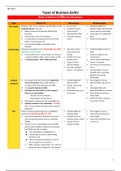
Type What is it? Advantages Disadvantages
Sole trader Someone who runs a business on his own as an → Easy to form → Unlimited liability for
employed person. They are: → Freedom to run as business debts: personal ones
✔ Right to make all the decisions affecting the owner sees fit may be used to repay debts
business; → Sole decision-maker → Lacks status of incorporated
✔ Owns all the assets of the business; → All profits belong to forms
✔ Is responsible for paying income tax on all the owner → No day-to-day support
profits of the business; and
✔ Has unlimited liability for the debts of the
business.
Partnership Governed principally by the Partnership Act 1890: → Very easy to form → Unlimited liability for firm’s
see below for more detail. (only require two debts
✔ Occurs where two or more persons run and own people) → Decision making can be
a business together with a view to make a profit. → Freedom to run as cumbersome
✔ Is unincorporated – NOT a body corporate owners see fit → Lack of written agreement
→ Support of joint lead to uncertainty
decision making → Lack status of incorporated
→ All profits belong to forms
owners – the partners → Leaving partner must be
brought out by remaining
partners (may not be
favourable)
Limited ✔ A company in the UK is formed by registering → Limited liability for → Must register to set up
company certain documents with a public official, in business debts → Extra formality and costs to
accordance with the Companies Act 2006. → Greater status than run
✔ Has separate legal personality other forms → Extra legal duties and
✔ Decisions are made either by the company’s → Potentially larger pool potential liability for directors
directors or shareholders. of investors → Information (inc finances)
o Directors run the company. made public
o Shareholders are the owners. → Profits earned by company,
✔ Not subject to income tax, but corporation tax not owners directly
✔ Liability is limited to its constitution – CA 2006,
s3(1). Can be: Limited by shares (more usual) or
guarantee
LLP A form of unincorporated business is established → Limited liability for → Must register to set up
under the Limited Partnerships Act 1907. business debts → Information (inc finances)
✔ Similar to partnership in that there must be at → Freedom to run as made public
least one general partner who has unlimited business owners see fit → Some extra formalities and
liability. → Support of joint costs to run
✔ However, an LP is permitted to have a limited decision-making
partner whose liability is limited to the amount
he initially invested, providing:
▪ Not controlling or managing the LP
▪ Not having the power to take binding
decisions; and
▪ Not removing his contribution to the LP
for as long as he is in business.
✔ Unlike ordinary partnerships, LPs must be
registered with the Registrar of Companies.
1
, BLP WS1
Partnerships
Approach to an Exam Question
1 Is there a partnership?
2 Who are the partners? Are they still partners?
3 What type of partnership is it?
→ Fixed / At will?
→ GP / LP / LLP?
4 What are the relevant terms?
→ Express by oral/written agreement – s.19 PA 1890
→ Inferred from conduct?
→ Implied by PA 1890, LPA 1907, LLPA 2000
5 Apply to facts
6 Conclude
Watch out for
✔ The time frame – is there a gap? What could have happened in between?
✔ Profit – be careful, have they been deliberately vague? Is it interest? An agreed payment?
Consultancy fee?
✔ Do you need more information? Ask questions!
✔ Restating statute terms? Clarity, contractual remedy.
✔ What will happen to the partnership on dissolution? On death of a partner? Try and
think of questions that will be asked by the partner in this scenario…
✔ A partnership – either an express agreement which a sol needs to be able to ascertain the
terms of and advise on, or an implied agreement by conduct/ PA 1890 which again need
to be able to advise on.
✔ Acting as agent? Do they have a share of the profits?
2
Types of Business Entity
Brief overview of different structures
Type What is it? Advantages Disadvantages
Sole trader Someone who runs a business on his own as an → Easy to form → Unlimited liability for
employed person. They are: → Freedom to run as business debts: personal ones
✔ Right to make all the decisions affecting the owner sees fit may be used to repay debts
business; → Sole decision-maker → Lacks status of incorporated
✔ Owns all the assets of the business; → All profits belong to forms
✔ Is responsible for paying income tax on all the owner → No day-to-day support
profits of the business; and
✔ Has unlimited liability for the debts of the
business.
Partnership Governed principally by the Partnership Act 1890: → Very easy to form → Unlimited liability for firm’s
see below for more detail. (only require two debts
✔ Occurs where two or more persons run and own people) → Decision making can be
a business together with a view to make a profit. → Freedom to run as cumbersome
✔ Is unincorporated – NOT a body corporate owners see fit → Lack of written agreement
→ Support of joint lead to uncertainty
decision making → Lack status of incorporated
→ All profits belong to forms
owners – the partners → Leaving partner must be
brought out by remaining
partners (may not be
favourable)
Limited ✔ A company in the UK is formed by registering → Limited liability for → Must register to set up
company certain documents with a public official, in business debts → Extra formality and costs to
accordance with the Companies Act 2006. → Greater status than run
✔ Has separate legal personality other forms → Extra legal duties and
✔ Decisions are made either by the company’s → Potentially larger pool potential liability for directors
directors or shareholders. of investors → Information (inc finances)
o Directors run the company. made public
o Shareholders are the owners. → Profits earned by company,
✔ Not subject to income tax, but corporation tax not owners directly
✔ Liability is limited to its constitution – CA 2006,
s3(1). Can be: Limited by shares (more usual) or
guarantee
LLP A form of unincorporated business is established → Limited liability for → Must register to set up
under the Limited Partnerships Act 1907. business debts → Information (inc finances)
✔ Similar to partnership in that there must be at → Freedom to run as made public
least one general partner who has unlimited business owners see fit → Some extra formalities and
liability. → Support of joint costs to run
✔ However, an LP is permitted to have a limited decision-making
partner whose liability is limited to the amount
he initially invested, providing:
▪ Not controlling or managing the LP
▪ Not having the power to take binding
decisions; and
▪ Not removing his contribution to the LP
for as long as he is in business.
✔ Unlike ordinary partnerships, LPs must be
registered with the Registrar of Companies.
1
, BLP WS1
Partnerships
Approach to an Exam Question
1 Is there a partnership?
2 Who are the partners? Are they still partners?
3 What type of partnership is it?
→ Fixed / At will?
→ GP / LP / LLP?
4 What are the relevant terms?
→ Express by oral/written agreement – s.19 PA 1890
→ Inferred from conduct?
→ Implied by PA 1890, LPA 1907, LLPA 2000
5 Apply to facts
6 Conclude
Watch out for
✔ The time frame – is there a gap? What could have happened in between?
✔ Profit – be careful, have they been deliberately vague? Is it interest? An agreed payment?
Consultancy fee?
✔ Do you need more information? Ask questions!
✔ Restating statute terms? Clarity, contractual remedy.
✔ What will happen to the partnership on dissolution? On death of a partner? Try and
think of questions that will be asked by the partner in this scenario…
✔ A partnership – either an express agreement which a sol needs to be able to ascertain the
terms of and advise on, or an implied agreement by conduct/ PA 1890 which again need
to be able to advise on.
✔ Acting as agent? Do they have a share of the profits?
2