CRIMINAL PROCEDURE EXAM 1 QUESTIONS AND
CORRECT DETAILED ANSWERS (VERIFIED ANSWERS)
ALREADY GRADED A+
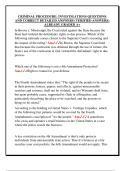
"Substantive" Criminal Law Ans✓✓✓Substantive defines the factual
elements of criminal offenses.
"Procedural" Criminal Law Ans✓✓✓Criminal procedure addresses the
procedures involved in the investigation, detection, and prosecution of
criminal offenses.
the standard by which people are convicted and the prosecutor
must prove at trial. Ans✓✓✓To convict a defendant, the prosecutor is
required to prove the required criminal intent and criminal act and
resulting harm beyond a REASONABLE DOUBT.
the objectives of the criminal justice system specifically; accuracy
and what it means. Ans✓✓✓Accuracy, Efficiency, Respect, Fairness,
Equality, Adversarial, Participation, Appeals, Justice.
Accuracy Ans✓✓✓The innocent should be protected from unjust
convictions, and the guilty should be convicted.
Efficiency Ans✓✓✓The criminal justice system should process cases in
a reasonable period of time so that individuals do not have the threat of
prosecution hanging over time.
, Respect Ans✓✓✓The dignity of defendants and victims should be
respected.
Fairness Ans✓✓✓Individuals should view the criminal justice process
as fair.
Equality Ans✓✓✓The same quality of justice should be provided to
both the rich and the poor and to various ethnic and racial groups.
Adversarial Ans✓✓✓Defendants should have the opportunity to be
represented by lawyers at crucial points in the criminal justice process.
Participation Ans✓✓✓There is a strong commitment to participation by
citizens on juries.
Appeals Ans✓✓✓An individual's freedom should not depend on the
decision of a single judge or jury. Appeals are provided to ensure that
defendants ' convictions are reached in a lawful fashion.
Justice Ans✓✓✓These goals together form a criminal justice system
whose procedures and results aim to provide justice for defendants and
victims and to help ensure a just society.
"level of proof" a police officer must have to detain a person.
Ans✓✓✓Reasonable Suspicion
CORRECT DETAILED ANSWERS (VERIFIED ANSWERS)
ALREADY GRADED A+
"Substantive" Criminal Law Ans✓✓✓Substantive defines the factual
elements of criminal offenses.
"Procedural" Criminal Law Ans✓✓✓Criminal procedure addresses the
procedures involved in the investigation, detection, and prosecution of
criminal offenses.
the standard by which people are convicted and the prosecutor
must prove at trial. Ans✓✓✓To convict a defendant, the prosecutor is
required to prove the required criminal intent and criminal act and
resulting harm beyond a REASONABLE DOUBT.
the objectives of the criminal justice system specifically; accuracy
and what it means. Ans✓✓✓Accuracy, Efficiency, Respect, Fairness,
Equality, Adversarial, Participation, Appeals, Justice.
Accuracy Ans✓✓✓The innocent should be protected from unjust
convictions, and the guilty should be convicted.
Efficiency Ans✓✓✓The criminal justice system should process cases in
a reasonable period of time so that individuals do not have the threat of
prosecution hanging over time.
, Respect Ans✓✓✓The dignity of defendants and victims should be
respected.
Fairness Ans✓✓✓Individuals should view the criminal justice process
as fair.
Equality Ans✓✓✓The same quality of justice should be provided to
both the rich and the poor and to various ethnic and racial groups.
Adversarial Ans✓✓✓Defendants should have the opportunity to be
represented by lawyers at crucial points in the criminal justice process.
Participation Ans✓✓✓There is a strong commitment to participation by
citizens on juries.
Appeals Ans✓✓✓An individual's freedom should not depend on the
decision of a single judge or jury. Appeals are provided to ensure that
defendants ' convictions are reached in a lawful fashion.
Justice Ans✓✓✓These goals together form a criminal justice system
whose procedures and results aim to provide justice for defendants and
victims and to help ensure a just society.
"level of proof" a police officer must have to detain a person.
Ans✓✓✓Reasonable Suspicion