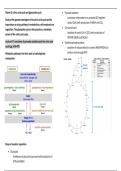
Theme D: citric acid cycle and glyoxylate cycle • Pyruvate oxidation
- conversion of pyruvate to an activated 2C-fragment
Study of the general strategies of the citric acid cycle and its
(acetyl-CoA) (with production of NADH and CO2)
importance as a key pathway in metabolism, with emphasis on
• Citric acid cycle
regulation. The glyoxylate cycle is discussed as a metabolic
- oxidation of acetyl-CoA → 2CO2 (with production of
variant of the citric acid cycle.
GTP/ATP, NADH and FADH2)
Lecture D1: reactions of pyruvate oxidation and the citric acid • Oxidative phosphorylation
cycle (pg. 455-470) - oxidation of reduced electron carriers (NADH/FADH2) to
Metabolic pathways that form part od carbohydrate produce more energy (ATP)
metabolism
Steps of aerobic reparation
• Glycolysis
- breakdown of glucose to pyruvate (with production of
ATP and NADH)
, Pyruvate oxidation Pyruvate oxidation
Pyruvate dehydrogenase complex
Pyruvate oxidation steps
1. Pyruvate Entry: Pyruvate, a three-carbon molecule,
produced in glycolysis, is transported from the cytoplasm
into the mitochondria
2. Decarboxylation: Within the mitochondria, pyruvate
undergoes decarboxylation, where it loses one carbon
atom in the form of carbon dioxide (CO2). This step results
in a two-carbon compound called acetyl-CoA
3. Dehydrogenation: During the decarboxylation step, a high-
energy electron is also transferred to an electron carrier
called NAD+, converting it into NADH
- conversion of pyruvate to an activated 2C-fragment
Study of the general strategies of the citric acid cycle and its
(acetyl-CoA) (with production of NADH and CO2)
importance as a key pathway in metabolism, with emphasis on
• Citric acid cycle
regulation. The glyoxylate cycle is discussed as a metabolic
- oxidation of acetyl-CoA → 2CO2 (with production of
variant of the citric acid cycle.
GTP/ATP, NADH and FADH2)
Lecture D1: reactions of pyruvate oxidation and the citric acid • Oxidative phosphorylation
cycle (pg. 455-470) - oxidation of reduced electron carriers (NADH/FADH2) to
Metabolic pathways that form part od carbohydrate produce more energy (ATP)
metabolism
Steps of aerobic reparation
• Glycolysis
- breakdown of glucose to pyruvate (with production of
ATP and NADH)
, Pyruvate oxidation Pyruvate oxidation
Pyruvate dehydrogenase complex
Pyruvate oxidation steps
1. Pyruvate Entry: Pyruvate, a three-carbon molecule,
produced in glycolysis, is transported from the cytoplasm
into the mitochondria
2. Decarboxylation: Within the mitochondria, pyruvate
undergoes decarboxylation, where it loses one carbon
atom in the form of carbon dioxide (CO2). This step results
in a two-carbon compound called acetyl-CoA
3. Dehydrogenation: During the decarboxylation step, a high-
energy electron is also transferred to an electron carrier
called NAD+, converting it into NADH