BPP GDL – Contract Law Exam Notes
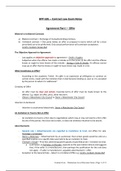
Agreement Part I – Offer
Bilateral vs Unilateral Contracts
a) Bilateral contract = Exchange of mutually binding promises.
b) Unilateral contract = One party makes an offer or proposal in terms which call for a clear
prescribed act to be performed. Only actual performance will constitute acceptance.
Carlill v Carbolic Smoke Ball
The Objective Approach to Agreement:
- Law applies an objective approach to agreement – Smith v Hughes.
- Subjective when the offeror has made a mistake as to the terms of the offer and the offeree
knows or ought to have known of the mistake - Hartog v Colin & Shields. An offeree cannot
snap up an offer that he knows or ought to have known was made in error.
What Constitutes an Offer?
- According to the academic Treitel, ‘An offer is an expression of willingness to contract on
certain terms, made with the intention that it shall become binding as soon as it is accepted
by the person to whom it is addressed.’
Certainty of Offer
- An offer must be clear and certain. Essential terms of offer must be made known to the
offeree. E.g. object on offer, price, other key term.
- Gibson v Manchester City Council vs Storer v Manchester City Council.
Intention to be Bound
- Intention is ascertained objectively. Storer v Manchester City Council.
An Invitation to Treat is Not an Offer
- An invitation to treat is a first step to negotiations which may or may not lead to a firm offer
by one of the parties. Not clear and certain, or does not evidence intention to be bound.
Advertisements
- General rule = Advertisements are regarded as invitations to treat, not offers for sale.
Partridge v Crittenden.
- Harris v Nickerson – Advertisement by an auctioneer that certain goods would be sold at a
specified location on a specific date was held to be an invitation to treat.
- Grainger v Gough – Price lists advertising specific goods at specified prices = Invitation to treat.
• Lord Parker, in Partidge v Crittenden, expands on this point obiter dictum and suggests
that, if the seller is a manufacturer, then perhaps the justification for the rule does
not apply ∴ if seller is manufacturer, arguable advertisement = offer.
- Exception to the General Rule – Advert is a Unilateral Offer e.g. Carlill v Carbolic Smoke Ball
Contract Law – Distinction Level Revision Notes | Page 1 of 21
,Display of Goods for Sale
- General rule = Price-marked goods displayed in a shop window are not an offer for sale but
an invitation to treat. Regardless of whether the shop actually expressly designates that the
goods are on offer. Fisher v Bell.
- Pharmaceutical Society of GB v Boots– Same general principle applies to goods displayed on
the shelves of a self-service store.
• Offer made by customer when he presented the goods at the cash desk. Offer could
be accepted or rejected.
Invitations to Tender
- General rule = Invitation to treat. Requestor is free to accept or reject any tender, even if it
is the most competitive. Submission of tender = offer.
• Spencer v Harding.
Exception to the General Rule
- Where invitation to tender expressly contains an undertaking to accept the highest or lowest
bid. à Unilateral offer, accepted by making the highest bid. Harvela Investments v Canada.
- Offer to consider bids properly submitted, not an offer to accept a bid fulfilling particular
conditions – Blackpool & Fylde Aero Club v Blackpool Borough Council. An invitation to tender
could give rise to a binding contractual obligation to consider tenders conforming to the
conditions of tender.
Auction Sales
- Payne v Cave. General rule = Auctioneer’s request for bids is an invitation to treat. Bidder
makes an offer which the auctioneer is then free to accept or reject. Acceptance of the
bidder’s offer will be indicated by the fall of the auctioneer’s hammer.
- ‘Without reserve’ = Promise to sell to highest bidder and not to apply any reserve price. If the
sale of the item in question is expressed to be ‘without reserve’ the auctioneer may be sued
for breach of contract if he refuses to sell to the highest bona fide bidder.
- This view was expressed in Barry v Davies. 2 potential contracts – bilateral contract formed in
usual way decides who gets the goods, unilateral contract based on promise auction will be
without reserve and will sell to person who makes highest bid. If a reserve is not applied and
the goods are withdrawn from sale, there is a breach of unilateral contract and the highest
bona fide bidder is entitled to be compensated by the payment of damages. Not entitled to
the goods. Auctioneer in breach of collateral unilateral contract – claimant entitled to
damages amounting to difference between bid price and actual value of goods.
Termination of an Offer
a) Rejection
b) Lapse
c) Revocation
In each case the offer loses its legal effect and becomes incapable of acceptance. Offer can be
accepted any time before termination.
Contract Law – Distinction Level Revision Notes | Page 2 of 21
, Rejection
- An offeree is free to reject. Kills off original offer, can no longer be accepted.
- A rejection does not take effect until it is actually communicated to the offeror. NB The postal
rule does not apply to the rejection of offers.
- Where an offeree makes a counter-offer, the original offer is deemed to have been rejected
and cannot be subsequently accepted. Hyde v Wrench.
Distinguishing a Counter-Offer from a Request for Information
- If, on receipt of an offer, the offeree attempts to clarify the extent and terms of the offer, or
to ascertain if the offeror would consent to changing certain aspects of the offer, the offeree’s
request may be construed as a request for information. In this event, since there has been no
counter-offer, the original offer remains valid and capable of acceptance.
- Stevenson, Jacques v McLean. Clarifying delivery or payment timings and mode. Language of
an inquiry.
Lapse of an Offer
- An offer may lapse and thus become incapable of acceptance
a. By passage of time – where acceptance is not made within prescribed period or
reasonable time – Ramsgate v Montefiore.
b. By death of one of the parties – Duff’s Executors
c. By non-fulfilment of conditions precedent – Financings Ltd v Stimpson
Revocation
- The offeror may withdraw his offer at any time before acceptance. However, once a valid
acceptance has been made, the offeror is bound by the terms of his offer.
- Payne v Cave – In an auction bidder may withdraw bid at any time before fall of the hammer.
- Routledge v Grant – Free to revoke offer even where said will be open for acceptance for a
certain time.
Options
- Where the offeror gives an undertaking to keep the offer open for a stipulated period, he is
not bound by his undertaking unless the offeree has given consideration in return for it.
- Where the offeree gives consideration to keep the offer open for a period, there is a separate
binding contract known as an option and revocation within the period will be in breach of that
contract – Dickinson v Dodds, no consideration given.
- Consideration need not be adequate – Chappell v Nestle
- Consideration must be sufficient – White v Bluett.
Communication is essential
- Revocation of an offer is effective only upon actual notice of it reaching the offeree.
- Where revocation is communicated by post it takes effect from the moment it is received by
the offeree and not from the time of posting. Byrne v Van Tienhoven.
Contract Law – Distinction Level Revision Notes | Page 3 of 21
Agreement Part I – Offer
Bilateral vs Unilateral Contracts
a) Bilateral contract = Exchange of mutually binding promises.
b) Unilateral contract = One party makes an offer or proposal in terms which call for a clear
prescribed act to be performed. Only actual performance will constitute acceptance.
Carlill v Carbolic Smoke Ball
The Objective Approach to Agreement:
- Law applies an objective approach to agreement – Smith v Hughes.
- Subjective when the offeror has made a mistake as to the terms of the offer and the offeree
knows or ought to have known of the mistake - Hartog v Colin & Shields. An offeree cannot
snap up an offer that he knows or ought to have known was made in error.
What Constitutes an Offer?
- According to the academic Treitel, ‘An offer is an expression of willingness to contract on
certain terms, made with the intention that it shall become binding as soon as it is accepted
by the person to whom it is addressed.’
Certainty of Offer
- An offer must be clear and certain. Essential terms of offer must be made known to the
offeree. E.g. object on offer, price, other key term.
- Gibson v Manchester City Council vs Storer v Manchester City Council.
Intention to be Bound
- Intention is ascertained objectively. Storer v Manchester City Council.
An Invitation to Treat is Not an Offer
- An invitation to treat is a first step to negotiations which may or may not lead to a firm offer
by one of the parties. Not clear and certain, or does not evidence intention to be bound.
Advertisements
- General rule = Advertisements are regarded as invitations to treat, not offers for sale.
Partridge v Crittenden.
- Harris v Nickerson – Advertisement by an auctioneer that certain goods would be sold at a
specified location on a specific date was held to be an invitation to treat.
- Grainger v Gough – Price lists advertising specific goods at specified prices = Invitation to treat.
• Lord Parker, in Partidge v Crittenden, expands on this point obiter dictum and suggests
that, if the seller is a manufacturer, then perhaps the justification for the rule does
not apply ∴ if seller is manufacturer, arguable advertisement = offer.
- Exception to the General Rule – Advert is a Unilateral Offer e.g. Carlill v Carbolic Smoke Ball
Contract Law – Distinction Level Revision Notes | Page 1 of 21
,Display of Goods for Sale
- General rule = Price-marked goods displayed in a shop window are not an offer for sale but
an invitation to treat. Regardless of whether the shop actually expressly designates that the
goods are on offer. Fisher v Bell.
- Pharmaceutical Society of GB v Boots– Same general principle applies to goods displayed on
the shelves of a self-service store.
• Offer made by customer when he presented the goods at the cash desk. Offer could
be accepted or rejected.
Invitations to Tender
- General rule = Invitation to treat. Requestor is free to accept or reject any tender, even if it
is the most competitive. Submission of tender = offer.
• Spencer v Harding.
Exception to the General Rule
- Where invitation to tender expressly contains an undertaking to accept the highest or lowest
bid. à Unilateral offer, accepted by making the highest bid. Harvela Investments v Canada.
- Offer to consider bids properly submitted, not an offer to accept a bid fulfilling particular
conditions – Blackpool & Fylde Aero Club v Blackpool Borough Council. An invitation to tender
could give rise to a binding contractual obligation to consider tenders conforming to the
conditions of tender.
Auction Sales
- Payne v Cave. General rule = Auctioneer’s request for bids is an invitation to treat. Bidder
makes an offer which the auctioneer is then free to accept or reject. Acceptance of the
bidder’s offer will be indicated by the fall of the auctioneer’s hammer.
- ‘Without reserve’ = Promise to sell to highest bidder and not to apply any reserve price. If the
sale of the item in question is expressed to be ‘without reserve’ the auctioneer may be sued
for breach of contract if he refuses to sell to the highest bona fide bidder.
- This view was expressed in Barry v Davies. 2 potential contracts – bilateral contract formed in
usual way decides who gets the goods, unilateral contract based on promise auction will be
without reserve and will sell to person who makes highest bid. If a reserve is not applied and
the goods are withdrawn from sale, there is a breach of unilateral contract and the highest
bona fide bidder is entitled to be compensated by the payment of damages. Not entitled to
the goods. Auctioneer in breach of collateral unilateral contract – claimant entitled to
damages amounting to difference between bid price and actual value of goods.
Termination of an Offer
a) Rejection
b) Lapse
c) Revocation
In each case the offer loses its legal effect and becomes incapable of acceptance. Offer can be
accepted any time before termination.
Contract Law – Distinction Level Revision Notes | Page 2 of 21
, Rejection
- An offeree is free to reject. Kills off original offer, can no longer be accepted.
- A rejection does not take effect until it is actually communicated to the offeror. NB The postal
rule does not apply to the rejection of offers.
- Where an offeree makes a counter-offer, the original offer is deemed to have been rejected
and cannot be subsequently accepted. Hyde v Wrench.
Distinguishing a Counter-Offer from a Request for Information
- If, on receipt of an offer, the offeree attempts to clarify the extent and terms of the offer, or
to ascertain if the offeror would consent to changing certain aspects of the offer, the offeree’s
request may be construed as a request for information. In this event, since there has been no
counter-offer, the original offer remains valid and capable of acceptance.
- Stevenson, Jacques v McLean. Clarifying delivery or payment timings and mode. Language of
an inquiry.
Lapse of an Offer
- An offer may lapse and thus become incapable of acceptance
a. By passage of time – where acceptance is not made within prescribed period or
reasonable time – Ramsgate v Montefiore.
b. By death of one of the parties – Duff’s Executors
c. By non-fulfilment of conditions precedent – Financings Ltd v Stimpson
Revocation
- The offeror may withdraw his offer at any time before acceptance. However, once a valid
acceptance has been made, the offeror is bound by the terms of his offer.
- Payne v Cave – In an auction bidder may withdraw bid at any time before fall of the hammer.
- Routledge v Grant – Free to revoke offer even where said will be open for acceptance for a
certain time.
Options
- Where the offeror gives an undertaking to keep the offer open for a stipulated period, he is
not bound by his undertaking unless the offeree has given consideration in return for it.
- Where the offeree gives consideration to keep the offer open for a period, there is a separate
binding contract known as an option and revocation within the period will be in breach of that
contract – Dickinson v Dodds, no consideration given.
- Consideration need not be adequate – Chappell v Nestle
- Consideration must be sufficient – White v Bluett.
Communication is essential
- Revocation of an offer is effective only upon actual notice of it reaching the offeree.
- Where revocation is communicated by post it takes effect from the moment it is received by
the offeree and not from the time of posting. Byrne v Van Tienhoven.
Contract Law – Distinction Level Revision Notes | Page 3 of 21